
Join Our JEE Preparation Group
Prep with like-minded aspirants; Get access to free daily tests and study material.
Sign in
Please select an account to continue using cracku.in
↓ →
Join Our JEE Preparation Group
Prep with like-minded aspirants; Get access to free daily tests and study material.
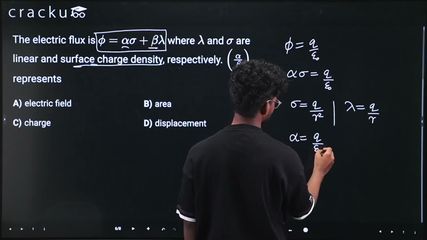
The electric flux is $$\phi=\alpha \sigma+\beta\lambda$$ where $$\lambda$$ and $$\sigma$$ are linear and surface charge density, respectively. $$\left(\frac{\alpha}{\beta}\right)$$ represents
The electric flux is given as $$\phi = \alpha \sigma + \beta \lambda$$, where $$\sigma$$ is the surface charge density and $$\lambda$$ is the linear charge density. We need to find what $$\frac{\alpha}{\beta}$$ represents.
Electric flux has dimensions derived from Gauss's law. The dimensional formula for electric flux is $$[\phi] = [\text{kg} \cdot \text{m}^3 \cdot \text{s}^{-2} \cdot \text{C}^{-1}]$$.
The surface charge density $$\sigma = \frac{\text{charge}}{\text{area}}$$, so its dimensional formula is $$[\sigma] = [\text{C} \cdot \text{m}^{-2}]$$.
The linear charge density $$\lambda = \frac{\text{charge}}{\text{length}}$$, so its dimensional formula is $$[\lambda] = [\text{C} \cdot \text{m}^{-1}]$$.
In the expression $$\phi = \alpha \sigma + \beta \lambda$$, both terms must have the same dimensions as flux.
For the term $$\alpha \sigma$$:
$$[\alpha \sigma] = [\alpha] \cdot [\sigma] = [\alpha] \cdot [\text{C} \cdot \text{m}^{-2}] = [\text{kg} \cdot \text{m}^3 \cdot \text{s}^{-2} \cdot \text{C}^{-1}]$$
Solving for $$[\alpha]$$:
$$[\alpha] = \frac{[\text{kg} \cdot \text{m}^3 \cdot \text{s}^{-2} \cdot \text{C}^{-1}]}{[\text{C} \cdot \text{m}^{-2}]} = [\text{kg} \cdot \text{m}^5 \cdot \text{s}^{-2} \cdot \text{C}^{-2}]$$
For the term $$\beta \lambda$$:
$$[\beta \lambda] = [\beta] \cdot [\lambda] = [\beta] \cdot [\text{C} \cdot \text{m}^{-1}] = [\text{kg} \cdot \text{m}^3 \cdot \text{s}^{-2} \cdot \text{C}^{-1}]$$
Solving for $$[\beta]$$:
$$[\beta] = \frac{[\text{kg} \cdot \text{m}^3 \cdot \text{s}^{-2} \cdot \text{C}^{-1}]}{[\text{C} \cdot \text{m}^{-1}]} = [\text{kg} \cdot \text{m}^4 \cdot \text{s}^{-2} \cdot \text{C}^{-2}]$$
Now, the ratio $$\frac{\alpha}{\beta}$$ has dimensions:
$$\left[\frac{\alpha}{\beta}\right] = \frac{[\alpha]}{[\beta]} = \frac{[\text{kg} \cdot \text{m}^5 \cdot \text{s}^{-2} \cdot \text{C}^{-2}]}{[\text{kg} \cdot \text{m}^4 \cdot \text{s}^{-2} \cdot \text{C}^{-2}]} = [\text{m}]$$
The dimension $$[\text{m}]$$ corresponds to length. Comparing with the options:
Displacement has the same dimension as length, so $$\frac{\alpha}{\beta}$$ represents displacement.
Therefore, the correct answer is displacement (option D).
Was this solution helpful?
Click on the Email ☝️ to Watch the Video Solution
Create a FREE account and get:
_1.webp)

Educational materials for JEE preparation

Ask our AI anything

AI can make mistakes. Please verify important information.
AI can make mistakes. Please verify important information.
