
Join Our JEE Preparation Group
Prep with like-minded aspirants; Get access to free daily tests and study material.
Sign in
Please select an account to continue using cracku.in
↓ →
Join Our JEE Preparation Group
Prep with like-minded aspirants; Get access to free daily tests and study material.
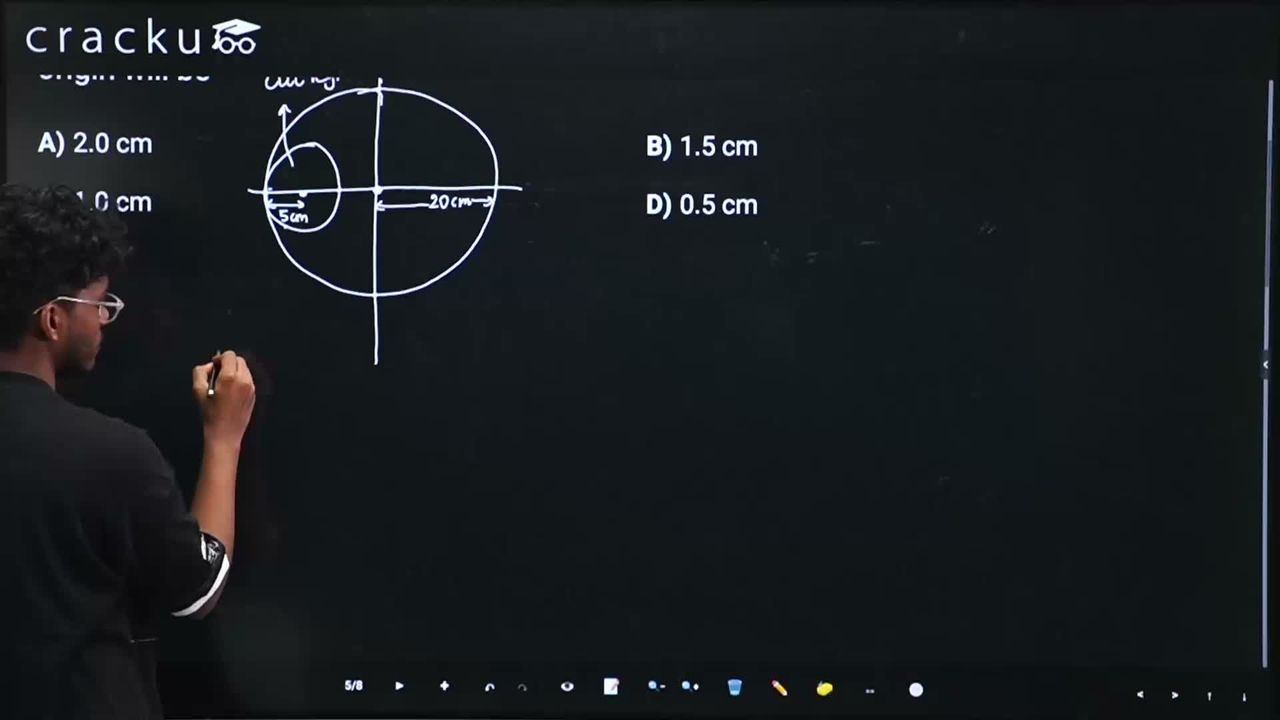
Consider a circular disc of radius 20 cm with centre located at the origin. A circular hole of radius 5 cm is cut from this disc in such a way that the edge of the hole touches the edge of the disc. The distance of centre of mass of residual or remaining disc from the origin will be
A circular disc of radius 20 cm has a circular hole of radius 5 cm cut such that the edge of the hole touches the edge of the disc. We need the distance of the center of mass of the remaining disc from the origin.
Place the center of the original disc at the origin. Since the edge of the hole touches the edge of the disc, the center of the hole is at distance $$20 - 5 = 15$$ cm from the origin along the x-axis, so the hole center is at $$(15, 0)$$.
Let $$\sigma$$ be the surface mass density. For a uniform disc, the mass of the original disc is $$M = \sigma \pi (20)^2 = 400\pi\sigma$$, the mass of the removed portion is $$m = \sigma \pi (5)^2 = 25\pi\sigma$$, and the mass of the remaining disc is $$M - m = 375\pi\sigma$$.
Using the principle of superposition, we write $$M \cdot 0 = (M-m) \cdot x_{cm} + m \cdot 15$$, which gives $$0 = 375\pi\sigma \cdot x_{cm} + 25\pi\sigma \cdot 15$$ and hence $$x_{cm} = -\frac{25 \times 15}{375} = -\frac{375}{375} = -1$$ cm.
The distance from the origin is $$|x_{cm}| = 1$$ cm, so the correct answer is Option 3: 1.0 cm.
Was this solution helpful?
Click on the Email ☝️ to Watch the Video Solution
Create a FREE account and get:
_1.webp)

Educational materials for JEE preparation

Ask our AI anything

AI can make mistakes. Please verify important information.
AI can make mistakes. Please verify important information.
