
Join Our JEE Preparation Group
Prep with like-minded aspirants; Get access to free daily tests and study material.
Sign in
Please select an account to continue using cracku.in
↓ →
Join Our JEE Preparation Group
Prep with like-minded aspirants; Get access to free daily tests and study material.
Given below are two statements: one is labelled as Assertion A and the other is labelled as Reason R Assertion A: In a central force field, the work done is independent of the path chosen. Reason R: Every force encountered in mechanics does not have an associated potential energy. In the light of the above statements, choose the most appropriate answer from the options given below
We need to evaluate the Assertion and Reason about central forces and potential energy.
Assertion (A): "In a central force field, the work done is independent of the path chosen."
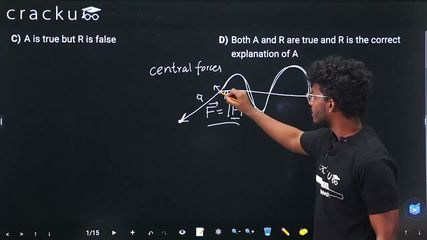
Analysis: A central force is always directed along the line joining the particle to a fixed center, with magnitude depending only on the distance: $$\vec{F} = f(r)\hat{r}$$. Central forces are conservative forces -- the work done depends only on the initial and final positions, not on the path. This is because the curl of a central force is zero. Assertion (A) is TRUE.
Reason (R): "Every force encountered in mechanics does not have an associated potential energy."
Analysis: This statement says that not every mechanical force has an associated potential energy. This is TRUE -- non-conservative forces like friction and viscous drag do not have an associated potential energy function. Only conservative forces (like gravity, spring force, and central forces) have well-defined potential energy functions.
Relationship between A and R: While both statements are true, R does not explain A. The fact that "some forces don't have potential energy" does not explain why "central forces are path-independent." The reason A is true is that central forces are conservative (they have a potential energy function), which is essentially the opposite situation from what R describes.
The correct answer is Option 2: Both A and R are true but R is NOT the correct explanation of A.
Was this solution helpful?
Click on the Email ☝️ to Watch the Video Solution
Create a FREE account and get:
_1.webp)

Educational materials for JEE preparation

Ask our AI anything

AI can make mistakes. Please verify important information.
AI can make mistakes. Please verify important information.
