
Join Our JEE Preparation Group
Prep with like-minded aspirants; Get access to free daily tests and study material.
Sign in
Please select an account to continue using cracku.in
↓ →
Join Our JEE Preparation Group
Prep with like-minded aspirants; Get access to free daily tests and study material.
A bead $$P$$ sliding on a frictionless semi-circular string ($$ACB$$) and it is at point $$S$$ at $$t = 0$$ and at this instant the horizontal component of its velocity is $$v$$. Another bead $$Q$$ of the same mass as $$P$$ is ejected from point $$A$$ at $$t = 0$$ along the horizontal string $$AB$$, with the speed $$v$$, friction between the beads and the respective strings may be neglected in both cases. Let $$t_{P}$$ and $$t_{Q}$$ be the respective times taken by beads P and Q to reach the point B, then the relation between $$t_{P}$$ and $$t_{Q}$$ is
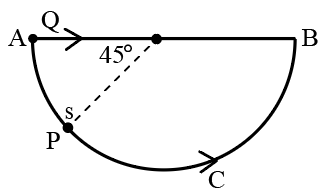
For bead Q: $$v_Q = v$$
$$t_Q = \frac{AB}{v} = \frac{2R}{v}$$
For bead P: $$v_{x} = v \text{ at point } S$$
Since string is frictionless, taking lowest point C as reference: $$E = K + U$$
As bead P moves below level AB, gravity performs positive work.
$$v_P > v_x \text{ throughout the motion below level AB}$$
$$v_{Px} > v \text{ for the major part of motion}$$
Comparing average horizontal velocities: $$v_{Px,\text{avg}} > v_Q$$
$$t_P = \frac{\text{Horizontal displacement}}{v_{Px,\text{avg}}} = \frac{AB}{v_{Px,\text{avg}}}$$
$$t_P < t_Q$$
Was this solution helpful?
Create a FREE account and get:
_1.webp)

Educational materials for JEE preparation

Ask our AI anything

AI can make mistakes. Please verify important information.
AI can make mistakes. Please verify important information.
