
Join Our JEE Preparation Group
Prep with like-minded aspirants; Get access to free daily tests and study material.
Sign in
Please select an account to continue using cracku.in
↓ →
Join Our JEE Preparation Group
Prep with like-minded aspirants; Get access to free daily tests and study material.
There are two infinitely long straight current-carrying conductors and they are held at right angles to each other so that their common ends meet at the origin as shown in the figure given below. The ratio of current in both conductors is 1:1. The magnetic field at point P is:
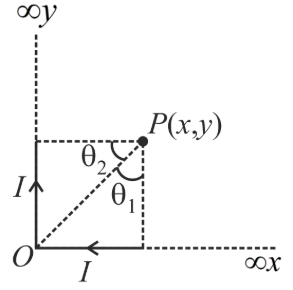
We need to determine the correct expression for the total magnetic field at point $$P(x, y)$$ due to two semi-infinite straight conductors meeting at the origin $$O(0,0)$$ at right angles.
From the layout shown , both wires carry an identical current $$I$$ and start from the origin, extending along the positive axes:
$$B_y = \frac{\mu_0 I}{4\pi x} \left(1 - \frac{y}{\sqrt{x^2 + y^2}}\right)$$
$$B_x = \frac{\mu_0 I}{4\pi y} \left(1 - \frac{x}{\sqrt{x^2 + y^2}}\right)$$
$$B_{\text{net}} = B_y + B_x = \frac{\mu_0 I}{4\pi x}\left(1 - \frac{y}{\sqrt{x^2 + y^2}}\right) + \frac{\mu_0 I}{4\pi y}\left(1 - \frac{x}{\sqrt{x^2 + y^2}}\right)$$
Factoring out the common constant $$\frac{\mu_0 I}{4\pi}$$ and combining the fractions over a common denominator ($$xy\sqrt{x^2 + y^2}$$) yields:
$$B_{\text{net}} = \frac{\mu_0 I}{4\pi xy\sqrt{x^2 + y^2}} \left[ y\sqrt{x^2 + y^2} - y^2 - x\sqrt{x^2 + y^2} + x^2 \right]$$
$$B_{\text{net}} = \frac{\mu_0 I}{4\pi xy\sqrt{x^2 + y^2}} \left[ (x^2 - y^2) + (x - y)\sqrt{x^2 + y^2} \right]$$
Was this solution helpful?
_1.webp)

Educational materials for JEE preparation

Ask our AI anything

AI can make mistakes. Please verify important information.
AI can make mistakes. Please verify important information.