For the following questions answer them individually
A student determined Young's Modulus of elasticity using the formula $$Y = \frac{Mgl^3}{4bd^3\delta}$$. The value of $$g$$ is taken to be 9.8 m s$$^{-2}$$ without any significant error, his observations are as following.
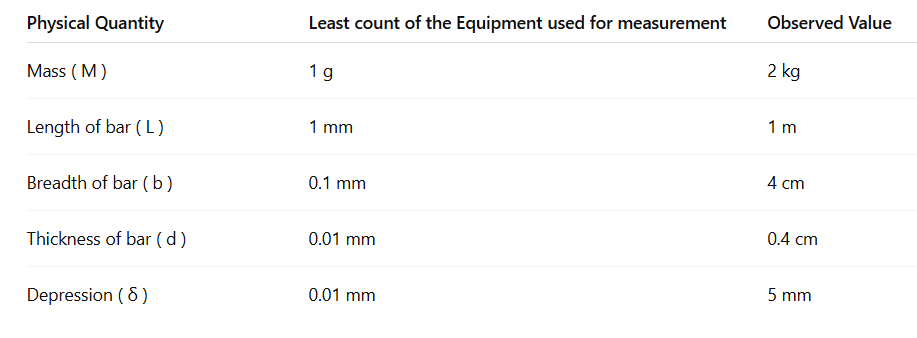
Then the fractional error in the measurement of $$Y$$ is:
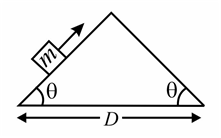
An object of mass $$m$$ is being moved with a constant velocity under the action of an applied force of 2 N along a frictionless surface with following surface profile.
The correct applied force vs distance graph will be:
The ranges and heights for two projectiles projected with the same initial velocity at angles 42° and 48° with the horizontal are $$R_1$$, $$R_2$$ and $$H_1$$, $$H_2$$ respectively. Choose the correct option:
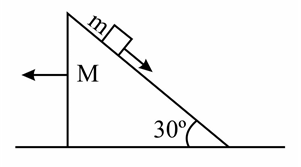
A block of mass $$m$$ slides on the wooden wedge, which in turn slides backward on the horizontal surface. The acceleration of the block with respect to the wedge is:
Given $$m = 8$$ kg, $$M = 16$$ kg
Assume all the surfaces shown in the figure to be frictionless.
A body of mass $$m$$ dropped from a height $$h$$ reaches the ground with a speed of $$0.8\sqrt{gh}$$. The value of work done by the air-friction is:
Electric field of a plane electromagnetic wave propagating through a non-magnetic medium is given by $$E = 20\cos(2 \times 10^{10}t - 200x)$$ V m$$^{-1}$$. The dielectric constant of the medium is equal to: (Take $$\mu_r = 1$$)
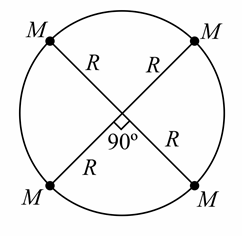
Four particles each of mass $$M$$, move along a circle of radius $$R$$ under the action of their mutual gravitational attraction as shown in figure. The speed of each particle is:
A glass tumbler having inner depth of 17.5 cm is kept on a table. A student starts pouring water ($$\mu = \frac{4}{3}$$) into it while looking at the surface of water from the above. When he feels that the tumbler is half filled, he stops pouring water. Up to what height, the tumbler is actually filled?
Due to cold weather, a 1 m water pipe of cross-sectional area 1 cm$$^2$$ is filled with ice at -10°C. Resistive heating is used to melt the ice. Current of 0.5 A is passed through 4 k$$\Omega$$ resistance. Assuming that all the heat produced is used for melting, what is the minimum time required?
(Given latent heat of fusion for water/ice = $$3.33 \times 10^5$$ J kg$$^{-1}$$, specific heat of ice = $$2 \times 10^3$$ J kg$$^{-1}$$ °C$$^{-1}$$ and density of ice = $$10^3$$ kg m$$^{-3}$$)
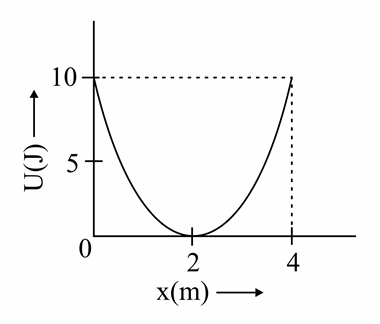
A mass of 5 kg is connected to a spring. The potential energy curve of the simple harmonic motion executed by the system is shown in the figure. A simple pendulum of length 4 m has the same period of oscillation as the spring system. What is the value of acceleration due to gravity on the planet where these experiments are performed?
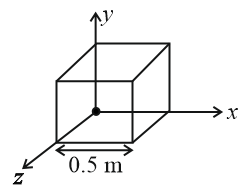
A cube is placed inside an electric field, $$\vec{E} = 150y^2\hat{j}$$. The side of the cube is 0.5 m and is placed in the field as shown in the given figure. The charge inside the cube is:
A capacitor is connected to a 20 V battery through a resistance of 10$$\Omega$$. It is found that the potential difference across the capacitor rises to 2 V in 1 $$\mu$$s. The capacitance of the capacitor is _________ $$\mu$$F.
Given $$\ln\frac{10}{9} = 0.105$$
Two resistors $$R_1 = (4 \pm 0.8)$$ $$\Omega$$ and $$R_2 = (4 \pm 0.4)$$ $$\Omega$$ are connected in parallel. The equivalent resistance of their parallel combination will be:
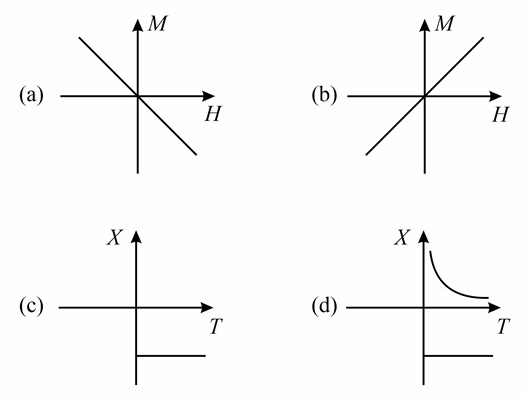
Following plots show Magnetization (M) vs Magnetising field (H) and Magnetic susceptibility ($$\chi$$) vs Temperature (T) graph:
Which of the following combination will be represented by a diamagnetic material?
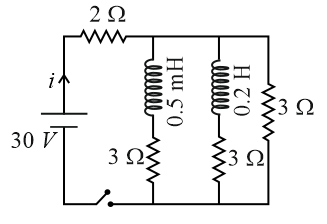
For the given circuit the current $$i$$ through the battery when the key is closed and the steady state has been reached is:
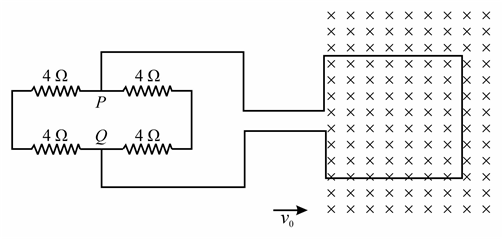
A square loop of side 20 cm and resistance 1 $$\Omega$$ is moved towards right with a constant speed $$v_0$$. The right arm of the loop is in a uniform magnetic field of 5 T. The field is perpendicular to the plane of the loop and is going into it. The loop is connected to a network of resistors each of value 4$$\Omega$$. What should be the value of $$v_0$$ so that a steady current of 2 mA flows in the loop?
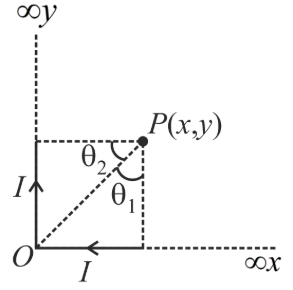
There are two infinitely long straight current-carrying conductors and they are held at right angles to each other so that their common ends meet at the origin as shown in the figure given below. The ratio of current in both conductors is 1:1. The magnetic field at point P is:
The temperature of an ideal gas in three dimensions is 300 K. The corresponding de-Broglie wavelength of the electron approximately at 300 K is:
$$m_e$$ = mass of electron = $$9 \times 10^{-31}$$ kg, $$h$$ = Planck constant = $$6.6 \times 10^{-34}$$ J s, $$k_B$$ = Boltzmann constant = $$1.38 \times 10^{-23}$$ J K$$^{-1}$$
The half life period of a radioactive element $$x$$ is same as the mean life time of another radioactive element $$y$$. Initially they have the same number of atoms. Then:
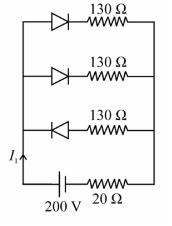
In the given figure, each diode has a forward bias resistance of 30 $$\Omega$$ and infinite resistance in reverse bias. The current $$I_1$$ will be:
The average translational kinetic energy of $$N_2$$ gas molecules at _________ °C becomes equal to the K.E. of an electron accelerated from rest through a potential difference of 0.1 volt.
(Given $$k_B = 1.38 \times 10^{-23}$$ J K$$^{-1}$$) (Fill the nearest integer).
An engine is attached to a wagon through a shock absorber of length 1.5 m. The system with a total mass of 40,000 kg is moving with a speed of 72 km h$$^{-1}$$ when the brakes are applied to bring it to rest. In the process of the system being brought to rest, the spring of the shock absorber gets compressed by 1.0 m. If 90% of energy of the wagon is lost due to friction, the spring constant is _________ $$\times 10^5$$ N m$$^{-1}$$.
When a body slides down from rest along a smooth inclined plane making an angle of 30° with the horizontal, it takes time $$T$$. When the same body slides down from rest along a rough inclined plane making the same angle and through the same distance, it takes time $$\alpha T$$, where $$\alpha$$ is a constant greater than 1. The co-efficient of friction between the body and the rough plane is $$\frac{1}{\sqrt{x}} \cdot \frac{\alpha^2-1}{\alpha^2}$$ where $$x$$ = _________.
A 2 kg steel rod of length 0.6 m is clamped on a table vertically at its lower end and is free to rotate in the vertical plane. The upper end is pushed so that the rod falls under gravity. Ignoring the friction due to clamping at its lower end, the speed of the free end of the rod when it passes through its lowest position is _________ m s$$^{-1}$$.
(Take $$g = 10$$ m s$$^{-2}$$)
The width of one of the two slits in a Young's double slit experiment is three times the other slit. If the amplitude of the light coming from a slit is proportional to the slit-width, the ratio of minimum to maximum intensity in the interference pattern is $$x : 4$$ where $$x$$ is _________.
A uniform heating wire of resistance 36 $$\Omega$$ is connected across a potential difference of 240 V. The wire is then cut into half and a potential difference of 240 V is applied across each half separately. The ratio of power dissipation in first case to the total power dissipation in the second case would be 1 : $$x$$, where $$x$$ is _________.
A steel rod with $$y = 2.0 \times 10^{11}$$ N m$$^{-2}$$ and $$\alpha = 10^{-5}$$ °C$$^{-1}$$ of length 4 m and area of cross-section 10 cm$$^2$$ is heated from 0°C to 400°C without being allowed to extend. The tension produced in the rod is $$x \times 10^5$$ N where the value of $$x$$ is _________.
The temperature of 3.00 mol of an ideal diatomic gas is increased by 40.0°C without changing the pressure of the gas. The molecules in the gas rotate but do not oscillate. If the ratio of change in internal energy of the gas to the amount of workdone by the gas is $$\frac{x}{10}$$. Then the value of $$x$$ (round off to the nearest integer) is _________.
(Given R = 8.31 J $$mol^{-1}$$ $$K^{-1}$$)
Two satellites revolve around a planet in coplanar circular orbits in anticlockwise direction. Their period of revolutions are 1 hour and 8 hours respectively. The radius of the orbit of nearer satellite is $$2 \times 10^3$$ km. The angular speed of the farther satellite as observed from the nearer satellite at the instant when both the satellites are closest is $$\frac{\pi}{x}$$ rad h$$^{-1}$$, where $$x$$ is _________.
A carrier wave with amplitude of 250 V is amplitude modulated by a sinusoidal base band signal of amplitude 150 V. The ratio of minimum amplitude to maximum amplitude for the amplitude modulated wave is 50 : $$x$$, then value of $$x$$, is _________.