
Join Our JEE Preparation Group
Prep with like-minded aspirants; Get access to free daily tests and study material.
Sign in
Please select an account to continue using cracku.in
↓ →
Join Our JEE Preparation Group
Prep with like-minded aspirants; Get access to free daily tests and study material.
An object of mass $$m$$ is being moved with a constant velocity under the action of an applied force of 2 N along a frictionless surface with following surface profile.
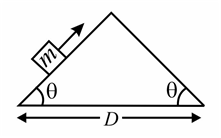
The correct applied force vs distance graph will be:
We need to determine the correct graph showing the applied force ($$F$$) vs. distance ($$x$$) required to move an object at a constant velocity along a frictionless surface profile.
When an object moves with a constant velocity, its acceleration is zero ($$a = 0$$). According to Newton's second law, the net force acting on the object along the direction of motion must be zero:
$$\Sigma F = 0 \implies F_{\text{applied}} + F_{\text{gravity, parallel}} = 0$$
$$F_{\text{applied}} = -F_{\text{gravity, parallel}}$$
This means the applied force must exactly balance the component of the gravitational force acting along the slope at every point on the surface profile.
Though the exact slope values depend on the specific geometry , let's look at the standard behavior for a symmetric dip or hill of length $$D$$:
The correct representation of the step-like force variation for flat-facetted inclines is shown in Graph A (Option A).
Was this solution helpful?
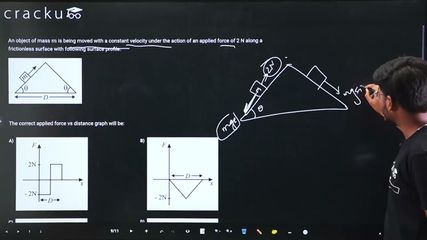
Click on the Email ☝️ to Watch the Video Solution
Create a FREE account and get:
_1.webp)

Educational materials for JEE preparation

Ask our AI anything

AI can make mistakes. Please verify important information.
AI can make mistakes. Please verify important information.
