
Join Our JEE Preparation Group
Prep with like-minded aspirants; Get access to free daily tests and study material.
Sign in
Please select an account to continue using cracku.in
↓ →
Join Our JEE Preparation Group
Prep with like-minded aspirants; Get access to free daily tests and study material.
A student determined Young's Modulus of elasticity using the formula $$Y = \frac{Mgl^3}{4bd^3\delta}$$. The value of $$g$$ is taken to be 9.8 m s$$^{-2}$$ without any significant error, his observations are as following.
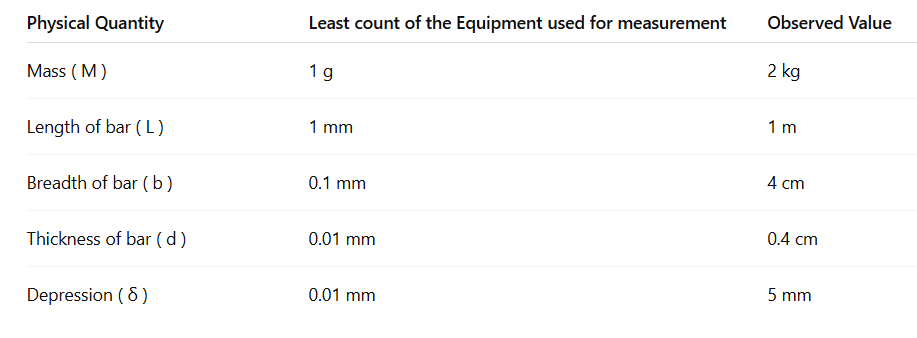
Then the fractional error in the measurement of $$Y$$ is:
We have to find the fractional (relative) error in Young’s modulus, whose working formula for the experiment is $$Y=\frac{M g \, l^{3}}{4\, b\, d^{3}\, \delta}\, .$$
In error analysis, when a quantity is a product or quotient of measured quantities raised to powers, the fractional error in the result equals the algebraic sum of the absolute values of the fractional errors of each factor, each multiplied by its power. Stated formally, if $$Q = A^{p}\, B^{q}\, C^{r}\dots ,$$ then $$\frac{\Delta Q}{Q}=|p|\frac{\Delta A}{A}+|q|\frac{\Delta B}{B}+|r|\frac{\Delta C}{C}+\dots.$$
Comparing with $$Y=\dfrac{M g\, l^{3}}{4\, b\, d^{3}\, \delta},$$ we notice that $$g$$ and the numerical constant $$4$$ are exact, so they contribute no error. The powers of the remaining variables are:
$$$M^{+1},\quad l^{+3},\quad b^{-1},\quad d^{-3},\quad \delta^{-1}.$$$
Therefore,
$$\frac{\Delta Y}{Y}= \frac{\Delta M}{M}+3\frac{\Delta l}{l}+\frac{\Delta b}{b}+3\frac{\Delta d}{d}+\frac{\Delta\delta}{\delta}.$$
The absolute error in each measurement is taken as its least count. We now convert every quantity and its least count to the same unit (SI) and evaluate each fractional error.
Mass: observed $$$M = 2\ \text{kg},\quad \text{least count}=1\ \text{g}=0.001\ \text{kg}.$$$
$$\frac{\Delta M}{M}= \frac{0.001}{2}=0.0005.$$
Length of bar: observed $$$l = 1\ \text{m},\quad \text{least count}=1\ \text{mm}=0.001\ \text{m}.$$$
$$\frac{\Delta l}{l}= \frac{0.001}{1}=0.001.$$
Breadth: observed $$$b = 4\ \text{cm}=0.04\ \text{m},\quad \text{least count}=0.1\ \text{mm}=0.0001\ \text{m}.$$$
$$\frac{\Delta b}{b}= \frac{0.0001}{0.04}=0.0025.$$
Thickness: observed $$$d = 0.4\ \text{cm}=0.004\ \text{m},\quad \text{least count}=0.01\ \text{mm}=0.00001\ \text{m}.$$$
$$\frac{\Delta d}{d}= \frac{0.00001}{0.004}=0.0025.$$
Depression: observed $$$\delta = 5\ \text{mm}=0.005\ \text{m},\quad \text{least count}=0.01\ \text{mm}=0.00001\ \text{m}.$$$
$$\frac{\Delta \delta}{\delta}= \frac{0.00001}{0.005}=0.002.$$
Substituting all these fractional errors into the earlier relation, we get
$$$\begin{aligned} \frac{\Delta Y}{Y} &= 0.0005 \;+\; 3(0.001) \;+\; 0.0025 \;+\; 3(0.0025) \;+\; 0.002\\[4pt] &= 0.0005 + 0.003 + 0.0025 + 0.0075 + 0.002\\[4pt] &= 0.0155. \end{aligned}$$$
Thus the fractional error in the measurement of $$Y$$ is $$0.0155$$.
Hence, the correct answer is Option D.
Was this solution helpful?
Click on the Email ☝️ to Watch the Video Solution
Create a FREE account and get:
_1.webp)

Educational materials for JEE preparation

Ask our AI anything

AI can make mistakes. Please verify important information.
AI can make mistakes. Please verify important information.
