For the following questions answer them individually
A student determined Young's Modulus of elasticity using the formula $$Y = \frac{Mgl^3}{4bd^3\delta}$$. The value of $$g$$ is taken to be 9.8 m s$$^{-2}$$ without any significant error, his observations are as following.
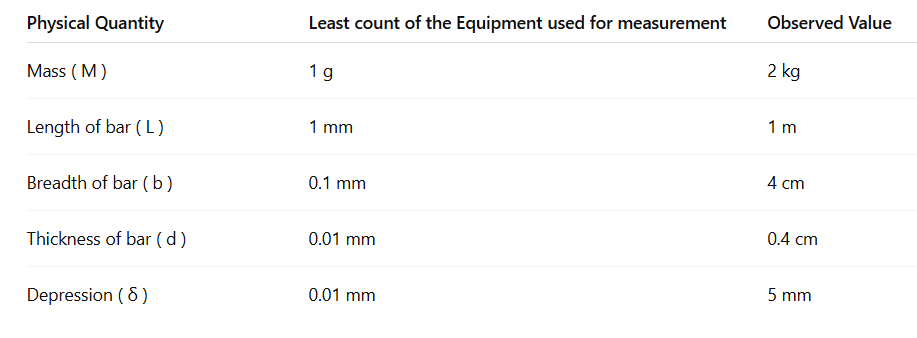
Then the fractional error in the measurement of $$Y$$ is:
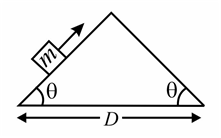
An object of mass $$m$$ is being moved with a constant velocity under the action of an applied force of 2 N along a frictionless surface with following surface profile.
The correct applied force vs distance graph will be:
The ranges and heights for two projectiles projected with the same initial velocity at angles 42° and 48° with the horizontal are $$R_1$$, $$R_2$$ and $$H_1$$, $$H_2$$ respectively. Choose the correct option:
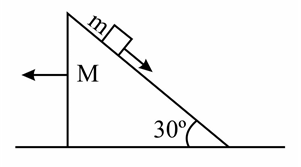
A block of mass $$m$$ slides on the wooden wedge, which in turn slides backward on the horizontal surface. The acceleration of the block with respect to the wedge is:
Given $$m = 8$$ kg, $$M = 16$$ kg
Assume all the surfaces shown in the figure to be frictionless.
A body of mass $$m$$ dropped from a height $$h$$ reaches the ground with a speed of $$0.8\sqrt{gh}$$. The value of work done by the air-friction is:
Electric field of a plane electromagnetic wave propagating through a non-magnetic medium is given by $$E = 20\cos(2 \times 10^{10}t - 200x)$$ V m$$^{-1}$$. The dielectric constant of the medium is equal to: (Take $$\mu_r = 1$$)
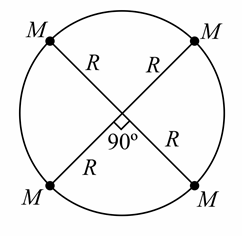
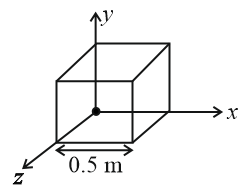
Four particles each of mass $$M$$, move along a circle of radius $$R$$ under the action of their mutual gravitational attraction as shown in figure. The speed of each particle is:
A glass tumbler having inner depth of 17.5 cm is kept on a table. A student starts pouring water ($$\mu = \frac{4}{3}$$) into it while looking at the surface of water from the above. When he feels that the tumbler is half filled, he stops pouring water. Up to what height, the tumbler is actually filled?
Due to cold weather, a 1 m water pipe of cross-sectional area 1 cm$$^2$$ is filled with ice at -10°C. Resistive heating is used to melt the ice. Current of 0.5 A is passed through 4 k$$\Omega$$ resistance. Assuming that all the heat produced is used for melting, what is the minimum time required?
(Given latent heat of fusion for water/ice = $$3.33 \times 10^5$$ J kg$$^{-1}$$, specific heat of ice = $$2 \times 10^3$$ J kg$$^{-1}$$ °C$$^{-1}$$ and density of ice = $$10^3$$ kg m$$^{-3}$$)
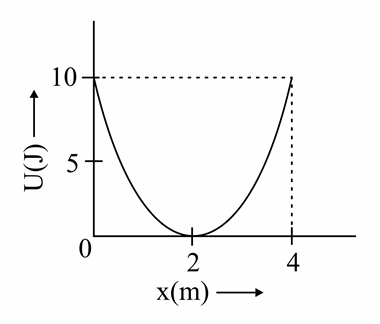
A mass of 5 kg is connected to a spring. The potential energy curve of the simple harmonic motion executed by the system is shown in the figure. A simple pendulum of length 4 m has the same period of oscillation as the spring system. What is the value of acceleration due to gravity on the planet where these experiments are performed?