NTA JEE Main 1st September 2021 Shift 2
For the following questions answer them individually
NTA JEE Main 1st September 2021 Shift 2 - Question 11
A cube is placed inside an electric field, $$\vec{E} = 150y^2\hat{j}$$. The side of the cube is 0.5 m and is placed in the field as shown in the given figure. The charge inside the cube is: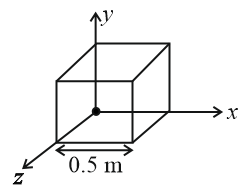
NTA JEE Main 1st September 2021 Shift 2 - Question 12
A capacitor is connected to a 20 V battery through a resistance of 10$$\Omega$$. It is found that the potential difference across the capacitor rises to 2 V in 1 $$\mu$$s. The capacitance of the capacitor is _________ $$\mu$$F.
Given $$\ln\frac{10}{9} = 0.105$$
NTA JEE Main 1st September 2021 Shift 2 - Question 13
Two resistors $$R_1 = (4 \pm 0.8)$$ $$\Omega$$ and $$R_2 = (4 \pm 0.4)$$ $$\Omega$$ are connected in parallel. The equivalent resistance of their parallel combination will be:

NTA JEE Main 1st September 2021 Shift 2 - Question 14
Following plots show Magnetization (M) vs Magnetising field (H) and Magnetic susceptibility ($$\chi$$) vs Temperature (T) graph: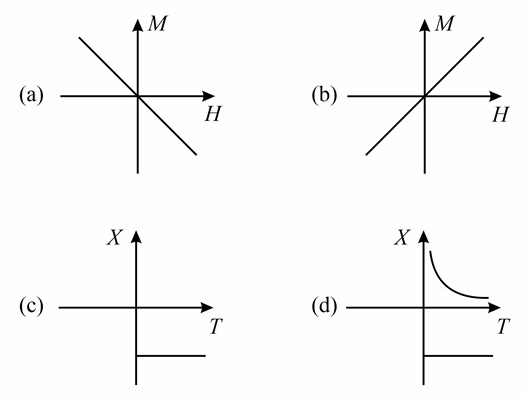
Which of the following combination will be represented by a diamagnetic material?
NTA JEE Main 1st September 2021 Shift 2 - Question 15
For the given circuit the current $$i$$ through the battery when the key is closed and the steady state has been reached is: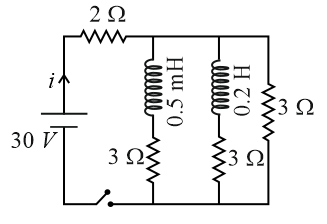
NTA JEE Main 1st September 2021 Shift 2 - Question 16
A square loop of side 20 cm and resistance 1 $$\Omega$$ is moved towards right with a constant speed $$v_0$$. The right arm of the loop is in a uniform magnetic field of 5 T. The field is perpendicular to the plane of the loop and is going into it. The loop is connected to a network of resistors each of value 4$$\Omega$$. What should be the value of $$v_0$$ so that a steady current of 2 mA flows in the loop?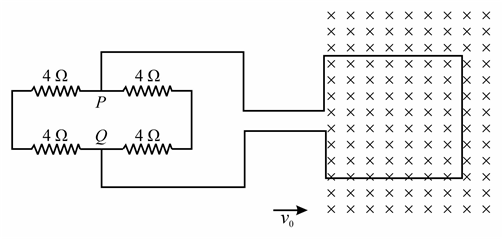
NTA JEE Main 1st September 2021 Shift 2 - Question 17
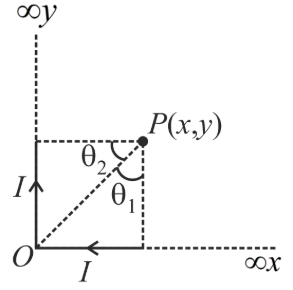
There are two infinitely long straight current-carrying conductors and they are held at right angles to each other so that their common ends meet at the origin as shown in the figure given below. The ratio of current in both conductors is 1:1. The magnetic field at point P is:
NTA JEE Main 1st September 2021 Shift 2 - Question 18
The temperature of an ideal gas in three dimensions is 300 K. The corresponding de-Broglie wavelength of the electron approximately at 300 K is:
$$m_e$$ = mass of electron = $$9 \times 10^{-31}$$ kg, $$h$$ = Planck constant = $$6.6 \times 10^{-34}$$ J s, $$k_B$$ = Boltzmann constant = $$1.38 \times 10^{-23}$$ J K$$^{-1}$$
NTA JEE Main 1st September 2021 Shift 2 - Question 19
The half life period of a radioactive element $$x$$ is same as the mean life time of another radioactive element $$y$$. Initially they have the same number of atoms. Then:
NTA JEE Main 1st September 2021 Shift 2 - Question 20
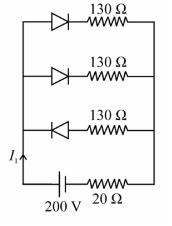
In the given figure, each diode has a forward bias resistance of 30 $$\Omega$$ and infinite resistance in reverse bias. The current $$I_1$$ will be: