
Join Our JEE Preparation Group
Prep with like-minded aspirants; Get access to free daily tests and study material.
Sign in
Please select an account to continue using cracku.in
↓ →
Join Our JEE Preparation Group
Prep with like-minded aspirants; Get access to free daily tests and study material.
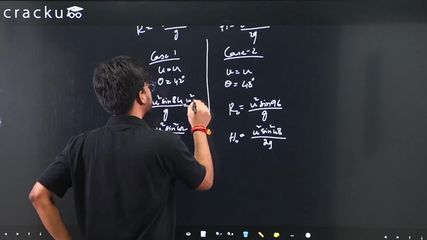
The ranges and heights for two projectiles projected with the same initial velocity at angles 42° and 48° with the horizontal are $$R_1$$, $$R_2$$ and $$H_1$$, $$H_2$$ respectively. Choose the correct option:
We start by recalling the standard results for a projectile launched with an initial speed $$u$$ at an angle $$\theta$$ to the horizontal.
Formula for horizontal range: $$R = \dfrac{u^{2}\sin 2\theta}{g}.$$
Formula for maximum height: $$H = \dfrac{u^{2}\sin^{2}\theta}{2g}.$$
Both projectiles are thrown with the same speed $$u$$, so $$u$$ and $$g$$ are common for the two cases. Let us denote the first angle by $$\theta_{1}=42^{\circ}$$ and the second by $$\theta_{2}=48^{\circ}.$$ Their corresponding ranges and heights are $$R_{1},\,H_{1}$$ and $$R_{2},\,H_{2}.$$
Evaluating the ranges
For the first projectile we have
$$R_{1}= \dfrac{u^{2}\sin 2\theta_{1}}{g} = \dfrac{u^{2}\sin(2\times 42^{\circ})}{g} = \dfrac{u^{2}\sin 84^{\circ}}{g}.$$
For the second projectile we obtain
$$R_{2}= \dfrac{u^{2}\sin 2\theta_{2}}{g} = \dfrac{u^{2}\sin(2\times 48^{\circ})}{g} = \dfrac{u^{2}\sin 96^{\circ}}{g}.$$
Now we use the trigonometric identity $$\sin(180^{\circ}-\alpha)=\sin\alpha.$$ Since $$96^{\circ}=180^{\circ}-84^{\circ},$$ we get $$\sin 96^{\circ}=\sin 84^{\circ}.$$ Substituting this equality above,
$$R_{2}= \dfrac{u^{2}\sin 96^{\circ}}{g}= \dfrac{u^{2}\sin 84^{\circ}}{g}=R_{1}.$$
Thus $$R_{1}=R_{2}.$$
Evaluating the heights
For the first projectile:
$$H_{1}=\dfrac{u^{2}\sin^{2}\theta_{1}}{2g} =\dfrac{u^{2}\sin^{2}42^{\circ}}{2g}.$$
For the second projectile:
$$H_{2}=\dfrac{u^{2}\sin^{2}\theta_{2}}{2g} =\dfrac{u^{2}\sin^{2}48^{\circ}}{2g}.$$
Because $$48^{\circ}>42^{\circ}$$ and $$\sin\theta$$ increases from $$0^{\circ}$$ to $$90^{\circ},$$ we have $$\sin 48^{\circ}>\sin 42^{\circ}.$$ Squaring preserves the inequality, so $$\sin^{2}48^{\circ}>\sin^{2}42^{\circ}.$$ Substituting this into the expressions for $$H_{1}$$ and $$H_{2}$$ gives
$$H_{2}>H_{1}.$$
Combining both comparisons, we find
$$R_{1}=R_{2}\quad\text{and}\quad H_{1}<H_{2}.$$
These results match Option B.
Hence, the correct answer is Option B.
Was this solution helpful?
Click on the Email ☝️ to Watch the Video Solution
Create a FREE account and get:
_1.webp)

Educational materials for JEE preparation

Ask our AI anything

AI can make mistakes. Please verify important information.
AI can make mistakes. Please verify important information.
