
Join Our JEE Preparation Group
Prep with like-minded aspirants; Get access to free daily tests and study material.
Sign in
Please select an account to continue using cracku.in
↓ →
Join Our JEE Preparation Group
Prep with like-minded aspirants; Get access to free daily tests and study material.
A block of mass $$m$$ slides on the wooden wedge, which in turn slides backward on the horizontal surface. The acceleration of the block with respect to the wedge is:
Given $$m = 8$$ kg, $$M = 16$$ kg
Assume all the surfaces shown in the figure to be frictionless.
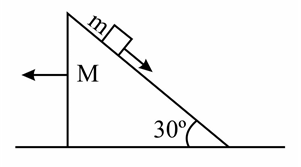
We need to find the acceleration of the block of mass $$m$$ with respect to the wooden wedge of mass $$M$$.
From the schematic , we have:
Let the horizontal acceleration of the wedge moving backward (to the left) be $$A_w$$. Let the acceleration of the block relative to the wedge down the incline be $$a_r$$.
Let's observe the block from the non-inertial reference frame of the accelerating wedge. In this frame, a horizontal pseudo force of magnitude $$mA_w$$ acts on the block towards the right.
The component of gravity pulling the block down is $$mg \sin\theta$$. The component of the pseudo force pushing it up the incline is $$mA_w \cos\theta$$.
$$mg \sin\theta + mA_w \cos\theta = m a_r$$
$$g \sin\theta + A_w \cos\theta = a_r \quad \text{--- (Equation 1)}$$
The normal force $$N$$ exerted by the wedge on the block is balanced by the components of gravity and the pseudo force:
$$N = mg \cos\theta - mA_w \sin\theta \quad \text{--- (Equation 2)}$$
Now, observing the wedge from the ground (inertial frame), the horizontal forces acting on it are due to the normal reaction $$N$$ from the block. The horizontal component of this normal force drives the wedge to the left:
$$N \sin\theta = M A_w \quad \text{--- (Equation 3)}$$
Substitute $$N$$ from Equation 2 into Equation 3:
$$(mg \cos\theta - mA_w \sin\theta)\sin\theta = M A_w$$
$$mg \sin\theta \cos\theta - mA_w \sin^2\theta = M A_w$$
$$mg \sin\theta \cos\theta = A_w (M + m \sin^2\theta)$$
$$A_w = \frac{mg \sin\theta \cos\theta}{M + m \sin^2\theta}$$
Substitute $$m = 8$$, $$M = 16$$, $$\sin 30^\circ = \frac{1}{2}$$, and $$\cos 30^\circ = \frac{\sqrt{3}}{2}$$ into the expression for $$A_w$$:
$$A_w = \frac{8 \cdot g \cdot \left(\frac{1}{2}\right) \cdot \left(\frac{\sqrt{3}}{2}\right)}{16 + 8 \cdot \left(\frac{1}{2}\right)^2} = \frac{2\sqrt{3}g}{16 + 2} = \frac{2\sqrt{3}g}{18} = \frac{\sqrt{3}}{9}g$$
Now, substitute $$A_w$$ back into Equation 1 to find the relative acceleration $$a_r$$:
$$a_r = g \sin 30^\circ + A_w \cos 30^\circ$$
$$a_r = g\left(\frac{1}{2}\right) + \left(\frac{\sqrt{3}}{9}g\right)\left(\frac{\sqrt{3}}{2}\right)$$
$$a_r = \frac{g}{2} + \frac{3g}{18} = \frac{g}{2} + \frac{g}{6}$$
$$a_r = \frac{3g + g}{6} = \frac{4g}{6} = \frac{2}{3}g$$
The acceleration of the block with respect to the wedge is $$\frac{2}{3}g$$, which corresponds to Option D.
Create a FREE account and get:
_1.webp)

Educational materials for JEE preparation

Ask our AI anything

AI can make mistakes. Please verify important information.
AI can make mistakes. Please verify important information.


