
Join Our JEE Preparation Group
Prep with like-minded aspirants; Get access to free daily tests and study material.
Sign in
Please select an account to continue using cracku.in
↓ →
Join Our JEE Preparation Group
Prep with like-minded aspirants; Get access to free daily tests and study material.
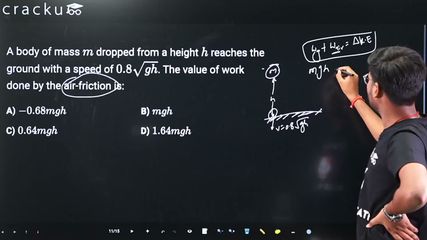
A body of mass $$m$$ dropped from a height $$h$$ reaches the ground with a speed of $$0.8\sqrt{gh}$$. The value of work done by the air-friction is:
Initially the body is at rest at a height $$h$$ above the ground, so its kinetic energy is zero and its gravitational potential energy is $$mgh$$.
At the moment of release we declare this to be the initial state. Let us write the energy-work relation that includes non-conservative forces (air friction):
$$U_{\text i}+K_{\text i}+W_{\text{air}}=U_{\text f}+K_{\text f}.$$
Here $$U$$ denotes gravitational potential energy, $$K$$ denotes kinetic energy and $$W_{\text{air}}$$ is the work done by air friction (which we need to find).
For the initial state we have
$$U_{\text i}=mgh,\qquad K_{\text i}=0.$$
For the final state (just before touching the ground) the height is zero, so
$$U_{\text f}=0.$$
The speed on reaching the ground is given to be $$0.8\sqrt{gh}$$. Hence the final kinetic energy is
$$K_{\text f}=\dfrac12 m\bigl(0.8\sqrt{gh}\bigr)^2 =\dfrac12 m\,(0.64\,gh) =0.32\,mgh.$$
Substituting every quantity into the energy-work relation gives
$$mgh+0+W_{\text{air}}=0+0.32\,mgh.$$
Now we isolate $$W_{\text{air}}$$:
$$W_{\text{air}}=0.32\,mgh-mgh =-0.68\,mgh.$$
The negative sign tells us that air friction has removed mechanical energy from the system.
Hence, the correct answer is Option A.
Click on the Email ☝️ to Watch the Video Solution
Create a FREE account and get:
_1.webp)

Educational materials for JEE preparation

Ask our AI anything

AI can make mistakes. Please verify important information.
AI can make mistakes. Please verify important information.


