
Join Our JEE Preparation Group
Prep with like-minded aspirants; Get access to free daily tests and study material.
Sign in
Please select an account to continue using cracku.in
↓ →
Join Our JEE Preparation Group
Prep with like-minded aspirants; Get access to free daily tests and study material.
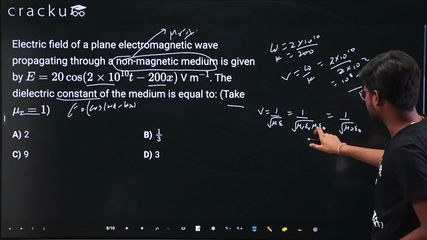
Electric field of a plane electromagnetic wave propagating through a non-magnetic medium is given by $$E = 20\cos(2 \times 10^{10}t - 200x)$$ V m$$^{-1}$$. The dielectric constant of the medium is equal to: (Take $$\mu_r = 1$$)
We start with the standard equation for a plane electromagnetic wave travelling in the +x direction,
$$E = E_0 \cos(\omega t - kx),$$
where $$\omega$$ is the angular frequency (in rad s-1) and $$k$$ is the wave number (in rad m-1). The given expression
$$E = 20\cos(2 \times 10^{10}t - 200x)\;{\rm V\,m^{-1}}$$
matches this form directly, so by simple comparison we have
$$\omega = 2 \times 10^{10}\;{\rm rad\,s^{-1}}, \qquad k = 200\;{\rm rad\,m^{-1}}.$$
For any wave, the phase velocity $$v$$ is defined by the relation
$$v = \frac{\omega}{k}.$$
Substituting the identified values,
$$v = \frac{2 \times 10^{10}}{200} = \frac{2}{200}\times 10^{10} = \frac{1}{100}\times 10^{10} = 10^{8}\;{\rm m\,s^{-1}}.$$
Now, the speed of propagation of an electromagnetic wave in a material medium is also given by the well-known formula
$$v = \frac{1}{\sqrt{\mu\varepsilon}}.$$
Here, $$\mu$$ is the absolute permeability and $$\varepsilon$$ is the absolute permittivity of the medium. For a non-magnetic medium the relative permeability is $$\mu_r = 1,$$ so
$$\mu = \mu_r \mu_0 = \mu_0.$$
If we write the permittivity as $$\varepsilon = \varepsilon_r \varepsilon_0,$$ where $$\varepsilon_r$$ is the dielectric constant (relative permittivity) that we have to find, then the velocity formula becomes
$$v = \frac{1}{\sqrt{\mu_0 \varepsilon_r \varepsilon_0}} = \frac{1}{\sqrt{\mu_0 \varepsilon_0}}\;\frac{1}{\sqrt{\varepsilon_r}} = \frac{c}{\sqrt{\varepsilon_r}},$$
because $$c = \dfrac{1}{\sqrt{\mu_0 \varepsilon_0}}$$ is the speed of light in vacuum.
Rearranging for $$\varepsilon_r$$ gives
$$\varepsilon_r = \left(\frac{c}{v}\right)^{2}.$$
We substitute the numerical values $$c = 3 \times 10^{8}\;{\rm m\,s^{-1}}$$ and $$v = 1 \times 10^{8}\;{\rm m\,s^{-1}},$$ obtaining
$$\varepsilon_r = \left(\frac{3 \times 10^{8}}{1 \times 10^{8}}\right)^{2} = (3)^{2} = 9.$$
This value of $$\varepsilon_r$$ is the dielectric constant of the given medium.
Hence, the correct answer is Option C.
Was this solution helpful?
Click on the Email ☝️ to Watch the Video Solution
Create a FREE account and get:
_1.webp)

Educational materials for JEE preparation

Ask our AI anything

AI can make mistakes. Please verify important information.
AI can make mistakes. Please verify important information.
