
Join Our JEE Preparation Group
Prep with like-minded aspirants; Get access to free daily tests and study material.
Sign in
Please select an account to continue using cracku.in
↓ →
Join Our JEE Preparation Group
Prep with like-minded aspirants; Get access to free daily tests and study material.
Four particles each of mass $$M$$, move along a circle of radius $$R$$ under the action of their mutual gravitational attraction as shown in figure. The speed of each particle is:
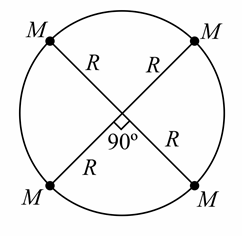
Let us analyze the forces acting on any one of the four particles moving along the circular path of radius $$R$$. Because of the symmetric square configuration formed by the four identical masses ($M$), the net gravitational force acting on any chosen particle points directly toward the center of the circle, providing the necessary centripetal force.
Let the four particles be positioned at the corners of a square inscribed within the circle. For any single particle, there are three distinct gravitational pulling forces exerted by the remaining three particles:
$$F_1 = F_2 = \frac{G M^2}{(\sqrt{2}R)^2} = \frac{G M^2}{2R^2}$$
$$F_3 = \frac{G M^2}{(2R)^2} = \frac{G M^2}{4R^2}$$
Now, we sum these force vectors along the radial line directed toward the center of the circle:
$$F_{12} = F_1 \cos(45^\circ) + F_2 \cos(45^\circ) = 2 \cdot \left(\frac{G M^2}{2R^2}\right) \cdot \frac{1}{\sqrt{2}} = \frac{G M^2}{\sqrt{2}R^2}$$
$$F_3 = \frac{G M^2}{4R^2}$$
Thus, the total net inward gravitational force ($F_{\text{net}}$) is:
$$F_{\text{net}} = \frac{G M^2}{\sqrt{2}R^2} + \frac{G M^2}{4R^2} = \frac{G M^2}{R^2} \left( \frac{1}{\sqrt{2}} + \frac{1}{4} \right)$$
To make factoring simpler, pull out a common denominator fraction of $$\frac{1}{4}$$:
$$F_{\text{net}} = \frac{G M^2}{4R^2} \left( 2\sqrt{2} + 1 \right)$$
This net gravitational pull acts entirely as the centripetal force keeping the particle moving in its circular orbit at a constant speed $$v$$:
$$F_{\text{net}} = \frac{M v^2}{R}$$
Equating our expressions and solving for orbital speed $$v$$:
$$\frac{M v^2}{R} = \frac{G M^2}{4R^2} \left( 2\sqrt{2} + 1 \right)$$
Cancel out one factor of mass ($M$) and one factor of radius ($R$) from both sides:
$$v^2 = \frac{G M}{4R} \left( 2\sqrt{2} + 1 \right)$$
Taking the square root of both sides gives the speed of each particle:
$$v = \sqrt{\frac{G M}{4R} \left( 2\sqrt{2} + 1 \right)} = \frac{1}{2}\sqrt{\frac{G M}{R}\left(2\sqrt{2} + 1\right)}$$
Concept Check: The geometric layout of symmetrically placed objects causes mutual pulls to reinforce each other along the lines of geometric symmetry. Factoring both the close-range side actions and the long-range diagonal pull gives a combined force scale factor that translates to an orbital speed of exactly $$\frac{1}{2}\sqrt{\frac{G M}{R}\left(2\sqrt{2} + 1\right)}$$.
Correct Option Choice: Option A $$\left(\frac{1}{2}\sqrt{\frac{G M}{R}\left(2\sqrt{2} + 1\right)}\right)$$
Was this solution helpful?
Click on the Email ☝️ to Watch the Video Solution
Create a FREE account and get:
_1.webp)

Educational materials for JEE preparation

Ask our AI anything

AI can make mistakes. Please verify important information.
AI can make mistakes. Please verify important information.
