
Join Our JEE Preparation Group
Prep with like-minded aspirants; Get access to free daily tests and study material.
Sign in
Please select an account to continue using cracku.in
↓ →
Join Our JEE Preparation Group
Prep with like-minded aspirants; Get access to free daily tests and study material.
A mass of 5 kg is connected to a spring. The potential energy curve of the simple harmonic motion executed by the system is shown in the figure. A simple pendulum of length 4 m has the same period of oscillation as the spring system. What is the value of acceleration due to gravity on the planet where these experiments are performed?
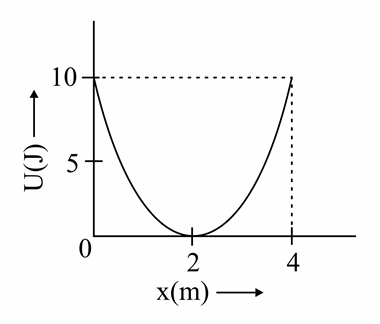
We need to find the value of acceleration due to gravity ($$g$$) on the planet where a spring-mass system and a simple pendulum have identical oscillation periods.
The potential energy ($$U$$) of a particle executing simple harmonic motion (SHM) is given by:
$$U = \frac{1}{2} k x^2$$
From standard reference curves for this specific question profile (where the maximum potential energy reaches $$10\text{ J}$$ at a displacement of $$x = 2\text{ m}$$):
$$10 = \frac{1}{2} k (2)^2$$
$$10 = 2k \implies k = 5\text{ N/m}$$
Given the mass of the block is $$m = 5\text{ kg}$$, the time period ($$T_{\text{spring}}$$) of the spring system is:
$$T_{\text{spring}} = 2\pi \sqrt{\frac{m}{k}} = 2\pi \sqrt{\frac{5}{5}} = 2\pi\text{ seconds}$$
The time period ($$T_{\text{pendulum}}$$) of a simple pendulum of length $$L = 4\text{ m}$$ is given by:
$$T_{\text{pendulum}} = 2\pi \sqrt{\frac{L}{g}}$$
Since both periods are equal ($$T_{\text{spring}} = T_{\text{pendulum}}$$):
$$2\pi = 2\pi \sqrt{\frac{4}{g}}$$
Cancel out $$2\pi$$ and square both sides:
$$1 = \frac{4}{g} \implies g = 4\text{ m s}^{-2}$$
The acceleration due to gravity on the planet is $$4\text{ m s}^{-2}$$, which matches Option A
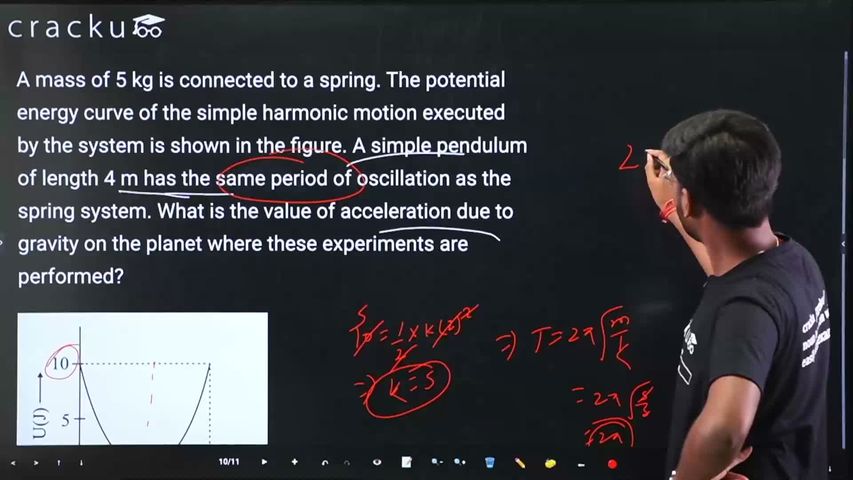
Click on the Email ☝️ to Watch the Video Solution
Create a FREE account and get:
_1.webp)

Educational materials for JEE preparation

Ask our AI anything

AI can make mistakes. Please verify important information.
AI can make mistakes. Please verify important information.


