
Join Our JEE Preparation Group
Prep with like-minded aspirants; Get access to free daily tests and study material.
Sign in
Please select an account to continue using cracku.in
↓ →
Join Our JEE Preparation Group
Prep with like-minded aspirants; Get access to free daily tests and study material.
Due to cold weather, a 1 m water pipe of cross-sectional area 1 cm$$^2$$ is filled with ice at -10°C. Resistive heating is used to melt the ice. Current of 0.5 A is passed through 4 k$$\Omega$$ resistance. Assuming that all the heat produced is used for melting, what is the minimum time required?
(Given latent heat of fusion for water/ice = $$3.33 \times 10^5$$ J kg$$^{-1}$$, specific heat of ice = $$2 \times 10^3$$ J kg$$^{-1}$$ °C$$^{-1}$$ and density of ice = $$10^3$$ kg m$$^{-3}$$)
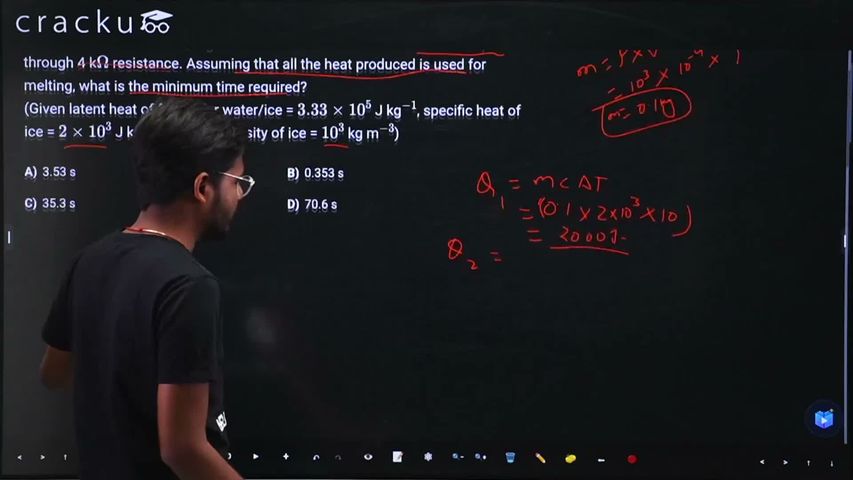
We first determine how much ice is present inside the pipe. The pipe is 1 m long and its cross-sectional area is 1 cm$$^{2}$$. Converting the area to square metres, we write $$1\text{ cm}^{2}=1\times(10^{-2}\text{ m})^{2}=1\times10^{-4}\text{ m}^{2}.$$ Hence the volume is
$$V=\text{area}\times\text{length}=1\times10^{-4}\text{ m}^{2}\times1\text{ m}=1\times10^{-4}\text{ m}^{3}.$$
Taking the density of ice as $$\rho=10^{3}\text{ kg m}^{-3},$$ the mass contained in this volume is
$$m=\rho V=10^{3}\text{ kg m}^{-3}\times1\times10^{-4}\text{ m}^{3}=0.1\text{ kg}.$$
The ice is initially at $$-10^\circ\text{C}$$. Before melting, it must be raised to $$0^\circ\text{C}$$. The heat needed for this warming is, by the specific-heat formula $$Q=mc\Delta T,$$ where the specific heat of ice is $$c=2\times10^{3}\text{ J kg}^{-1}{}^\circ\text{C}^{-1}$$ and the temperature change is $$\Delta T=10^\circ\text{C}.$$ Thus
$$Q_1=m\,c\,\Delta T=0.1\text{ kg}\times2\times10^{3}\text{ J kg}^{-1}{}^\circ\text{C}^{-1}\times10^\circ\text{C}=0.1\times20\,000\text{ J}=2\,000\text{ J}.$$
Next, the ice at $$0^\circ\text{C}$$ must melt. Using the latent-heat formula $$Q=mL,$$ with latent heat of fusion $$L=3.33\times10^{5}\text{ J kg}^{-1},$$ we get
$$Q_2=mL=0.1\text{ kg}\times3.33\times10^{5}\text{ J kg}^{-1}=33\,300\text{ J}.$$
The total heat required is the sum of these two amounts:
$$Q_{\text{total}}=Q_1+Q_2=2\,000\text{ J}+33\,300\text{ J}=35\,300\text{ J}.$$
This heat is supplied electrically. The power dissipated in a resistor is given by $$P=I^{2}R.$$ Here the current is $$I=0.5\text{ A}$$ and the resistance is $$R=4\text{ k}\Omega=4\,000\ \Omega.$$ Therefore,
$$P=(0.5\text{ A})^{2}\times4\,000\ \Omega=0.25\times4\,000\text{ W}=1\,000\text{ W}.$$
Since power is energy per unit time, $$P=\dfrac{Q}{t},$$ so the time required is
$$t=\dfrac{Q_{\text{total}}}{P}=\dfrac{35\,300\text{ J}}{1\,000\text{ J s}^{-1}}=35.3\text{ s}.$$
Hence, the correct answer is Option 3.
Click on the Email ☝️ to Watch the Video Solution
Create a FREE account and get:
_1.webp)

Educational materials for JEE preparation

Ask our AI anything

AI can make mistakes. Please verify important information.
AI can make mistakes. Please verify important information.


