
Join Our JEE Preparation Group
Prep with like-minded aspirants; Get access to free daily tests and study material.
Sign in
Please select an account to continue using cracku.in
↓ →
Join Our JEE Preparation Group
Prep with like-minded aspirants; Get access to free daily tests and study material.
A cube is placed inside an electric field, $$\vec{E} = 150y^2\hat{j}$$. The side of the cube is 0.5 m and is placed in the field as shown in the given figure. The charge inside the cube is:
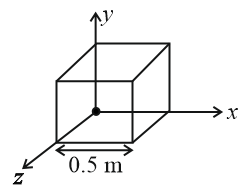
We need to determine the total electric charge enclosed inside a cube of side length $$a = 0.5\text{ m}$$ placed in a position-dependent electric field.
From the diagram , the electric field vector is given as:
$$\vec{E} = 150 y^2 \hat{j}$$
This tells us two very important things:
Let's evaluate the electric flux through the two active faces:
$$\vec{E}_{\text{bottom}} = 150(0)^2 \hat{j} = 0$$
Since the electric field strength is zero at the base plane, the flux passing through the bottom face is:$$\Phi_{\text{bottom}} = 0$$
$$\vec{E}_{\text{top}} = 150(0.5)^2 \hat{j} = 150 \times 0.25 \hat{j} = 37.5 \hat{j}\text{ N C}^{-1}$$
The flux passing out of the top face is:$$\Phi_{\text{top}} = \vec{E}_{\text{top}} \cdot \vec{A} = 37.5 \times 0.25 = 9.375\text{ N m}^2\text{ C}^{-1}$$
The total net electric flux ($$\Phi_{\text{net}}$$) emerging from the entire cube is:
$$\Phi_{\text{net}} = \Phi_{\text{top}} + \Phi_{\text{bottom}} = 9.375 + 0 = 9.375\text{ N m}^2\text{ C}^{-1}$$
According to Gauss's Law, the net electric flux through any closed surface is proportional to the net charge enclosed inside it:
$$\Phi_{\text{net}} = \frac{q_{\text{in}}}{\varepsilon_0} \implies q_{\text{in}} = \Phi_{\text{net}} \cdot \varepsilon_0$$
Using the standard permittivity constant value ($$\varepsilon_0 = 8.854 \times 10^{-12}\text{ C}^2\text{ N}^{-1}\text{ m}^{-2}$$):
$$q_{\text{in}} = 9.375 \times 8.854 \times 10^{-12}$$
$$q_{\text{in}} \approx 83.006 \times 10^{-12}\text{ C} = 8.3 \times 10^{-11}\text{ C}$$
The total net charge inside the cube is $$8.3 \times 10^{-11}\text{ C}$$, which corresponds exactly to Option A.
Was this solution helpful?
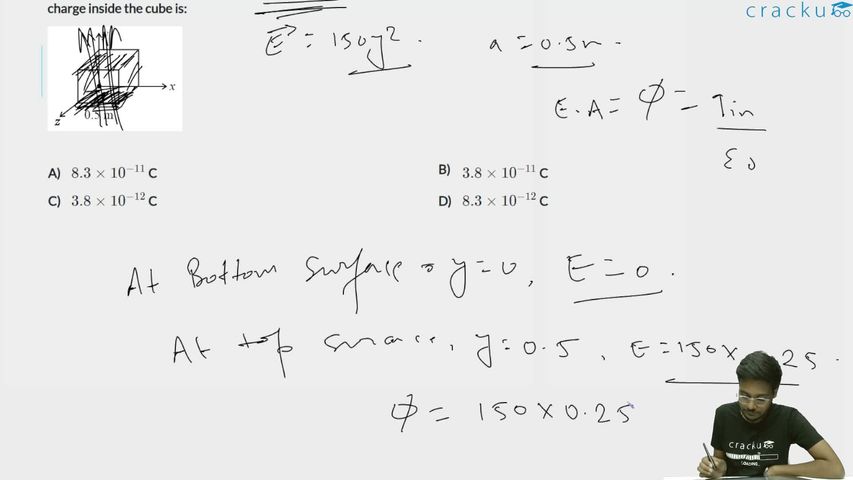
Click on the Email ☝️ to Watch the Video Solution
Create a FREE account and get:
_1.webp)

Educational materials for JEE preparation

Ask our AI anything

AI can make mistakes. Please verify important information.
AI can make mistakes. Please verify important information.
