
Join Our JEE Preparation Group
Prep with like-minded aspirants; Get access to free daily tests and study material.
Sign in
Please select an account to continue using cracku.in
↓ →
Join Our JEE Preparation Group
Prep with like-minded aspirants; Get access to free daily tests and study material.
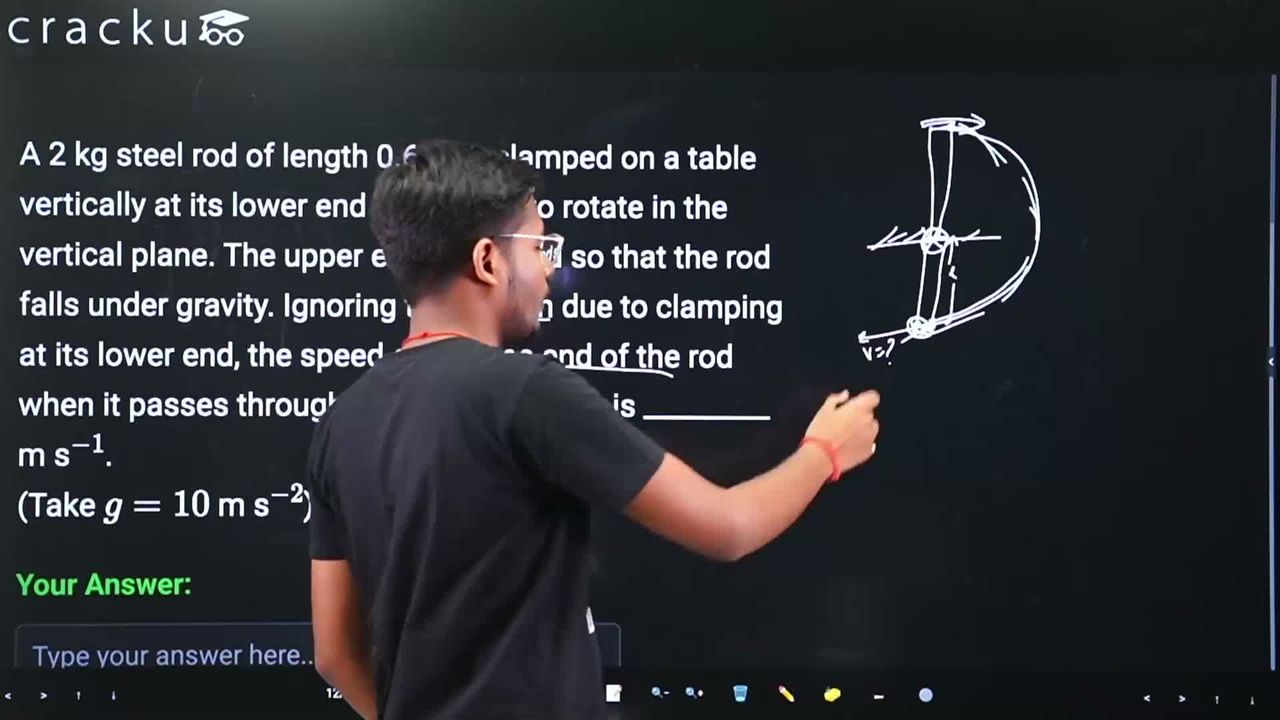
A 2 kg steel rod of length 0.6 m is clamped on a table vertically at its lower end and is free to rotate in the vertical plane. The upper end is pushed so that the rod falls under gravity. Ignoring the friction due to clamping at its lower end, the speed of the free end of the rod when it passes through its lowest position is _________ m s$$^{-1}$$.
(Take $$g = 10$$ m s$$^{-2}$$)
Correct Answer: 6
We have a uniform steel rod of mass $$m = 2\;\text{kg}$$ and length $$L = 0.6\;\text{m}$$. It is clamped at its lower end, so that end acts as a fixed horizontal axis. The upper (free) end is given a slight push and the rod is then allowed to fall only under the action of gravity. Because the clamp is friction-less, mechanical energy is conserved.
At the instant of release the rod is perfectly vertical, pointing upwards from the pivot. After falling through half a rotation (an angle of $$180^{\circ}$$), the rod becomes vertical again but now points downwards. That latter orientation is the position in which the free (upper) end attains its lowest point in the circular path. We wish to find the linear speed of that free end at this lowest position.
First we calculate the change in gravitational potential energy of the rod’s centre of mass (C.M.). For a uniform rod the C.M. lies at its mid-point, i.e. at a distance $$\dfrac{L}{2}$$ from the pivot.
Initial height of C.M. above the pivot:$$h_i = +\frac{L}{2}$$ Final height of C.M. (after a $$180^{\circ}$$ rotation):$$h_f = -\frac{L}{2}$$
Thus the vertical drop of the centre of mass is
$$\Delta h = h_i - h_f = \frac{L}{2} - \left(-\frac{L}{2}\right)=L.$$
The loss in gravitational potential energy is therefore
$$\Delta U = m g \,\Delta h = m g L.$$
Substituting the numerical values,
$$\Delta U = 2\;\text{kg} \times 10\;\text{m s}^{-2} \times 0.6\;\text{m} = 12\;\text{J}.$$
This entire loss of potential energy appears as rotational kinetic energy about the pivot. The formula for rotational kinetic energy is
$$K = \frac12 I \omega^2,$$
where $$I$$ is the moment of inertia of the rod about the pivot and $$\omega$$ is its angular speed at the considered instant.
For a uniform rod hinged about one end, the moment of inertia is given by
$$I = \frac{1}{3} m L^2.$$
Putting the numbers,
$$I = \frac13 \times 2\;\text{kg} \times (0.6\;\text{m})^2 = \frac13 \times 2 \times 0.36\;\text{kg m}^2 = 0.24\;\text{kg m}^2.$$
Conserving mechanical energy, we equate the gravitational energy lost to the rotational kinetic energy gained:
$$m g L = \frac12 I \omega^2.$$
Substituting $$m g L = 12\;\text{J}$$ and $$I = 0.24\;\text{kg m}^2,$$
$$12 = \frac12 \times 0.24 \times \omega^2,$$ $$12 = 0.12\,\omega^2,$$ $$\omega^2 = \frac{12}{0.12} = 100,$$ $$\omega = 10\;\text{rad s}^{-1}.$$
The linear speed of the free end is related to the angular speed by
$$v = \omega L.$$
Hence,
$$v = 10\;\text{rad s}^{-1} \times 0.6\;\text{m} = 6\;\text{m s}^{-1}.$$
So, the answer is $$6$$.
Click on the Email ☝️ to Watch the Video Solution
Create a FREE account and get:
_1.webp)

Educational materials for JEE preparation

Ask our AI anything

AI can make mistakes. Please verify important information.
AI can make mistakes. Please verify important information.


