
Join Our JEE Preparation Group
Prep with like-minded aspirants; Get access to free daily tests and study material.
Sign in
Please select an account to continue using cracku.in
↓ →
Join Our JEE Preparation Group
Prep with like-minded aspirants; Get access to free daily tests and study material.
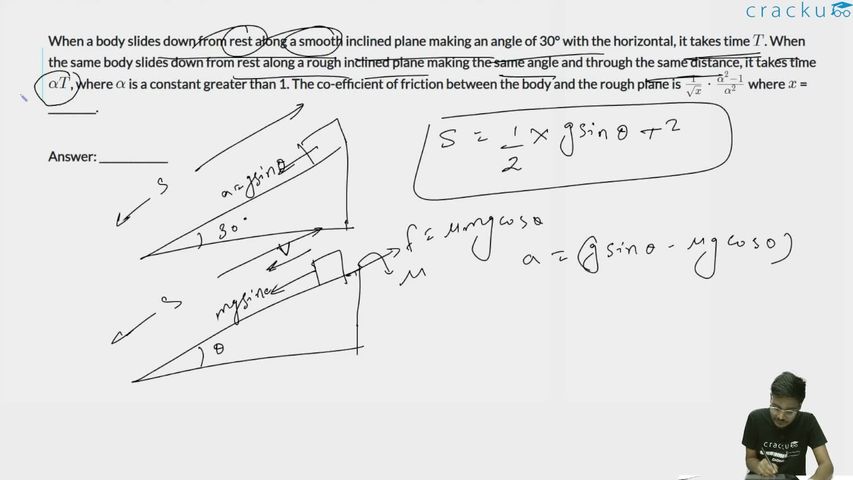
When a body slides down from rest along a smooth inclined plane making an angle of 30° with the horizontal, it takes time $$T$$. When the same body slides down from rest along a rough inclined plane making the same angle and through the same distance, it takes time $$\alpha T$$, where $$\alpha$$ is a constant greater than 1. The co-efficient of friction between the body and the rough plane is $$\frac{1}{\sqrt{x}} \cdot \frac{\alpha^2-1}{\alpha^2}$$ where $$x$$ = _________.
Correct Answer: 3
We are given two situations for the same body moving down the same distance $$s$$ on two different 30° inclined planes, one smooth (no friction) and the other rough (with friction).
For any motion with uniform acceleration, the kinematic relation that connects distance travelled from rest, acceleration and time is stated first:
$$s=\dfrac12\,a\,t^2.$$
Motion on the smooth plane
The only component of gravity acting along the plane is $$g\sin\theta$$, where $$\theta=30^\circ$$. Therefore
$$a_{\text{smooth}}=g\sin\theta.$$
If the time taken is $$T$$, we substitute in the kinematic formula:
$$s=\dfrac12 \,a_{\text{smooth}}\,T^2 =\dfrac12 \,g\sin\theta\,T^2.$$
Motion on the rough plane
Let the coefficient of friction be $$\mu$$.
The normal reaction is $$N=mg\cos\theta$$, so the frictional force is $$\mu N = \mu mg\cos\theta$$ acting up the plane.
The net force down the plane is therefore
$$mg\sin\theta-\mu mg\cos\theta =m\bigl(g\sin\theta-\mu g\cos\theta\bigr).$$
Hence the acceleration on the rough plane is
$$a_{\text{rough}}=g\sin\theta-\mu g\cos\theta.$$
The time of descent now is given to be $$\alpha T$$, so the kinematic relation gives
$$s=\dfrac12 \,a_{\text{rough}}\,( \alpha T )^2 =\dfrac12 \bigl(g\sin\theta-\mu g\cos\theta \bigr)\alpha^2 T^2.$$
Equating the two expressions for the same distance $$s$$
$$\dfrac12 g\sin\theta\,T^2 =\dfrac12 \bigl(g\sin\theta-\mu g\cos\theta\bigr)\,\alpha^2 T^2.$$
The common factors $$\dfrac12\,g\,T^2$$ cancel, leaving
$$\sin\theta =\alpha^2\bigl(\sin\theta-\mu\cos\theta\bigr).$$
Expanding the right side, we have
$$\sin\theta =\alpha^2\sin\theta-\alpha^2\mu\cos\theta.$$
Rearranging to isolate $$\mu$$:
$$\alpha^2\mu\cos\theta =\alpha^2\sin\theta-\sin\theta =(\alpha^2-1)\sin\theta,$$
so
$$\mu=\dfrac{\sin\theta}{\cos\theta}\;\dfrac{\alpha^2-1}{\alpha^2}.$$
Because $$\dfrac{\sin\theta}{\cos\theta}=\tan\theta,$$ we write
$$\mu=\tan\theta\;\dfrac{\alpha^2-1}{\alpha^2}.$$
Given $$\theta=30^\circ,$$ we recall the standard trigonometric value
$$\tan30^\circ=\dfrac1{\sqrt3}.$$
Thus
$$\mu=\dfrac1{\sqrt3}\;\dfrac{\alpha^2-1}{\alpha^2}.$$
This matches the form stated in the question, namely
$$\mu=\dfrac1{\sqrt{x}}\;\dfrac{\alpha^2-1}{\alpha^2},$$
and by direct comparison we identify
$$x=3.$$
So, the answer is $$3$$.
Was this solution helpful?
Click on the Email ☝️ to Watch the Video Solution
Create a FREE account and get:
_1.webp)

Educational materials for JEE preparation

Ask our AI anything

AI can make mistakes. Please verify important information.
AI can make mistakes. Please verify important information.
