
Join Our JEE Preparation Group
Prep with like-minded aspirants; Get access to free daily tests and study material.
Sign in
Please select an account to continue using cracku.in
↓ →
Join Our JEE Preparation Group
Prep with like-minded aspirants; Get access to free daily tests and study material.
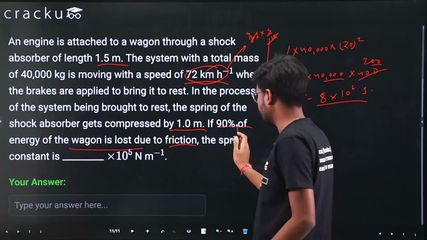
An engine is attached to a wagon through a shock absorber of length 1.5 m. The system with a total mass of 40,000 kg is moving with a speed of 72 km h$$^{-1}$$ when the brakes are applied to bring it to rest. In the process of the system being brought to rest, the spring of the shock absorber gets compressed by 1.0 m. If 90% of energy of the wagon is lost due to friction, the spring constant is _________ $$\times 10^5$$ N m$$^{-1}$$.
Correct Answer: 16
First, we note that the only mechanical energy initially present in the engine-wagon system is its translational kinetic energy. The mass of the entire system is given as $$m = 40\,000\ \text{kg}$$ and its initial speed is stated as $$72\ \text{km h}^{-1}$$. We convert this speed into the SI unit metres per second:
$$72\ \text{km h}^{-1} = 72 \times \frac{1000\ \text{m}}{3600\ \text{s}} = 20\ \text{m s}^{-1}.$$
Now we write the formula for kinetic energy:
$$\text{Kinetic energy} = \frac12 m v^{2}.$$
Substituting the numerical values, we obtain
$$\frac12 \times 40\,000\ \text{kg} \times (20\ \text{m s}^{-1})^{2} = \frac12 \times 40\,000 \times 400 = 20\,000 \times 400 = 8\,000\,000\ \text{J}.$$
Thus the initial kinetic energy is $$8.0 \times 10^{6}\ \text{J}.$$
The problem statement tells us that, while the brakes are applied, 90 % of this energy is dissipated as heat and other losses due to friction. Therefore only 10 % of the original kinetic energy remains to be stored as elastic potential energy in the spring (shock absorber) when it is fully compressed.
We calculate this remaining energy:
$$E_{\text{spring}} = 0.10 \times 8.0 \times 10^{6}\ \text{J} = 0.8 \times 10^{6}\ \text{J} = 8.0 \times 10^{5}\ \text{J}.$$
The spring is stated to compress by $$x = 1.0\ \text{m}$$. The formula for elastic potential energy stored in a spring is
$$E_{\text{spring}} = \frac12 k x^{2},$$
where $$k$$ is the spring (force) constant that we need to determine. We already know $$E_{\text{spring}} = 8.0 \times 10^{5}\ \text{J}$$ and $$x = 1.0\ \text{m}$$. Inserting these into the formula gives
$$8.0 \times 10^{5} = \frac12 k (1.0)^{2}.$$
Solving for $$k$$, we multiply both sides by 2:
$$k = 2 \times 8.0 \times 10^{5} = 1.6 \times 10^{6}\ \text{N m}^{-1}.$$
Finally, we express this value in the form asked for in the question, namely as a multiple of $$10^{5}\ \text{N m}^{-1}$$:
$$k = 16 \times 10^{5}\ \text{N m}^{-1}.$$
Hence, the correct answer is Option 16.
Was this solution helpful?
Click on the Email ☝️ to Watch the Video Solution
Create a FREE account and get:
_1.webp)

Educational materials for JEE preparation

Ask our AI anything

AI can make mistakes. Please verify important information.
AI can make mistakes. Please verify important information.
