
Join Our JEE Preparation Group
Prep with like-minded aspirants; Get access to free daily tests and study material.
Sign in
Please select an account to continue using cracku.in
↓ →
Join Our JEE Preparation Group
Prep with like-minded aspirants; Get access to free daily tests and study material.
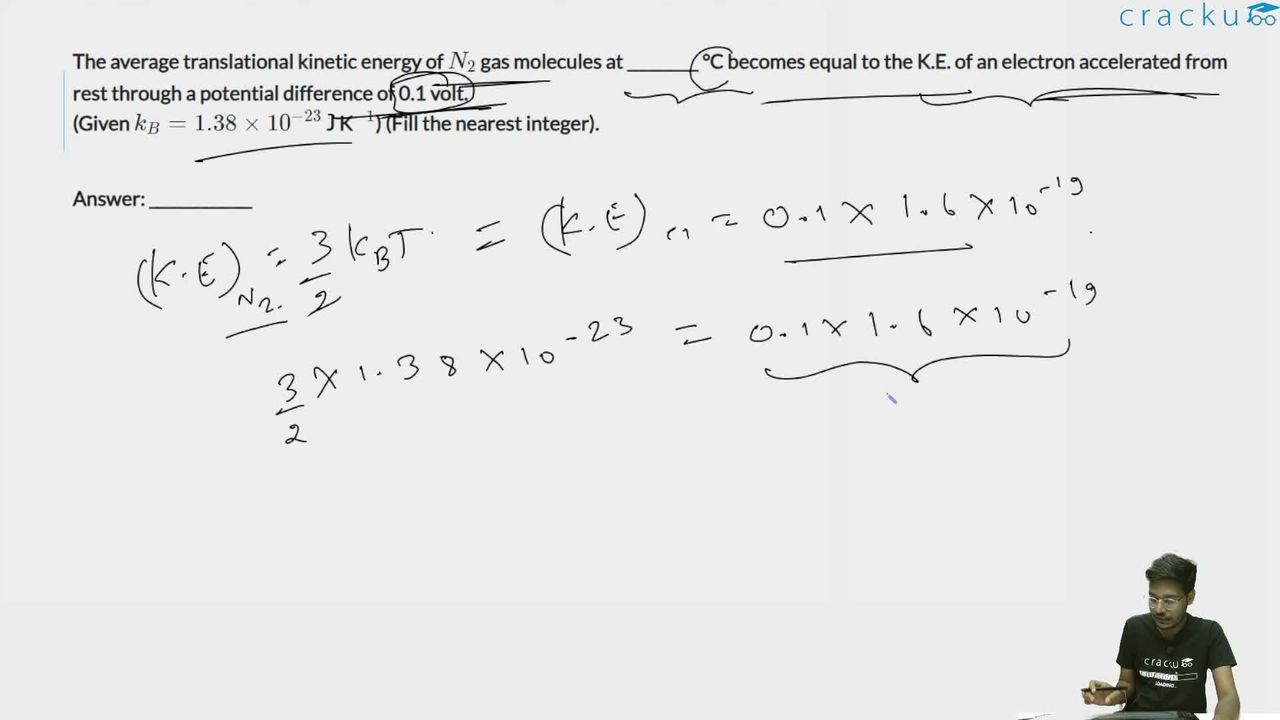
The average translational kinetic energy of $$N_2$$ gas molecules at _________ °C becomes equal to the K.E. of an electron accelerated from rest through a potential difference of 0.1 volt.
(Given $$k_B = 1.38 \times 10^{-23}$$ J K$$^{-1}$$) (Fill the nearest integer).
Correct Answer: 500
For any ideal gas, the average translational kinetic energy per molecule is given first:
$$\text{Average K.E. per molecule} = \dfrac{3}{2}\,k_B\,T,$$
where $$k_B$$ is the Boltzmann constant and $$T$$ is the absolute temperature in kelvin.
An electron that starts from rest and is accelerated through a potential difference $$V$$ acquires kinetic energy according to the work-energy principle. The work done on a charge $$q$$ in moving through a potential difference $$V$$ is
$$\text{K.E. gained} = q\,V.$$
For an electron, the magnitude of the charge is $$e = 1.6 \times 10^{-19}\ \text{C}$$. Given that the accelerating potential difference is $$V = 0.1\ \text{V}$$, we have
$$\text{K.E. of the electron} = eV = (1.6 \times 10^{-19}\ \text{C})(0.1\ \text{V}) = 1.6 \times 10^{-20}\ \text{J}.$$
According to the statement of the question, this electron kinetic energy must equal the average translational kinetic energy of one $$\mathrm{N_2}$$ molecule. Hence we equate the two expressions:
$$\dfrac{3}{2}\,k_B\,T = 1.6 \times 10^{-20}\ \text{J}.$$
Now we substitute the given value $$k_B = 1.38 \times 10^{-23}\ \text{J K}^{-1}$$ and solve algebraically for $$T$$:
$$T = \dfrac{2}{3}\,\dfrac{1.6 \times 10^{-20}}{1.38 \times 10^{-23}}\ \text{K}.$$
Simplifying step by step, we first divide the numerical factors:
$$\dfrac{1.6}{1.38} \approx 1.1594,$$
and we handle the powers of ten separately:
$$10^{-20}\, /\,10^{-23} = 10^{3}.$$
So the fraction becomes
$$\dfrac{1.6 \times 10^{-20}}{1.38 \times 10^{-23}} \approx 1.1594 \times 10^{3} = 1.1594 \times 10^{3}.$$
Multiplying by the factor $$\dfrac{2}{3}$$ gives
$$T = \dfrac{2}{3} \times 1.1594 \times 10^{3}\ \text{K}.$$
Carrying out the multiplication,
$$\dfrac{2}{3} \times 1.1594 \approx 0.7730,$$
and finally,
$$T \approx 0.7730 \times 10^{3}\ \text{K} = 773\ \text{K}.$$
To express this temperature in degrees Celsius, we use the relation
$$T\;({}^{\circ}\text{C}) = T\;(\text{K}) - 273,$$
so
$$T\;({}^{\circ}\text{C}) = 773 - 273 = 500^{\circ}\text{C}.$$
The question asks for the nearest integer value, which is already an integer. Hence, the correct answer is Option 500.
Click on the Email ☝️ to Watch the Video Solution
Create a FREE account and get:
_1.webp)

Educational materials for JEE preparation

Ask our AI anything

AI can make mistakes. Please verify important information.
AI can make mistakes. Please verify important information.


