
Join Our JEE Preparation Group
Prep with like-minded aspirants; Get access to free daily tests and study material.
Sign in
Please select an account to continue using cracku.in
↓ →
Join Our JEE Preparation Group
Prep with like-minded aspirants; Get access to free daily tests and study material.
In the given figure, each diode has a forward bias resistance of 30 $$\Omega$$ and infinite resistance in reverse bias. The current $$I_1$$ will be:
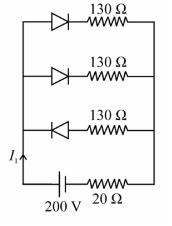
Based on the circuit diagram provided in the image, here is the clear, step-by-step breakdown of how to solve this question:
The $$200\text{ V}$$ battery has its positive terminal on the left (the longer vertical line). The total current $$I_1$$ flows out from this positive terminal and travels upward into the three parallel branches:
Each forward-biased diode has a resistance of $$30\ \Omega$$.
Since the top and middle branches are in parallel, we find their combined parallel resistance ($$R_p$$):
$$R_p = \frac{160 \times 160}{160 + 160} = 80\ \Omega$$
This parallel combination is connected in series with the $$20\ \Omega$$ resistor near the battery:
$$R_{\text{eq}} = R_p + 20\ \Omega = 80\ \Omega + 20\ \Omega = 100\ \Omega$$
Using Ohm's Law ($$I = \frac{V}{R}$$):
$$I_1 = \frac{200\text{ V}}{100\ \Omega} = 2.0\text{ A}$$
Correct Option: A (2.0 A)
Was this solution helpful?
Click on the Email ☝️ to Watch the Video Solution
Create a FREE account and get:
_1.webp)

Educational materials for JEE preparation

Ask our AI anything

AI can make mistakes. Please verify important information.
AI can make mistakes. Please verify important information.
