
Join Our JEE Preparation Group
Prep with like-minded aspirants; Get access to free daily tests and study material.
Sign in
Please select an account to continue using cracku.in
↓ →
Join Our JEE Preparation Group
Prep with like-minded aspirants; Get access to free daily tests and study material.
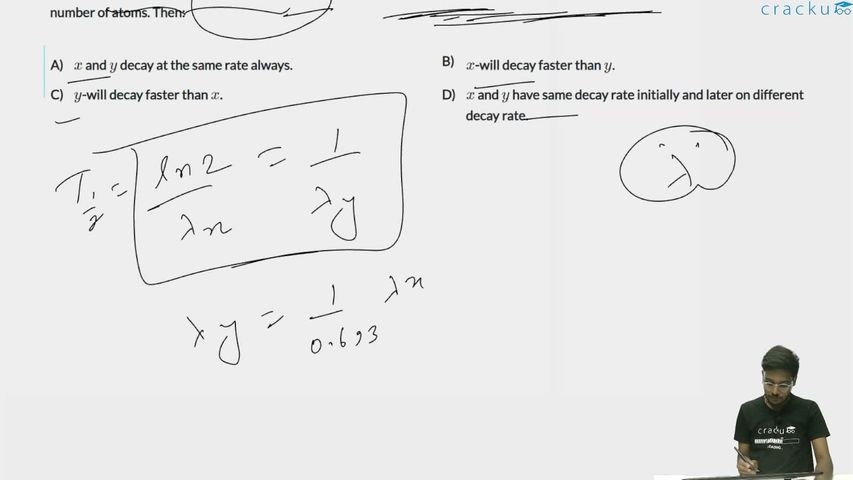
The half life period of a radioactive element $$x$$ is same as the mean life time of another radioactive element $$y$$. Initially they have the same number of atoms. Then:
First we recall two standard formulae of radioactivity:
1. The half-life of any radionuclide is given by $$T_{1/2}=\dfrac{\ln 2}{\lambda} ,$$ where $$\lambda$$ is its decay constant.
2. The mean (average) life is $$\tau=\dfrac{1}{\lambda}.$$
The statement of the problem is that the half-life of element $$x$$ is numerically equal to the mean life of element $$y$$. Expressing this relation in symbols,
$$T_{1/2,x}=\tau_y.$$
Substituting the two formulae written above, we get
$$\dfrac{\ln 2}{\lambda_x}= \dfrac{1}{\lambda_y}.$$
Now we solve this equation step by step for the ratio of the two decay constants:
$$\lambda_y = \dfrac{1}{\ln 2}\,\lambda_x.$$
The numerical value of $$\dfrac{1}{\ln 2}$$ is 1.443. Hence
$$\lambda_y = 1.443\,\lambda_x,$$
so that
$$\lambda_y > \lambda_x.$$
A larger decay constant means the nucleus disintegrates more rapidly. In other words, the element having the larger $$\lambda$$ “decays faster.” Therefore element $$y$$, whose decay constant is 1.443 times that of $$x$$, is intrinsically the faster-decaying nuclide.
To see the same fact through the exponential decay law, we note that the number of undecayed nuclei at time $$t$$ is
$$N_x(t)=N_0e^{-\lambda_x t},\qquad N_y(t)=N_0e^{-\lambda_y t},$$
because the two samples start with the same initial number $$N_0$$ of atoms. Taking their ratio,
$$\dfrac{N_y(t)}{N_x(t)} = e^{-(\lambda_y-\lambda_x)t} = e^{-0.443\,\lambda_x t}.$$
For every positive time $$t$$ the exponent is negative, so the ratio is always less than 1. This means that at any instant $$t>0$$ the sample of element $$y$$ has fewer atoms left than the sample of element $$x$$; hence element $$y$$ is losing its atoms more quickly than element $$x$$.
Thus, in all practical senses of the phrase “decays faster,” the element $$y$$ outpaces element $$x$$.
Hence, the correct answer is Option C.
Click on the Email ☝️ to Watch the Video Solution
Create a FREE account and get:
_1.webp)

Educational materials for JEE preparation

Ask our AI anything

AI can make mistakes. Please verify important information.
AI can make mistakes. Please verify important information.


