
Join Our JEE Preparation Group
Prep with like-minded aspirants; Get access to free daily tests and study material.
Sign in
Please select an account to continue using cracku.in
↓ →
Join Our JEE Preparation Group
Prep with like-minded aspirants; Get access to free daily tests and study material.
As shown in the figure, a metallic rod of linear density 0.45 kg m$$^{-1}$$ is lying horizontally on a smooth incline plane which makes an angle of 45° with the horizontal. The minimum current flowing in the rod required to keep it stationary, when 0.15 T magnetic field is acting on it in the vertical upward direction, will be (Use $$g = 10$$ m s$$^{-2}$$)
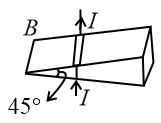
We need to determine the minimum current ($$I$$) required to keep a metallic rod stationary on a smooth inclined plane under the influence of a vertical magnetic field.
For the rod to remain stationary on the smooth inclined plane, the components of the forces acting parallel to the surface of the incline must perfectly balance each other:
Equating the force component acting up the incline to the force component acting down the incline:
$$I l B \cos\theta = mg \sin\theta$$
Rearranging the formula to solve for the current ($$I$$):
$$I = \left(\frac{m}{l}\right) \frac{g}{B} \cdot \frac{\sin\theta}{\cos\theta}$$
$$I = \lambda \frac{g}{B} \tan\theta$$
Substitute the given numerical values into our derived equilibrium equation:
$$I = 0.45 \times \frac{10}{0.15} \times \tan(45^\circ)$$
Since $$\tan(45^\circ) = 1$$:
$$I = \frac{4.5}{0.15} \times 1 = 30\text{ A}$$
Therefore, the minimum current flowing in the rod required to keep it stationary is 30 A, which corresponds to Option A.
Create a FREE account and get:
_1.webp)

Educational materials for JEE preparation

Ask our AI anything

AI can make mistakes. Please verify important information.
AI can make mistakes. Please verify important information.


