
Join Our JEE Preparation Group
Prep with like-minded aspirants; Get access to free daily tests and study material.
Sign in
Please select an account to continue using cracku.in
↓ →
Join Our JEE Preparation Group
Prep with like-minded aspirants; Get access to free daily tests and study material.
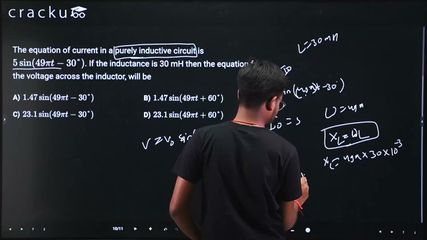
The equation of current in a purely inductive circuit is $$5\sin(49\pi t - 30°)$$. If the inductance is 30 mH then the equation for the voltage across the inductor, will be
We need to find the voltage equation across an inductor given the current equation $$i = 5\sin(49\pi t - 30°)$$ and inductance $$L = 30 \text{ mH}$$.
First, we identify the parameters: the peak current $$I_0 = 5$$ A, the angular frequency $$\omega = 49\pi$$ rad/s, and the inductance $$L = 30 \text{ mH} = 30 \times 10^{-3}$$ H.
Since the circuit is purely inductive, the peak voltage is given by $$V_0 = I_0 \times \omega L$$. Substituting the known values yields:
$$V_0 = 5 \times 49\pi \times 30 \times 10^{-3}$$
$$= 5 \times 49 \times 3.1416 \times 0.03$$
$$= 5 \times 4.618$$
$$= 23.09 \approx 23.1 \text{ V}$$
In a purely inductive circuit, the voltage leads the current by 90°. Therefore, the phase of the voltage is shifted by +90° relative to the current, giving:
$$V = V_0 \sin(\omega t - 30° + 90°) = V_0 \sin(49\pi t + 60°)$$
Substituting the calculated peak voltage into this expression provides the voltage equation:
$$V = 23.1\sin(49\pi t + 60°)$$
Hence, the correct answer is Option D: $$23.1\sin(49\pi t + 60°)$$.
Was this solution helpful?
Click on the Email ☝️ to Watch the Video Solution
Create a FREE account and get:
_1.webp)

Educational materials for JEE preparation

Ask our AI anything

AI can make mistakes. Please verify important information.
AI can make mistakes. Please verify important information.
