
Join Our JEE Preparation Group
Prep with like-minded aspirants; Get access to free daily tests and study material.
Sign in
Please select an account to continue using cracku.in
↓ →
Join Our JEE Preparation Group
Prep with like-minded aspirants; Get access to free daily tests and study material.
A rectangular loop of wire, supporting a mass m, hangs with one end in a uniform magnetic field $$\vec{B}$$ pointing out of the plane of the paper. A clockwise current is set up such that $$i > mg/Ba$$, where a is the width of the loop. Then :
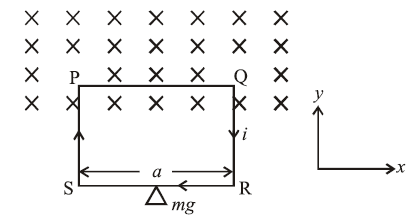
The rectangular loop has a width $$a$$ and carries a clockwise current $$i$$. The uniform magnetic field $$\vec{B}$$ points out of the plane of the paper and is present only in a region where one end of the loop, specifically the bottom horizontal side, is immersed. The loop supports a mass $$m$$, so the gravitational force acting downward is $$mg$$. The magnetic force on a current-carrying wire is given by $$\vec{F} = i (\vec{L} \times \vec{B})$$, where $$\vec{L}$$ is the length vector in the direction of the current. For the bottom horizontal side of the loop, the current flows from right to left (due to the clockwise current). The length vector $$\vec{L}$$ is directed to the left, and $$\vec{B}$$ is out of the paper. Using the right-hand rule for the cross product $$\vec{L} \times \vec{B}$$: pointing the fingers to the left (direction of $$\vec{L}$$) and curling towards the out-of-paper direction (direction of $$\vec{B}$$), the thumb points upward. Thus, the magnetic force on the bottom wire is upward. The magnitude of this force is $$F_{\text{mag}} = i L B$$, where $$L$$ is the length of the wire. Since the width of the loop is $$a$$, the bottom wire has length $$a$$, so $$F_{\text{mag}} = i a B$$. Given that $$i > \frac{mg}{B a}$$, it follows that $$i a B > mg$$. Therefore, $$F_{\text{mag}} > mg$$. The net vertical force upward is $$F_{\text{mag}} - mg > 0$$, causing the loop (and the weight) to accelerate upward. Hence, the weight rises due to the vertical magnetic force. Regarding work done: the magnetic force arises from the interaction between the moving charges (current) and the magnetic field. The magnetic force on a moving charge is always perpendicular to its velocity, so the work done by the magnetic field on the charges (and thus on the system) is zero. Although the weight rises, indicating an increase in mechanical energy, this energy comes from the external source maintaining the current, not from the magnetic field itself. Therefore, no work is done by the magnetic field on the system. Now, evaluating the options: - Option A states that work is done on the system, but this is ambiguous and could imply work by the magnetic field, which is incorrect. - Option B incorrectly claims the weight does not rise. - Option C correctly states that the weight rises due to the magnetic force but no work is done on the system (by the magnetic field). - Option D incorrectly claims work is extracted from the magnetic field. Hence, the correct answer is Option C.
Was this solution helpful?
Create a FREE account and get:
_1.webp)

Educational materials for JEE preparation

Ask our AI anything

AI can make mistakes. Please verify important information.
AI can make mistakes. Please verify important information.


