For the following questions answer them individually
If the time period $$t$$ of the oscillation of a drop of liquid of density $$d$$, radius $$r$$, vibrating under surface tension $$s$$ is given by the formula $$t = \sqrt{r^{2b}s^c d^{a/2}}$$. It is observed that the time period is directly proportional to $$\sqrt{\frac{d}{s}}$$. The value of $$b$$ should therefore be :
A 70 kg man leaps vertically into the air from a crouching position. To take the leap the man pushes the ground with a constant force F to raise himself. The center of gravity rises by 0.5 m before he leaps. After the leap the c.g. rises by another 1 m. The maximum power delivered by the muscles is : (Take g = 10 ms$$^{-2}$$)
A boy of mass 20 kg is standing on a 80 kg free to move long cart. There is negligible friction between cart and ground. Initially, the boy is standing 25 m from a wall. If he walks 10 m on the cart towards the wall, then the final distance of the boy from the wall will be
A projectile of mass M is fired so that the horizontal range is 4 km. At the highest point the projectile explodes in two parts of masses M/4 and 3M/4 respectively and the heavier part starts falling down vertically with zero initial speed. The horizontal range (distance from point of firing) of the lighter part is :
A particle of mass 2 kg is moving such that at time t, its position, in meter, is given by $$\vec{r}(t) = 5\hat{i} - 2t^2\hat{j}$$. The angular momentum of the particle at $$t = 2s$$ about the origin in kgm$$^{-2}$$ s$$^{-1}$$ is :
A body of mass 'm' is tied to one end of a spring and whirled round in a horizontal plane with a constant angular velocity. The elongation in the spring is 1 cm. If the angular velocity is doubled, the elongation in the spring is 5 cm. The original length of the spring is :
A copper wire of length 1.0 m and a steel wire of length 0.5 m having equal cross-sectional areas are joined end to end. The composite wire is stretched by a certain load which stretches the copper wire by 1 mm. If the Young's modulii of copper and steel are respectively $$1.0 \times 10^{11}$$ Nm$$^{-2}$$ and $$2.0 \times 10^{11}$$ Nm$$^{-2}$$, the total extension of the composite wire is :
Wax is coated on the inner wall of a capillary tube and the tube is then dipped in water. Then, compared to the unwaxed capillary, the angle of contact $$\theta$$ and the height $$h$$ upto which water rises change. These changes are :
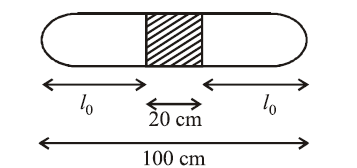
A thin tube sealed at both ends is 100 cm long. It lies horizontally, the middle 20 cm containing mercury and two equal ends containing air at standard atmospheric pressure. If the tube is now turned to a vertical position, by what amount will the mercury be displaced?
(Given : cross-section of the tube can be assumed to be uniform)
The ratio of the coefficient of volume expansion of a glass container to that of a viscous liquid kept inside the container is 1 : 4. What fraction of the inner volume of the container should the liquid occupy so that the volume of the remaining vacant space will be same at all temperatures?