
Join Our JEE Preparation Group
Prep with like-minded aspirants; Get access to free daily tests and study material.
Sign in
Please select an account to continue using cracku.in
↓ →
Join Our JEE Preparation Group
Prep with like-minded aspirants; Get access to free daily tests and study material.
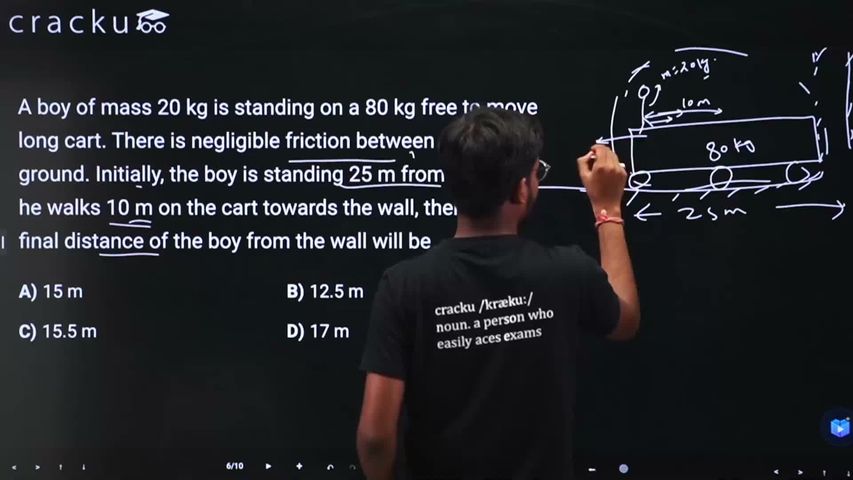
A boy of mass 20 kg is standing on a 80 kg free to move long cart. There is negligible friction between cart and ground. Initially, the boy is standing 25 m from a wall. If he walks 10 m on the cart towards the wall, then the final distance of the boy from the wall will be
We have a boy of mass 20 kg standing on a cart of mass 80 kg. The cart is free to move and there is negligible friction between the cart and the ground. Initially, the boy is 25 m from a wall. The boy walks 10 m towards the wall on the cart. We need to find the final distance of the boy from the wall.
Since there is no external force acting on the system (friction is negligible), the center of mass of the system (boy + cart) remains stationary. This is a key principle we will use.
Set up a coordinate system with the wall at position $$x = 0$$. Initially, the boy is at $$x_{\text{boy, initial}} = 25$$ m. Let the initial position of the center of mass of the cart be $$X$$. The center of mass of the entire system ($$x_{\text{cm}}$$) is given by:
$$ x_{\text{cm}} = \frac{m_{\text{boy}} \cdot x_{\text{boy, initial}} + m_{\text{cart}} \cdot X}{m_{\text{boy}} + m_{\text{cart}}} = \frac{20 \cdot 25 + 80 \cdot X}{100} = \frac{500 + 80X}{100} = 5 + 0.8X $$
Now, the boy walks 10 m towards the wall relative to the cart. Since the wall is to the left (negative x-direction), the boy moves $$-10$$ m relative to the cart. However, as the boy moves, the cart may also move. Let the displacement of the cart's center of mass be $$D$$ (positive if to the right). The displacement of the boy relative to the ground is then the displacement relative to the cart plus the displacement of the cart:
Displacement of boy relative to ground $$ = -10 + D $$
Thus, the final position of the boy is:
$$ x_{\text{boy, final}} = x_{\text{boy, initial}} + (-10 + D) = 25 - 10 + D = 15 + D $$
The final position of the cart's center of mass is:
$$ x_{\text{cart, final}} = X + D $$
The center of mass remains unchanged, so:
$$ x_{\text{cm}} = \frac{m_{\text{boy}} \cdot x_{\text{boy, final}} + m_{\text{cart}} \cdot x_{\text{cart, final}}}{m_{\text{boy}} + m_{\text{cart}}} = \frac{20 \cdot (15 + D) + 80 \cdot (X + D)}{100} $$
Set this equal to the initial center of mass:
$$ \frac{20(15 + D) + 80(X + D)}{100} = 5 + 0.8X $$
Multiply both sides by 100 to clear the denominator:
$$ 20(15 + D) + 80(X + D) = 100(5 + 0.8X) $$
Expand both sides:
Left side: $$20 \cdot 15 + 20 \cdot D + 80 \cdot X + 80 \cdot D = 300 + 20D + 80X + 80D = 300 + 100D + 80X$$
Right side: $$100 \cdot 5 + 100 \cdot 0.8X = 500 + 80X$$
So:
$$ 300 + 100D + 80X = 500 + 80X $$
Subtract $$80X$$ from both sides:
$$ 300 + 100D = 500 $$
Subtract 300 from both sides:
$$ 100D = 200 $$
Divide by 100:
$$ D = 2 $$
So the cart moves 2 m to the right. The final position of the boy is:
$$ x_{\text{boy, final}} = 15 + D = 15 + 2 = 17 \text{ m} $$
Therefore, the final distance of the boy from the wall is 17 m.
Hence, the correct answer is Option D.
Was this solution helpful?
Click on the Email ☝️ to Watch the Video Solution
Create a FREE account and get:
_1.webp)

Educational materials for JEE preparation

Ask our AI anything

AI can make mistakes. Please verify important information.
AI can make mistakes. Please verify important information.


