
Join Our JEE Preparation Group
Prep with like-minded aspirants; Get access to free daily tests and study material.
Sign in
Please select an account to continue using cracku.in
↓ →
Join Our JEE Preparation Group
Prep with like-minded aspirants; Get access to free daily tests and study material.
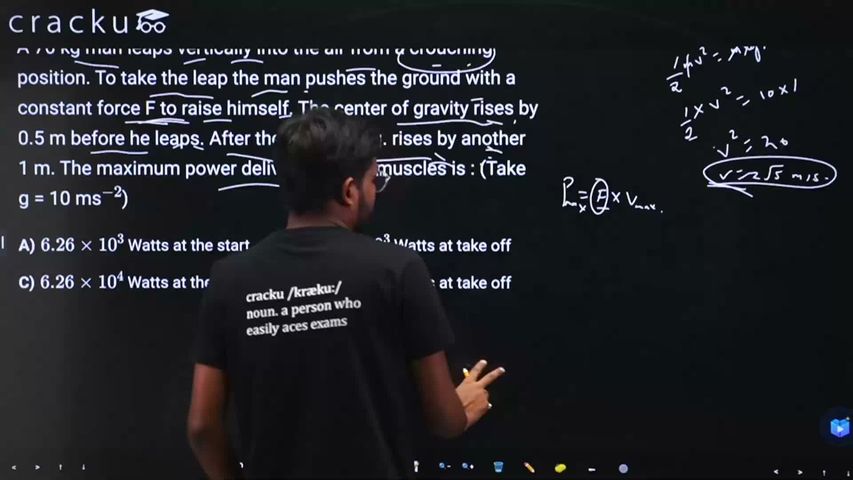
A 70 kg man leaps vertically into the air from a crouching position. To take the leap the man pushes the ground with a constant force F to raise himself. The center of gravity rises by 0.5 m before he leaps. After the leap the c.g. rises by another 1 m. The maximum power delivered by the muscles is : (Take g = 10 ms$$^{-2}$$)
The man crouches and pushes the ground with a constant force $$F$$, raising his centre of gravity by $$0.5 \text{ m}$$ before his feet leave the ground. After take-off the centre of gravity rises an additional $$1 \text{ m}$$.
After take-off no external force acts other than gravity, so the kinetic energy at take-off equals the gain in gravitational potential energy during the aerial phase: $$\frac{1}{2}mv^{2} = mg \times 1$$. With $$m = 70 \text{ kg}$$ and $$g = 10 \text{ m/s}^{2}$$, this gives $$\frac{1}{2}(70)v^{2} = 700$$, hence $$v^{2} = 20 \text{ m}^{2}\text{/s}^{2}$$ and $$v = 2\sqrt{5} \text{ m/s}$$.
During the push phase the net upward force $$F_{\text{net}} = F - mg$$ does work over $$0.5 \text{ m}$$, producing the take-off kinetic energy: $$F_{\text{net}} \times 0.5 = 700$$, so $$F_{\text{net}} = 1400 \text{ N}$$. Because the man starts from rest and accelerates uniformly, the velocity increases from zero to $$v = 2\sqrt{5} \text{ m/s}$$ over this distance, meaning the maximum velocity occurs at the instant of take-off.
The maximum power delivered by the muscles equals the net force times the velocity at take-off: $$P_{\max} = F_{\text{net}} \times v = 1400 \times 2\sqrt{5} = 2800\sqrt{5} \approx 6.26 \times 10^{3} \text{ Watts}$$.
This maximum power is delivered at the moment of take-off, corresponding to option (B).
Was this solution helpful?
Click on the Email ☝️ to Watch the Video Solution
Create a FREE account and get:
_1.webp)

Educational materials for JEE preparation

Ask our AI anything

AI can make mistakes. Please verify important information.
AI can make mistakes. Please verify important information.


