
Join Our JEE Preparation Group
Prep with like-minded aspirants; Get access to free daily tests and study material.
Sign in
Please select an account to continue using cracku.in
↓ →
Join Our JEE Preparation Group
Prep with like-minded aspirants; Get access to free daily tests and study material.
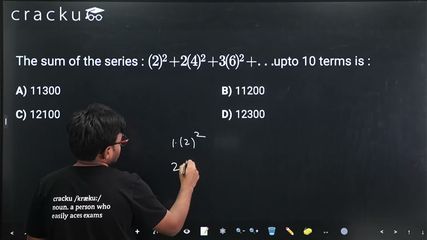
The given series is $$(2)^2 + 2(4)^2 + 3(6)^2 + \ldots$$ upto 10 terms. To find the sum, we first identify the general term of the series. Observing the pattern, the coefficients are natural numbers $$1, 2, 3, \ldots$$, and the bases are even numbers $$2, 4, 6, \ldots$$. The $$n$$th even number is $$2n$$. Therefore, the $$n$$th term of the series is given by $$T_n = n \times (2n)^2$$.
Simplifying the expression: $$T_n = n \times (2n)^2 = n \times 4n^2 = 4n^3$$. So, $$T_n = 4n^3$$.
The sum of the first 10 terms is $$S = \sum_{n=1}^{10} T_n = \sum_{n=1}^{10} 4n^3$$. We can factor out the constant 4: $$S = 4 \times \sum_{n=1}^{10} n^3$$.
The sum of cubes of the first $$k$$ natural numbers is given by $$\sum_{n=1}^{k} n^3 = \left[ \frac{k(k+1)}{2} \right]^2$$. Substituting $$k = 10$$: $$\sum_{n=1}^{10} n^3 = \left[ \frac{10 \times 11}{2} \right]^2 = \left[ \frac{110}{2} \right]^2 = [55]^2 = 3025$$.
Therefore, $$S = 4 \times 3025 = 12100$$.
Hence, the sum of the series upto 10 terms is 12100. Comparing with the options, 12100 corresponds to option C.
Hence, the correct answer is Option C.
Was this solution helpful?
Click on the Email ☝️ to Watch the Video Solution
Create a FREE account and get:
_1.webp)

Educational materials for JEE preparation

Ask our AI anything

AI can make mistakes. Please verify important information.
AI can make mistakes. Please verify important information.


