
Join Our JEE Preparation Group
Prep with like-minded aspirants; Get access to free daily tests and study material.
Sign in
Please select an account to continue using cracku.in
↓ →
Join Our JEE Preparation Group
Prep with like-minded aspirants; Get access to free daily tests and study material.
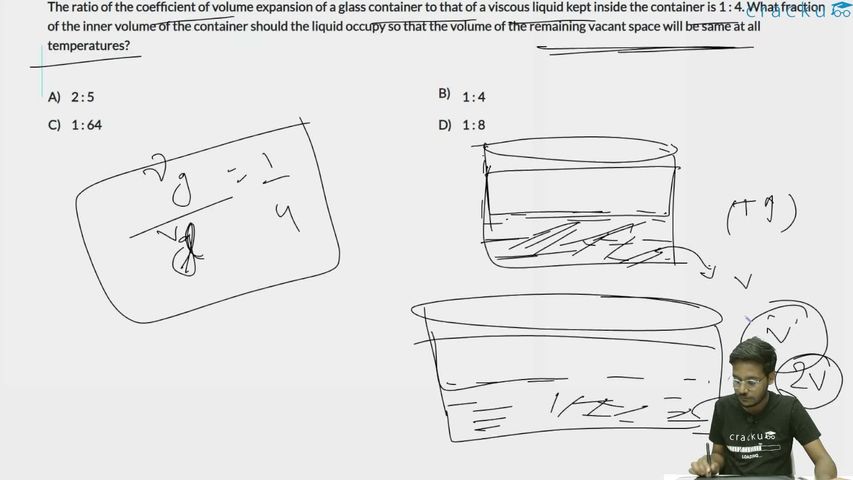
The ratio of the coefficient of volume expansion of a glass container to that of a viscous liquid kept inside the container is 1 : 4. What fraction of the inner volume of the container should the liquid occupy so that the volume of the remaining vacant space will be same at all temperatures?
The ratio of the coefficient of volume expansion of the glass container to that of the viscous liquid is given as 1 : 4. Let the coefficient of volume expansion of the glass container be $$\gamma_g$$ and that of the liquid be $$\gamma_l$$. Therefore, $$\gamma_g / \gamma_l = 1/4$$, which implies $$\gamma_l = 4\gamma_g$$.
Let the initial inner volume of the container at temperature $$T_0$$ be $$V_0$$. We need to find the fraction of $$V_0$$ that the liquid should occupy at $$T_0$$ so that the volume of the vacant space remains constant at all temperatures. Let this fraction be $$k$$, so the initial volume of the liquid is $$k V_0$$ and the initial vacant space is $$(1 - k) V_0$$.
When the temperature changes by $$\Delta T$$, the new volume of the container is $$V_0 (1 + \gamma_g \Delta T)$$. The new volume of the liquid is $$k V_0 (1 + \gamma_l \Delta T) = k V_0 (1 + 4\gamma_g \Delta T)$$, since $$\gamma_l = 4\gamma_g$$. The vacant space at the new temperature is the difference between the container volume and the liquid volume:
$$\text{Vacant space} = V_0 (1 + \gamma_g \Delta T) - k V_0 (1 + 4\gamma_g \Delta T)$$
This vacant space must remain constant and equal to the initial vacant space $$(1 - k) V_0$$ at all temperatures. Therefore, we set up the equation:
$$V_0 (1 + \gamma_g \Delta T) - k V_0 (1 + 4\gamma_g \Delta T) = (1 - k) V_0$$
Dividing both sides by $$V_0$$ (assuming $$V_0 \neq 0$$):
$$1 + \gamma_g \Delta T - k (1 + 4\gamma_g \Delta T) = 1 - k$$
Expanding the left side:
$$1 + \gamma_g \Delta T - k - 4k\gamma_g \Delta T = 1 - k$$
Subtracting 1 from both sides:
$$\gamma_g \Delta T - k - 4k\gamma_g \Delta T = -k$$
Adding $$k$$ to both sides:
$$\gamma_g \Delta T - 4k\gamma_g \Delta T = 0$$
Factoring out $$\gamma_g \Delta T$$:
$$\gamma_g \Delta T (1 - 4k) = 0$$
Since $$\gamma_g \neq 0$$ and $$\Delta T$$ can be arbitrary (not always zero), the term $$(1 - 4k)$$ must be zero:
$$1 - 4k = 0$$
Solving for $$k$$:
$$4k = 1$$
$$k = \frac{1}{4}$$
Thus, the liquid should occupy $$\frac{1}{4}$$ of the inner volume of the container at the initial temperature. This fraction corresponds to the ratio 1 : 4.
Verifying the solution: with $$k = \frac{1}{4}$$, the initial liquid volume is $$\frac{V_0}{4}$$ and the initial vacant space is $$\frac{3V_0}{4}$$. At a new temperature, the container volume is $$V_0 (1 + \gamma_g \Delta T)$$, and the liquid volume is $$\frac{V_0}{4} (1 + 4\gamma_g \Delta T)$$. The vacant space is:
$$V_0 (1 + \gamma_g \Delta T) - \frac{V_0}{4} (1 + 4\gamma_g \Delta T) = V_0 + V_0\gamma_g \Delta T - \frac{V_0}{4} - V_0\gamma_g \Delta T = V_0 - \frac{V_0}{4} = \frac{3V_0}{4}$$
This is constant and equal to the initial vacant space, confirming the solution.
Hence, the correct answer is Option B.
Was this solution helpful?
Click on the Email ☝️ to Watch the Video Solution
Create a FREE account and get:
_1.webp)

Educational materials for JEE preparation

Ask our AI anything

AI can make mistakes. Please verify important information.
AI can make mistakes. Please verify important information.


