
Join Our JEE Preparation Group
Prep with like-minded aspirants; Get access to free daily tests and study material.
Sign in
Please select an account to continue using cracku.in
↓ →
Join Our JEE Preparation Group
Prep with like-minded aspirants; Get access to free daily tests and study material.
A thin tube sealed at both ends is 100 cm long. It lies horizontally, the middle 20 cm containing mercury and two equal ends containing air at standard atmospheric pressure. If the tube is now turned to a vertical position, by what amount will the mercury be displaced?
(Given : cross-section of the tube can be assumed to be uniform)
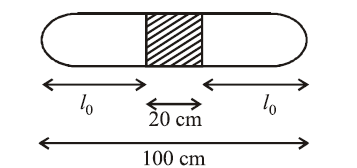
When the tube is turned vertical, let the mercury be displaced by a distance $$x$$. The new lengths of the air columns will be $$(40 - x)$$ for the lower section and $$(40 + x)$$ for the upper section.
Applying Boyle's Law ($$P_1V_1 = P_2V_2$$) for both air columns:
Upper air column: $$P_1(40 + x) = P_0(40) \implies P_1 = \frac{76 \times 40}{40 + x}$$
Lower air column: $$P_2(40 - x) = P_0(40) \implies P_2 = \frac{76 \times 40}{40 - x}$$
$$P_2 = P_1 + 20$$
$$\frac{76 \times 40}{40 - x} = \frac{76 \times 40}{40 + x} + 20$$
$$\frac{152}{40 - x} = \frac{152}{40 + x} + 1$$
$$152 \left[ \frac{1}{40 - x} - \frac{1}{40 + x} \right] = 1$$
$$152 \left[ \frac{(40 + x) - (40 - x)}{1600 - x^2} \right] = 1$$
$$152 \left( \frac{2x}{1600 - x^2} \right) = 1 \implies 304x = 1600 - x^2$$
$$x^2 + 304x - 1600 = 0$$
$$x \approx \frac{-304 + 314.35}{2} = \frac{10.35}{2} \approx 5.18\text{ cm}$$
Was this solution helpful?
Create a FREE account and get:
_1.webp)

Educational materials for JEE preparation

Ask our AI anything

AI can make mistakes. Please verify important information.
AI can make mistakes. Please verify important information.


