
Join Our JEE Preparation Group
Prep with like-minded aspirants; Get access to free daily tests and study material.
Sign in
Please select an account to continue using cracku.in
↓ →
Join Our JEE Preparation Group
Prep with like-minded aspirants; Get access to free daily tests and study material.
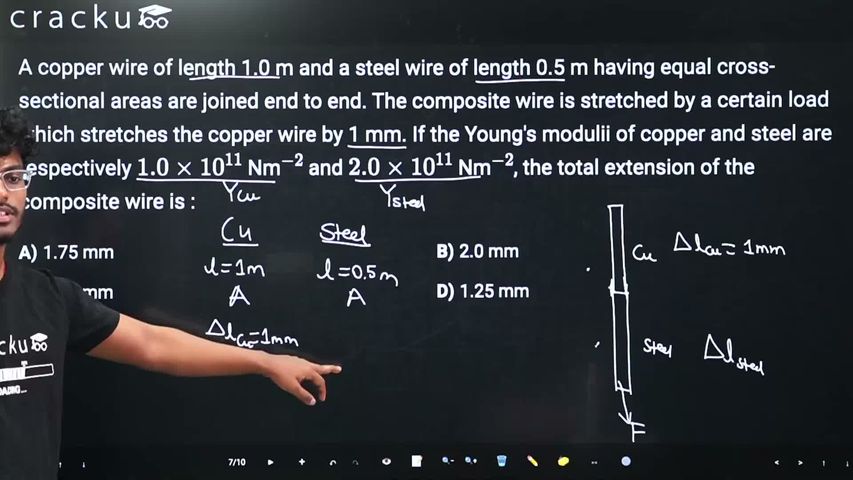
A copper wire of length 1.0 m and a steel wire of length 0.5 m having equal cross-sectional areas are joined end to end. The composite wire is stretched by a certain load which stretches the copper wire by 1 mm. If the Young's modulii of copper and steel are respectively $$1.0 \times 10^{11}$$ Nm$$^{-2}$$ and $$2.0 \times 10^{11}$$ Nm$$^{-2}$$, the total extension of the composite wire is :
We have a composite wire made of copper and steel joined end to end. The copper wire is 1.0 m long and the steel wire is 0.5 m long, both with the same cross-sectional area. The composite wire is stretched by a load that causes the copper wire to extend by 1 mm. We need to find the total extension of the composite wire.
Given:
Since the wires are joined end to end, the same force $$ F $$ acts on both wires. The cross-sectional area $$ A $$ is the same for both.
Using Hooke's law for the copper wire:
$$ Y_c = \frac{F \cdot L_c}{A \cdot \Delta L_c} $$
Solving for the force $$ F $$:
$$ F = \frac{Y_c \cdot A \cdot \Delta L_c}{L_c} $$
Substituting the values:
$$ F = \frac{(1.0 \times 10^{11}) \cdot A \cdot (0.001)}{1.0} $$
$$ F = (1.0 \times 10^{11}) \cdot A \cdot 0.001 $$
$$ F = 1.0 \times 10^{11} \times 10^{-3} \cdot A $$
$$ F = 1.0 \times 10^{8} A \text{ Newtons} $$
Now, for the steel wire, the same force $$ F $$ is applied. Using Hooke's law:
$$ Y_s = \frac{F \cdot L_s}{A \cdot \Delta L_s} $$
Solving for the extension of steel $$ \Delta L_s $$:
$$ \Delta L_s = \frac{F \cdot L_s}{A \cdot Y_s} $$
Substituting the values:
$$ \Delta L_s = \frac{(1.0 \times 10^{8} A) \cdot (0.5)}{A \cdot (2.0 \times 10^{11})} $$
The $$ A $$ cancels out:
$$ \Delta L_s = \frac{1.0 \times 10^{8} \cdot 0.5}{2.0 \times 10^{11}} $$
$$ \Delta L_s = \frac{5.0 \times 10^{7}}{2.0 \times 10^{11}} $$
$$ \Delta L_s = \frac{5.0}{2.0} \times 10^{7-11} $$
$$ \Delta L_s = 2.5 \times 10^{-4} \text{m} $$
Converting to millimeters (since 1 m = 1000 mm):
$$ \Delta L_s = 2.5 \times 10^{-4} \times 1000 = 0.25 \text{mm} $$
The total extension of the composite wire is the sum of the extensions of the copper and steel parts:
$$ \Delta L_{\text{total}} = \Delta L_c + \Delta L_s = 1 \text{mm} + 0.25 \text{mm} = 1.25 \text{mm} $$
Hence, the correct answer is Option D.
Was this solution helpful?
Click on the Email ☝️ to Watch the Video Solution
Create a FREE account and get:
_1.webp)

Educational materials for JEE preparation

Ask our AI anything

AI can make mistakes. Please verify important information.
AI can make mistakes. Please verify important information.


