

 Group
Group
 Group
Group


 Preferred Source

 Google Discover

JEE Elasticity PYQs
JEE Elasticity PYQs are a useful part of JEE Physics preparation because they show you how questions from the mechanical properties of solids are asked in the exam. By solving previous-year questions, you can improve your understanding of stress, strain, Young’s modulus, bulk modulus, shear modulus, Poisson’s ratio, elastic energy, and the deformation of solids.
Elasticity is a relatively short chapter, but students often find the formulas confusing because many of them look similar. The easiest way to approach this chapter is to first understand what is happening to the material. Is its length changing? Is its volume changing? Or is only its shape being affected? Once you identify the type of deformation, choosing the correct formula becomes much easier.
Most questions from this chapter are direct numerical problems, short conceptual questions, or graph-based questions. Some problems may also connect Elasticity with gravitation, thermal expansion, fluid mechanics, or energy conservation.
In this blog, you will find important previous-year questions, a quick formula table, preparation tips, common mistakes, and practice guidance. You will also learn how to use mock tests and daily study targets more effectively.
JEE Elasticity Questions PDF
The JEE Elasticity Questions PDF can include important previous-year questions and exam-level practice problems from this chapter. These questions may cover longitudinal stress, volume stress, shearing stress, different types of strain, elastic moduli, Poisson’s ratio, extension of a wire, and elastic potential energy.
Practising these questions will help you understand which concepts are asked frequently in the exam. It will also improve your ability to recognise whether a question requires Young’s modulus, bulk modulus, or shear modulus.
Before applying a formula, take a moment to understand the type of deformation described in the question.
For example, check whether the object is:
- Increasing or decreasing in length
- Changing in volume
- Changing in shape
- Stretching under its own weight
- Storing elastic potential energy
Once the physical situation is clear, the rest of the solution usually becomes more straightforward.
Important JEE Mains Formula for Elasticity
A compact revision sheet can be very helpful during the final stage of preparation. Most important JEE Mains Formula relations from Elasticity are based on stress, strain, elastic moduli, and the energy stored in a deformed body.
These formulas are commonly used in questions involving wires, rods, solids, pressure, deformation, and elastic energy.
| Concept | Formula |
|---|---|
| Longitudinal Stress | $$\text{Stress} = \frac{F}{A}$$ |
| Longitudinal Strain | $$\text{Strain} = \frac{\Delta L}{L}$$ |
| Young’s Modulus | $$Y = \frac{F/A}{\Delta L/L}$$ |
| Extension of a Wire | $$\Delta L = \frac{FL}{AY}$$ |
| Volume Stress | $$\text{Volume Stress} = \Delta P$$ |
| Volume Strain | $$\text{Volume Strain} = \frac{\Delta V}{V}$$ |
| Bulk Modulus | $$K = -\frac{\Delta P}{\Delta V/V}$$ |
| Shearing Stress | $$\text{Shearing Stress} = \frac{F}{A}$$ |
| Shearing Strain | $$\text{Shearing Strain} = \frac{x}{L}$$ |
| Shear Modulus | $$\eta = \frac{F/A}{x/L}$$ |
| Poisson’s Ratio | $$\sigma = -\frac{\text{Lateral Strain}}{\text{Longitudinal Strain}}$$ |
| Elastic Potential Energy | $$U = \frac{1}{2}F\Delta L$$ |
| Energy per Unit Volume | $$u = \frac{1}{2}\times\text{Stress}\times\text{Strain}$$ |
| Force Constant of a Wire | $$k = \frac{YA}{L}$$ |
| Relation Between (Y), (K), and (\eta) | $$Y = \frac{9K\eta}{3K+\eta}$$ |
Do not memorise them without understanding what each term represents. For example, in the formula for the extension of a wire, extension increases when the force or original length increases. It decreases when the cross-sectional area or Young’s modulus increases.
This type of physical understanding can help you check whether your final answer makes sense.
How to Practise JEE Mains PYQ Problems
Solving JEE Mains PYQ problems is one of the best ways to understand the actual level of questions asked from Elasticity. Previous-year questions also show you how the same formula can be tested in different ways.
Begin with direct questions based on stress, strain, and Young’s modulus. Once you are comfortable with those, move to problems involving multiple wires, elastic energy, dimensional changes, and comparisons between materials.
A simple approach can make your practice more effective:
- Identify the type of deformation.
- Write down all the given quantities.
- Convert the values into SI units.
- Choose the correct elastic modulus.
- Check whether the final answer is physically reasonable.
Do not focus only on how many questions you solve. A smaller number of properly reviewed questions is more useful than a large number of questions solved without understanding your mistakes.
Set a JEE Daily Target for Elasticity
A practical JEE Daily Target can help you finish this chapter without feeling overloaded. Since Elasticity is not very lengthy, you can divide it into small study sessions.
On the first day, revise stress, strain, Hooke’s law, and the different elastic moduli. On the second day, practise numerical questions based on the extension of wires and rods. On the third day, focus on elastic energy, Poisson’s ratio, and mixed-concept problems.
A simple daily study plan may include:
- 20 minutes of concept revision
- 15 minutes of formula revision
- 8 to 10 basic numerical questions
- 5 previous-year questions
- 10 minutes of mistake analysis
Your daily target should not be limited to completing a fixed number of questions. Also note why you got a question wrong. This habit will help you avoid repeating the same mistake in the actual exam.
Top 5 Common Mistakes to Avoid in Elasticity PYQs
Students often lose marks in Elasticity because of small calculation errors, incorrect units, or confusion between the different moduli. Here are some common mistakes you should avoid.
Confusing Stress With Force
Stress and force are not the same.
Stress is the force acting per unit cross-sectional area. Two wires may experience the same force but have different stresses if their cross-sectional areas are different.
Using Diameter Instead of Radius
When the diameter of a wire is given, students sometimes use it directly in the area formula.
Remember:
A = πr²
Always divide the diameter by two before calculating the radius.
Choosing the Wrong Elastic Modulus
Young’s modulus is used when the length changes, bulk modulus is used when the volume changes, and shear modulus is used when the shape changes.
Before applying any formula, identify the type of deformation taking place.
Ignoring Unit Conversion
Length may be given in metres, centimetres, or millimetres. Area may be given in square millimetres, while force is usually given in newtons.
Convert all quantities into SI units before substitution. Even a small unit error can completely change the final answer.
Misunderstanding the Negative Sign
The negative sign in the bulk modulus formula shows that an increase in pressure generally causes a decrease in volume.
In most numerical questions, you may use the magnitude, but it is still important to understand the physical meaning of the sign.
Practise With a JEE Main Free Mock Test
After revising the theory and solving previous-year questions, attempt a JEE Main Free Mock Test under timed conditions. This will help you check whether you can identify the correct concept quickly and complete the calculation without spending too much time on one question.
During the test, pay close attention to the units and dimensions given in the problem. Elasticity questions often look simple, but a single missed conversion can lead to the wrong answer.
After completing the test, review each mistake carefully. Check whether the error happened because of:
- Choosing the wrong modulus
- Using the wrong cross-sectional area
- Missing a unit conversion
- Applying the wrong energy formula
- Misreading the type of deformation
- Making a calculation mistake
This review is more valuable than simply checking your score because it tells you exactly what you need to improve.
List of JEE Elasticity Practice Questions
A good practice set should include direct numerical questions, conceptual questions, and problems that combine Elasticity with other Physics chapters.
Start with simple formula-based questions and gradually move to problems involving two or more concepts.
Try to solve every question on your own before checking the answer. If you get stuck, return to the basic definition of the quantity being asked. In many Elasticity problems, understanding the physical situation is more useful than trying to remember a shortcut.
With regular revision, careful unit conversion, and consistent practice, Elasticity can become a simple and scoring chapter in JEE Physics.
Question 1
A wire fixed at the upper end stretches by length $$\ell$$ by applying a force $$F$$. The work done in stretching is
correct answer:- 4
Question 2
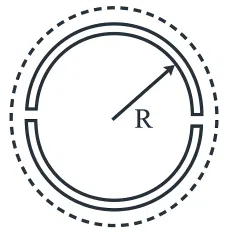
A wooden wheel of radius $$R$$ is made of two semicircular parts (see figure). The two parts are held together by a ring made of a metal strip of cross sectional area $$S$$ and length $$L$$. $$L$$ is slightly less than $$2\pi R$$. To fit the ring on the wheel, it is heated so that its temperature rises by $$\Delta T$$ and it just steps over the wheel. As it cools down to surrounding temperature, it presses the semicircular parts together. If the coefficient of linear expansion of the metal is $$\alpha$$, and its Young's modulus is $$Y$$, the force that one part of the wheel applies on the other part is :
correct answer:- 4
Question 3
A 3 m long wire of radius 3 mm shows an extension of 0.1 mm when loaded vertically by a mass of 50 kg in an experiment to determine Young's modulus. The value of Young's modulus of the wire is $$P \times 10^{11}$$ Nm$$^{-2}$$, where P is : (Take $$g = 3\pi$$ m/s$$^2$$)
correct answer:- 1
Question 4
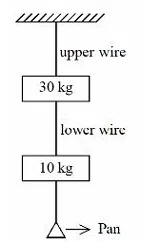
Two wires as shown in the figure below, made of steel and have breaking stress of $$12 \times 10^8$$ N/m$$^2$$. Area of cross-section of upper wire is 0.008 cm$$^2$$ and of lower wire is 0.004 cm$$^2$$. The maximum mass that can be added to pan without breaking any wire is _______ kg. (take $$g = 10$$ m/s$$^2$$)
correct answer:- 2
Question 5
A uniform wire of length $$l$$ of weight w is suspended from the roof with a weight of W at the other end. The stress in the wire at $$\frac{l}{3}$$ distance from the top is $$\left(\frac{W}{A} + \frac{2}{\gamma} \cdot \frac{w}{A}\right)$$, where A is the cross sectional area of the wire. The value of $$\gamma$$ is __________.
correct answer:- 3

Question 6
A wire elongates by $$\ell\,mm$$ when a load $$W$$ is hanged from it. If the wire goes over a pulley and two weights $$W$$ each are hung at the two ends, the elongation of the wire will be (in $$mm$$)
correct answer:- 2
Question 7
The bulk moduli of ethanol, mercury and water are given as 0.9, 25 and 2.2 respectively in units of $$10^9$$ Nm$$^{-2}$$. For a given value of pressure, the fractional compression in volume is $$\frac{\Delta V}{V}$$. Which of the following statements about $$\frac{\Delta V}{V}$$ for these three liquids is correct?
correct answer:- 1
Question 8
When the temperature of a metal wire is increased from 0$$°$$C to 10$$°$$C, its length increases by 0.02%. The percentage change in its mass density will be closed to:
correct answer:- 1
Question 9
A uniform wire (Young's modulus $$2 \times 10^{11}$$ Nm$$^{-2}$$) is subjected to longitudinal tensile stress of $$5 \times 10^7$$ Nm$$^{-2}$$. If the overall volume change in the wire is 0.02%, the fractional decrease in the radius of the wire is close to:
correct answer:- 3
Question 10
If the length of a wire is made double and radius is halved of its respective values. Then, the Young's modulus of the material of the wire will:
correct answer:- 1

Question 11
A string of area of cross-section 4 mm$$^2$$ and length 0.5 is connected with a rigid body of mass 2 kg. The body is rotated in a vertical circular path of radius 0.5 m. The body acquires a speed of 5 m s$$^{-1}$$ at the bottom of the circular path. Strain produced in the string when the body is at the bottom of the circle is _____ $$\times 10^{-5}$$. (Use Young's modulus $$10^{11}$$ N m$$^{-2}$$ and $$g = 10 \ m s^{-2}$$)
correct answer:- 30
Question 12
Two wires A and B are made of same material having ratio of lengths $$\frac{L_A}{L_B} = \frac{1}{3}$$ and their diameters ratio $$\frac{d_A}{d_B} = 2$$. If both the wires are stretched using same force, what would be the ratio of their respective elongations?
correct answer:- 2
Question 13
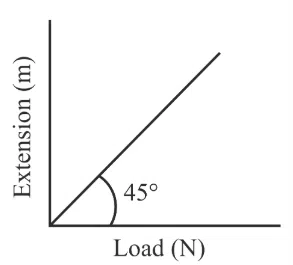
As shown in the figure, in an experiment to determine Young's modulus of a wire, the extension-load curve is plotted. The curve is a straight line passing through the origin and makes an angle of 45° with the load axis. The length of the wire is 62.8 cm and its diameter is 4 mm. The Young's modulus is found to be $$x \times 10^4$$ N m$$^{-2}$$. The value of $$x$$ is _____.
correct answer:- 5
Question 14
In an experiment with photoelectric effect, the stopping potential,
correct answer:- 4
Question 15
The increase in the pressure required to decrease the volume $$(\Delta V)$$ of water is $$6.3 \times 10^7$$ N/m². The percentage decrease in the volume is _____. (Bulk modulus of water = $$2.1 \times 10^9$$ N/m².)
correct answer:- 2

Question 16
The bulk modulus of a liquid is $$3 \times 10^{10}$$ Nm$$^{-2}$$. The pressure required to reduce the volume of liquid by $$2\%$$ is :
correct answer:- 2
Question 17
The Young's modulus of a steel wire of length $$6$$ m and cross-sectional area $$3$$ mm$$^2$$, is $$2 \times 10^{11}$$ N/m$$^2$$. The wire is suspended from its support on a given planet. A block of mass $$4$$ kg is attached to the free end of the wire. The acceleration due to gravity on the planet is $$\frac{1}{4}$$ of its value on the earth. The elongation of wire is (Take $$g$$ on the earth $$= 10$$ m/s$$^2$$):
correct answer:- 3
Question 18
a
correct answer:- 1
Question 19
Under the same load, wire A having length 5.0 m and cross section $$2.5 \times 10^{-5}$$ m$$^2$$ stretches uniformly by the same amount as another wire B of length 6.0 m and a cross section of $$3.0 \times 10^{-5}$$ m$$^2$$ stretches. The ratio of the Young's modulus of wire A to that of wire B will be:
correct answer:- 2
Question 20
A wire of length $$L$$ and radius $$r$$ is clamped rigidly at one end. When the other end of the wire is pulled by a force $$f$$, its length increases by $$l$$. Another wire of same material of length $$2L$$ and radius $$2r$$ is pulled by a force $$2f$$. Then the increase in its length will be:
correct answer:- 4

Question 21
The length of a wire becomes $$l_1$$ and $$l_2$$ when 100 N and 120 N tension are applied respectively. If $$10l_2 = 11l_1$$, then the natural length of wire will be $$\frac{1}{x}l_1$$. Here the value of $$x$$ is _______
correct answer:- 2
Question 22
A metal string A is suspended from a rigid support and its free end is attached to a block of mass M. Second block having mass 2M is suspended at the bottom of the first block using a string B. The area of cross sections of strings A and B are same. The ratio of lengths of strings of A to B is 2 and the ratio of their Young's moduli $$(Y_A/Y_B)$$ is 0.5. The ratio of elongations in A to B is ______.
correct answer:- 4
Question 23
The Young's modulus of steel wire of radius $$r$$ and length $$L$$ is $$Y$$. If the radius $$r$$ and length $$L$$ of the wire are doubled then the value of $$Y$$
correct answer:- 3
Question 24
A lift of mass 1600 kg is supported by thick iron wire. If the maximum stress which the wire can withstand is $$4 \times 10^8$$ N/m$$^2$$ and its radius is 4 mm, then maximum acceleration the lift can take is _______ m/s$$^2$$.
(take g = 10 m/s$$^2$$ and $$\pi$$ = 3.14)
correct answer:- 1
Question 25
A certain gas is isothermally compressed to $$\left(\frac{1}{3}\right)^{rd}$$ of its initial volume ($$V_0 = 3$$ litre) by applying required pressure. If the bulk modulus of the gas is $$3 \times 10^5$$ N/m$$^2$$, the magnitude of work done on the gas is _______ J.
correct answer:- 989

Question 26
A solid sphere of radius r made of a soft material of bulk modulus K is surrounded by a liquid in a cylindrical container. A massless piston of area a floats on the surface of the liquid, covering entire cross-section of cylindrical container. When a mass m is placed on the surface of the piston to compress the liquid, the fractional decrement in the radius of the sphere $$\left(\frac{dr}{r}\right)$$, is:
correct answer:- 4
Question 27
A square aluminium (shear modulus is $$25 \times 10^9 \text{ N m}^{-2}$$) slab of side $$60 \text{ cm}$$ and thickness $$15 \text{ cm}$$ is subjected to a shearing force (on its narrow face) of $$18.0 \times 10^4 \text{ N}$$. The lower edge is riveted to the floor. The displacement of the upper edge is ______ $$\mu m$$.
correct answer:- 48
Question 28
A cube has side length 5 cm and modulus of rigidity $$10^5$$ N/m$$^2$$. The displacement produced by a force of 10 N in the upper face of cube is _______ mm.
correct answer:- 2
Question 29
A steel rod of length 1 m and cross-sectional area $$10^{-4}$$ m$$^2$$ is heated from 0$$^\circ$$C to 200$$^\circ$$C without being allowed to extend or bend. The compressive tension produced in the rod is _______ $$\times 10^4$$ N. (Given Young's modulus of steel $$= 2 \times 10^{11}$$ N m$$^{-2}$$, coefficient of linear expansion $$= 10^{-5}$$ K$$^{-1}$$)
correct answer:- 4
Question 30
Two wires are made of the same material and have the same volume. However wire 1 has crosssectional area $$A$$ and wire-2 has cross-sectional area $$3A$$. If the length of wire 1 increases by $$\Delta x$$ on applying force $$F$$, how much force is needed to stretch wire 2 by the same amount?
correct answer:- 4
.webp)