
Join Our JEE Preparation Group
Prep with like-minded aspirants; Get access to free daily tests and study material.
Sign in
Please select an account to continue using cracku.in
↓ →
Join Our JEE Preparation Group
Prep with like-minded aspirants; Get access to free daily tests and study material.
A square aluminium (shear modulus is $$25 \times 10^9 \text{ N m}^{-2}$$) slab of side $$60 \text{ cm}$$ and thickness $$15 \text{ cm}$$ is subjected to a shearing force (on its narrow face) of $$18.0 \times 10^4 \text{ N}$$. The lower edge is riveted to the floor. The displacement of the upper edge is ______ $$\mu m$$.
Correct Answer: 48
We are given a square aluminium slab with shear modulus $$G = 25 \times 10^9 \text{ N m}^{-2}$$, side $$60 \text{ cm} = 0.6 \text{ m}$$, thickness $$15 \text{ cm} = 0.15 \text{ m}$$, and shearing force $$F = 18.0 \times 10^4 \text{ N}$$. We need to find the displacement of the upper edge.
The shearing force is applied on the narrow face (the side face). The narrow face has dimensions: length $$= 0.6 \text{ m}$$ and thickness $$= 0.15 \text{ m}$$.
$$A = 0.6 \times 0.15 = 0.09 \text{ m}^2$$
$$\text{Shearing stress} = \frac{F}{A} = \frac{18.0 \times 10^4}{0.09} = 2 \times 10^6 \text{ N m}^{-2}$$
The shear modulus is defined as:
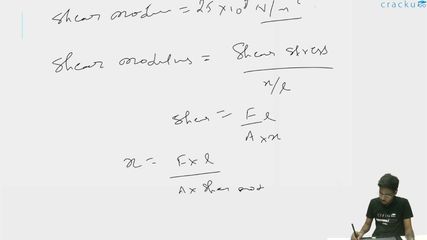
$$G = \frac{\text{Shearing stress}}{\text{Shearing strain}} = \frac{F/A}{\Delta x / L}$$
where $$L$$ is the height over which shearing occurs (the side length $$= 0.6 \text{ m}$$) and $$\Delta x$$ is the displacement of the upper edge.
$$\Delta x = \frac{F \times L}{A \times G}$$
$$\Delta x = \frac{2 \times 10^6 \times 0.6}{25 \times 10^9}$$
$$\Delta x = \frac{1.2 \times 10^6}{25 \times 10^9} = 4.8 \times 10^{-5} \text{ m}$$
$$\Delta x = 48 \text{ } \mu\text{m}$$
The displacement of the upper edge is $$48 \text{ } \mu\text{m}$$.
Was this solution helpful?
Click on the Email ☝️ to Watch the Video Solution
Create a FREE account and get:
_1.webp)

Educational materials for JEE preparation

Ask our AI anything

AI can make mistakes. Please verify important information.
AI can make mistakes. Please verify important information.
