
Join Our JEE Preparation Group
Prep with like-minded aspirants; Get access to free daily tests and study material.
Sign in
Please select an account to continue using cracku.in
↓ →
Join Our JEE Preparation Group
Prep with like-minded aspirants; Get access to free daily tests and study material.
A pulley of radius $$1.5 \text{ m}$$ is rotated about its axis by a force $$F = (12t - 3t^2) \text{ N}$$ applied tangentially (while $$t$$ is measured in seconds). If moment of inertia of the pulley about its axis of rotation is $$4.5 \text{ kg m}^2$$, the number of rotations made by the pulley before its direction of motion is reversed, will be $$\dfrac{K}{\pi}$$. The value of $$K$$ is ______.
Correct Answer: 18
We are given a pulley of radius $$r = 1.5 \text{ m}$$, a tangential force $$F = (12t - 3t^2) \text{ N}$$, and moment of inertia $$I = 4.5 \text{ kg m}^2$$. We need to find $$K$$ where the number of rotations before the direction reverses is $$\dfrac{K}{\pi}$$.
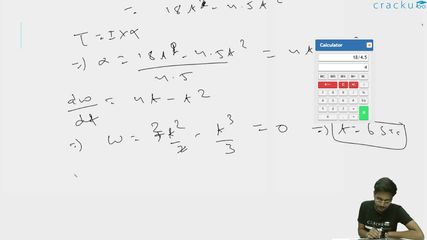
$$\tau = F \times r = (12t - 3t^2) \times 1.5 = 18t - 4.5t^2$$
$$\alpha = \frac{\tau}{I} = \frac{18t - 4.5t^2}{4.5} = 4t - t^2$$
Since the pulley starts from rest ($$\omega = 0$$ at $$t = 0$$):
$$\omega = \int_0^t \alpha \, dt = \int_0^t (4t - t^2) \, dt = 2t^2 - \frac{t^3}{3}$$
The direction reverses when $$\omega = 0$$ (after the pulley has started rotating):
$$2t^2 - \frac{t^3}{3} = 0$$
$$t^2\left(2 - \frac{t}{3}\right) = 0$$
$$t = 0$$ or $$t = 6 \text{ s}$$
So the direction reverses at $$t = 6 \text{ s}$$.
$$\theta = \int_0^6 \omega \, dt = \int_0^6 \left(2t^2 - \frac{t^3}{3}\right) dt$$
$$\theta = \left[\frac{2t^3}{3} - \frac{t^4}{12}\right]_0^6$$
$$\theta = \frac{2(216)}{3} - \frac{1296}{12} = 144 - 108 = 36 \text{ rad}$$
$$\text{Number of rotations} = \frac{\theta}{2\pi} = \frac{36}{2\pi} = \frac{18}{\pi}$$
Comparing with $$\dfrac{K}{\pi}$$, we get $$K = 18$$.
Was this solution helpful?
Click on the Email ☝️ to Watch the Video Solution
Create a FREE account and get:
_1.webp)

Educational materials for JEE preparation

Ask our AI anything

AI can make mistakes. Please verify important information.
AI can make mistakes. Please verify important information.
