
Join Our JEE Preparation Group
Prep with like-minded aspirants; Get access to free daily tests and study material.
Sign in
Please select an account to continue using cracku.in
↓ →
Join Our JEE Preparation Group
Prep with like-minded aspirants; Get access to free daily tests and study material.
A ball of mass $$m$$ is thrown vertically upward. Another ball of mass $$2 \text{ m}$$ is thrown at an angle $$\theta$$ with the vertical. Both the balls stay in air for the same period of time. The ratio of the heights attained by the two balls respectively is $$\dfrac{1}{x}$$. The value of $$x$$ is ______.
Correct Answer: 1
We are given that a ball of mass $$0.9 \text{ kg}$$ is thrown vertically upward, and another ball of mass $$2 \text{ m}$$ is thrown at an angle $$\theta$$ with the vertical. Both stay in the air for the same time. We need to find $$x$$ where the ratio of heights is $$\dfrac{1}{x}$$.
Let the initial velocity of the first ball be $$u_1$$. Time of flight:
$$T_1 = \frac{2u_1}{g}$$
Maximum height attained:
$$H_1 = \frac{u_1^2}{2g}$$
Let the initial velocity of the second ball be $$u_2$$. Since the angle is $$\theta$$ with the vertical, the vertical component of velocity is $$u_2 \cos\theta$$.
Time of flight:
$$T_2 = \frac{2u_2 \cos\theta}{g}$$
Maximum height attained:
$$H_2 = \frac{u_2^2 \cos^2\theta}{2g}$$
$$\frac{2u_1}{g} = \frac{2u_2 \cos\theta}{g}$$
$$u_1 = u_2 \cos\theta$$
$$\frac{H_1}{H_2} = \frac{u_1^2 / (2g)}{u_2^2 \cos^2\theta / (2g)} = \frac{u_1^2}{u_2^2 \cos^2\theta}$$
Since $$u_1 = u_2 \cos\theta$$:
$$\frac{H_1}{H_2} = \frac{u_2^2 \cos^2\theta}{u_2^2 \cos^2\theta} = 1$$
So $$\dfrac{H_1}{H_2} = \dfrac{1}{1}$$, which means $$\dfrac{1}{x} = \dfrac{1}{1}$$.
Therefore, $$x = 1$$.
Was this solution helpful?
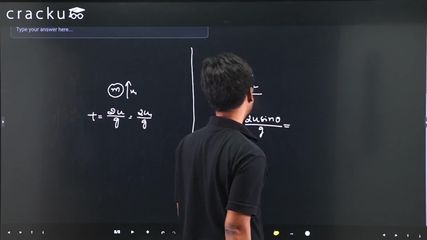
Click on the Email ☝️ to Watch the Video Solution
Create a FREE account and get:
_1.webp)

Educational materials for JEE preparation

Ask our AI anything

AI can make mistakes. Please verify important information.
AI can make mistakes. Please verify important information.
