The increase in the pressure required to decrease the volume $$(\Delta V)$$ of water is $$6.3 \times 10^7$$ N/m². The percentage decrease in the volume is _____. (Bulk modulus of water = $$2.1 \times 10^9$$ N/m².)
JEE Elasticity Questions
The bulk modulus (incompressibility) of a fluid is defined as
$$K = -\frac{\Delta P}{\Delta V/V}$$ $$-(1)$$
where
$$\Delta P$$ = rise in pressure,
$$\Delta V$$ = change in volume (negative for compression),
$$\Delta V/V$$ = fractional change in volume.
We are interested only in the magnitude of the fractional change, so from $$-(1)$$
$$\left|\frac{\Delta V}{V}\right| = \frac{\Delta P}{K}$$ $$-(2)$$
Given data:
$$\Delta P = 6.3 \times 10^{7}\,\text{N/m}^2$$
$$K = 2.1 \times 10^{9}\,\text{N/m}^2$$
Substituting in $$-(2)$$:
$$\left|\frac{\Delta V}{V}\right| = \frac{6.3 \times 10^{7}}{2.1 \times 10^{9}}$$
Divide the numbers and powers of 10 separately:
$$\frac{6.3}{2.1} = 3 \quad\text{and}\quad 10^{7}/10^{9} = 10^{-2} = 0.01$$
Hence
$$\left|\frac{\Delta V}{V}\right| = 3 \times 0.01 = 0.03$$
The fractional decrease in volume is $$0.03$$, i.e. a $$3\%$$ decrease.
Therefore, the percentage decrease in the volume of water is $$3\%$$.
Option B which is: $$3\%$$
Two wires A and B made of different materials of lengths 6.0 cm and 5.4 cm, respectively and area of cross sections $$3.0\times 10^{-5}m^{2}\text{ and }4.5\times 10^{-5}m^{2}$$, respectively are stretched by the same magnitude under a given load. The ratio of the Young's modulus of A to that of B is x : 3. The value of x is ___ .
Wire A: length 6.0 cm, area $$3.0 \times 10^{-5}$$ m$$^2$$. Wire B: length 5.4 cm, area $$4.5 \times 10^{-5}$$ m$$^2$$. Same elongation under same load. Find $$Y_A/Y_B = x:3$$.
Apply Hooke's law for each wire.
$$\Delta L = \frac{FL}{AY}$$
Same $$\Delta L$$ and same $$F$$:
$$\frac{FL_A}{A_A Y_A} = \frac{FL_B}{A_B Y_B}$$
$$\frac{L_A}{A_A Y_A} = \frac{L_B}{A_B Y_B}$$
$$\frac{Y_A}{Y_B} = \frac{L_A \cdot A_B}{L_B \cdot A_A} = \frac{6.0 \times 4.5 \times 10^{-5}}{5.4 \times 3.0 \times 10^{-5}} = \frac{27}{16.2} = \frac{5}{3}$$
So $$Y_A:Y_B = 5:3$$, meaning $$x = 5$$.
The correct answer is Option D: 5.
A lift of mass 1600 kg is supported by thick iron wire. If the maximum stress which the wire can withstand is $$4 \times 10^8$$ N/m$$^2$$ and its radius is 4 mm, then maximum acceleration the lift can take is _______ m/s$$^2$$.
(take g = 10 m/s$$^2$$ and $$\pi$$ = 3.14)
A metal string A is suspended from a rigid support and its free end is attached to a block of mass M. Second block having mass 2M is suspended at the bottom of the first block using a string B. The area of cross sections of strings A and B are same. The ratio of lengths of strings of A to B is 2 and the ratio of their Young's moduli $$(Y_A/Y_B)$$ is 0.5. The ratio of elongations in A to B is ______.
Both strings have the same cross-sectional area, call it $$A$$. The masses of the strings themselves are negligible, so the only forces are the weights of the attached masses.
For string B
Only the mass $$2M$$ is hanging from its lower end, so the tension throughout string B is
$$F_B = 2Mg$$
For string A
String A has to support both masses: the mass $$M$$ fixed to its lower end and the mass $$2M$$ hanging further below. Hence the tension in string A is
$$F_A = (M + 2M)g = 3Mg$$
The elongation of a string of length $$L$$ under tension $$F$$ is given by
$$\Delta L = \frac{F\,L}{A\,Y}$$
where $$Y$$ is Young’s modulus.
Let the original lengths be $$L_A$$ and $$L_B$$. The data give
$$\frac{L_A}{L_B} = 2 \quad\Rightarrow\quad L_A = 2L_B$$
and
$$\frac{Y_A}{Y_B} = 0.5 \quad\Rightarrow\quad Y_B = 2Y_A$$
Now write the ratio of elongations:
$$\frac{\Delta L_A}{\Delta L_B} = \frac{\dfrac{F_A L_A}{A Y_A}} {\dfrac{F_B L_B}{A Y_B}} = \frac{F_A L_A Y_B}{F_B L_B Y_A}$$
Insert the known values:
$$\frac{\Delta L_A}{\Delta L_B} = \frac{(3Mg)\,(2L_B)\,(2Y_A)}{(2Mg)\,(L_B)\,(Y_A)} = \frac{3 \times 2 \times 2}{2} = 6$$
Therefore, the ratio of elongations is $$\mathbf{6}$$.
Option D which is: $$6$$
The Young's modulus of steel wire of radius $$r$$ and length $$L$$ is $$Y$$. If the radius $$r$$ and length $$L$$ of the wire are doubled then the value of $$Y$$
Young’s modulus:
Y = (stress) / (strain)
$$Y=\frac{F/A}{\Delta L/L}=\frac{FL}{A\Delta L}$$
Now if:
radius → 2r ⇒ area $$A\propto r^2$$ becomes 4A
length → 2L
Substitute in formula:
$$Y'=\frac{F(2L)}{(4A)(\Delta L')}$$
But extension $$ΔL′$$ also changes such that:
$$\Delta L'=\frac{F(2L)}{Y(4A)}=\frac{1}{2}\Delta L$$
Putting back:
Y′=Y
Figure represents the extension ($$\Delta l$$) of a wire of length 1 meter, suspended from the ceiling of the room at one end with a load W connected to the other end. If the cross-sectional area of the wire is $$10^{-5}$$ m$$^2$$ then the Young's modulus of the wire is __________ N/m$$^2$$.
A string A of length 0.314 m and Young's modulus $$2 \times 10^{10}$$ N/m² is connected to another string B of length and Young's modulus both twice of those of A. This series combination of strings is then suspended from a rigid support and its free end is fixed to a load of mass 0.8 kg. The net change in length of the combination is _____ mm.
(radius of both the strings is 0.2 mm and acceleration due to gravity = 10 $$m/s^{2}$$)
(Mass of both strings is to be neglected as compared to the mass of load )
The extension of a uniform string under a steady load is obtained from
$$\Delta L = \dfrac{F\,L}{A\,Y}$$
where $$F$$ is the tension (equal to the load’s weight), $$L$$ is the original length, $$A$$ is the cross-sectional area and $$Y$$ is Young’s modulus.
Data for the two strings
String A: $$L_1 = 0.314\ \text{m},\quad Y_1 = 2 \times 10^{10}\ \text{N m}^{-2}$$
String B: $$L_2 = 2L_1 = 0.628\ \text{m},\quad Y_2 = 2Y_1 = 4 \times 10^{10}\ \text{N m}^{-2}$$
Common radius: $$r = 0.2\ \text{mm} = 0.2 \times 10^{-3}\ \text{m}$$
Cross-sectional area of either string:
$$A = \pi r^{2} = \pi\,(0.2 \times 10^{-3})^{2}$$
$$A = \pi \times 0.04 \times 10^{-6} = 4\pi \times 10^{-8}\ \text{m}^{2}$$
Load attached at the lower end:
$$m = 0.8\ \text{kg},\quad g = 10\ \text{m s}^{-2}$$
$$F = mg = 0.8 \times 10 = 8\ \text{N}$$
Extension of String A
$$\Delta L_1 = \dfrac{F\,L_1}{A\,Y_1}
= \dfrac{8 \times 0.314}{(4\pi \times 10^{-8})\,(2 \times 10^{10})}$$
Denominator: $$4\pi \times 10^{-8} \times 2 \times 10^{10} = 8\pi \times 10^{2} = 800\pi$$
Hence
$$\Delta L_1 = \dfrac{2.512}{800\pi}\ \text{m}
\approx 0.000999\ \text{m} = 0.999\ \text{mm}$$
Extension of String B
$$\Delta L_2 = \dfrac{F\,L_2}{A\,Y_2}
= \dfrac{8 \times 0.628}{(4\pi \times 10^{-8})\,(4 \times 10^{10})}$$
Denominator: $$4\pi \times 10^{-8} \times 4 \times 10^{10} = 16\pi \times 10^{2} = 1600\pi$$
So
$$\Delta L_2 = \dfrac{5.024}{1600\pi}\ \text{m}
\approx 0.000999\ \text{m} = 0.999\ \text{mm}$$
Total extension of the series combination
$$\Delta L_{\text{total}} = \Delta L_1 + \Delta L_2
\approx 0.999\ \text{mm} + 0.999\ \text{mm}
\approx 1.998\ \text{mm}$$
Rounded to the nearest millimetre, the net change in length is $$2\ \text{mm}$$.
Option B which is: $$2$$
The two wires $$A$$ and $$B$$ of equal cross-section but of different materials are joined together. The ratio of Young's modulus of wire $$A$$ and wire $$B$$ is 20/11. When the joined wire is kept under certain tension the elongations in the wires $$A$$ and $$B$$ are equal. If the length of wire $$A$$ is 2.2 m, then the length of wire $$B$$ is _______ m.
Two wires as shown in the figure below, made of steel and have breaking stress of $$12 \times 10^8$$ N/m$$^2$$. Area of cross-section of upper wire is 0.008 cm$$^2$$ and of lower wire is 0.004 cm$$^2$$. The maximum mass that can be added to pan without breaking any wire is _______ kg. (take $$g = 10$$ m/s$$^2$$)
Breaking stress = $$12\times10^8N/m^2$$
Areas:
$$upper=0.008cm^2=8\times10^{-7}m^2$$
$$lower=0.004cm^2=4\times10^{-7}m^2$$
step 1: max tension each wire can bear
upper wire:
$$T_u=σA=12\times10^8\times8\times10^{-7}=960N$$
lower wire:
$$T_l=12\times10^8\times4\times10^{-7}=480N$$
step 2: tensions in wires
let mass added = mmm
lower wire carries:
$$T_l=(10+m)g=(10+m)\times10$$
=100+10m
limit:
$$100+10m\le480\Rightarrow m\le38$$
upper wire carries total mass:
$$30+10+m=40+m$$
$$T_u=(40+m)\times10=400+10m$$
limit:
$$400+10m\le960\Rightarrow m\le56$$
step 3: final
smaller limit governs → m=38
The strain-stress plot for materials A, B, C and D is shown in the figure. Which material has the largest Young's modulus?
Young's modulus, $$Y = \frac{\text{Stress}}{\text{Strain}}$$
In the given plot, strain is on the $$y$$-axis and stress is on the $$x$$-axis.
$$\text{Slope} = \frac{\text{Strain}}{\text{Stress}} = \frac{1}{Y}$$
Therefore, the material with the least slope will have the largest Young's modulus.
Observing the plot, material C has the minimum slope. Therefore, it possesses the largest Young's modulus.
A copper wire of length 3 m is stretched by 3 mm by applying an external force. The volume of the wire is $$600 \times 10^{-6}$$ m³. The elastic potential energy stored in the wire in stretched condition would be _______ J :
(Given Young's modulus of copper $$ = 1.1 \times 10^{11}$$ N/m²)
A cube has side length 5 cm and modulus of rigidity $$10^5$$ N/m$$^2$$. The displacement produced by a force of 10 N in the upper face of cube is _______ mm.
Use shear relation:
shear modulus $$G=\frac{\text{stress}}{\text{strain}}$$
$$G=\frac{F/A}{x/L}\Rightarrow x=\frac{FL}{AG}$$
given:
side = 5 cm = 0.05 m
area $$A=(0.05)2=2.5\times10^{-3}m^2$$
L=0.05m
F=10
$$G=10^5$$
$$x=\frac{10\times0.05}{2.5\times10^{-3}\times10^5}$$
$$=\frac{0.5}{250}=0.002m$$
=2 mm
A uniform wire of length $$l$$ of weight w is suspended from the roof with a weight of W at the other end. The stress in the wire at $$\frac{l}{3}$$ distance from the top is $$\left(\frac{W}{A} + \frac{2}{\gamma} \cdot \frac{w}{A}\right)$$, where A is the cross sectional area of the wire. The value of $$\gamma$$ is __________.
Let the origin be at the top end of the wire and measure distance downward along the wire by the variable $$y$$ (so $$y = 0$$ at the roof and $$y = l$$ at the lower end).
The weight of the entire wire is $$w$$, so its weight per unit length is $$\dfrac{w}{l}\;({\rm N\,m^{-1}})$$.
At a distance $$y$$ from the top, the portion of the wire lying $$\text$$it{below} that point has length $$(l - y)$$. Therefore the weight of that lower portion is
$$\left(l-y\right)\left(\dfrac{w}{l}\right)=w\left(1-\dfrac{y}{l}\right).$$
The tension $$T(y)$$ at the cross-section situated at distance $$y$$ must support both the hanging load $$W$$ and the weight of the wire below that section. Hence
$$T(y)=W+w\left(1-\dfrac{y}{l}\right).$$
The stress $$\sigma(y)$$ equals tension divided by cross-sectional area $$A$$:
$$\sigma(y)=\dfrac{T(y)}{A}=\dfrac{W}{A}+\dfrac{w}{A}\left(1-\dfrac{y}{l}\right).$$
The question asks for the stress at the point where $$y=\dfrac{l}{3}$$, i.e., one-third the length from the top. Substitute $$y=\dfrac{l}{3}$$:
$$\sigma\!\left(\dfrac{l}{3}\right)=\dfrac{W}{A}+\dfrac{w}{A}\left(1-\dfrac{1}{3}\right)=\dfrac{W}{A}+\dfrac{w}{A}\left(\dfrac{2}{3}\right)=\dfrac{W}{A}+\dfrac{2}{3}\dfrac{w}{A}.$$
The given form of the answer is $$\dfrac{W}{A}+\dfrac{2}{\gamma}\dfrac{w}{A}$$. Comparing the two expressions, we equate the coefficients of $$\dfrac{w}{A}$$:
$$\dfrac{2}{\gamma}=\dfrac{2}{3}\; \Longrightarrow\; \gamma=3.$$
Hence, the required value of $$\gamma$$ is 3.
A certain gas is isothermally compressed to $$\left(\frac{1}{3}\right)^{rd}$$ of its initial volume ($$V_0 = 3$$ litre) by applying required pressure. If the bulk modulus of the gas is $$3 \times 10^5$$ N/m$$^2$$, the magnitude of work done on the gas is _______ J.
Given below are two statements: one is labelled as Assertion A and the other is labelled as Reason R Assertion A:A sound wave has higher speed in solids than gases. Reason R: Gases have higher value of Bulk modulus than solids. In the light of the above statements, choose the correct answer from the options given below
We need to evaluate the Assertion and Reason about the speed of sound in different media.
Assertion A: A sound wave has higher speed in solids than in gases.
The speed of sound in a medium is given by $$v = \sqrt{\frac{E}{\rho}}$$, where $$E$$ is the appropriate elastic modulus and $$\rho$$ is the density. In solids, the elastic modulus (Young's modulus) is extremely high compared to gases. Although solids have higher density, the much larger elastic modulus dominates. For example, the speed of sound in steel is approximately 5960 m/s, while in air it is approximately 343 m/s.
Assertion A is TRUE.
Reason R: Gases have higher value of bulk modulus than solids.
This is incorrect. Solids have a much higher bulk modulus than gases. For example, the bulk modulus of steel is about $$1.6 \times 10^{11}$$ Pa, while for air at atmospheric pressure it is approximately $$1.42 \times 10^{5}$$ Pa. Solids resist compression far more effectively than gases.
Reason R is FALSE.
Since Assertion A is true but Reason R is false, the correct answer is Option B: A is true but R is false.
A 3 m long wire of radius 3 mm shows an extension of 0.1 mm when loaded vertically by a mass of 50 kg in an experiment to determine Young's modulus. The value of Young's modulus of the wire is $$P \times 10^{11}$$ Nm$$^{-2}$$, where P is : (Take $$g = 3\pi$$ m/s$$^2$$)
The extension in a wire under a load is related to Young’s modulus $$Y$$ by the formula
$$Y = \frac{F\,L}{A\,\Delta L}$$
where
$$F$$ = stretching force,
$$L$$ = original length of the wire,
$$A$$ = cross-sectional area, and
$$\Delta L$$ = extension produced.
First, find each quantity from the data given:
Force
The load is a mass of $$50\ \text{kg}$$, so the force is its weight:
$$F = m g = 50 \times 3\pi = 150\pi\ \text{N}$$
Original length
$$L = 3\ \text{m}$$
Extension
$$\Delta L = 0.1\ \text{mm} = 0.1 \times 10^{-3}\ \text{m} = 1 \times 10^{-4}\ \text{m}$$
Cross-sectional area
The wire has radius $$r = 3\ \text{mm} = 3 \times 10^{-3}\ \text{m}$$.
Area $$A = \pi r^{2} = \pi \left(3 \times 10^{-3}\right)^{2} = \pi \times 9 \times 10^{-6} = 9\pi \times 10^{-6}\ \text{m}^{2}$$
Substitute into the formula for $$Y$$
$$Y = \frac{150\pi \times 3}{9\pi \times 10^{-6} \times 1 \times 10^{-4}}$$
Simplify step by step:
• Multiply force and length:
$$150\pi \times 3 = 450\pi$$
• Multiply area and extension:
$$9\pi \times 10^{-6} \times 1 \times 10^{-4} = 9\pi \times 10^{-10}$$
• Divide:
$$Y = \frac{450\pi}{9\pi \times 10^{-10}} = \frac{450}{9} \times 10^{10} = 50 \times 10^{10}\ \text{N m}^{-2}$$
• Write in the required power-of-ten form:
$$50 \times 10^{10} = 5 \times 10^{11}\ \text{N m}^{-2}$$
Hence the Young’s modulus is $$P \times 10^{11}\ \text{N m}^{-2}$$ with $$P = 5$$.
Therefore, the correct option is Option A.
A cylindrical rod of length 1 m and radius 4 cm is mounted vertically. It is subjected to a shear force of $$10^5$$ N at the top. Considering infinitesimally small displacement in the upper edge, the angular displacement $$\theta$$ of the rod axis from its original position would be : (shear moduli, $$G = 10^{10}$$ N/m$$^2$$)
The cylindrical rod is subjected to a horizontal (shear) force at its upper end while the lower end is fixed. Such a loading produces a uniform shear stress over the circular cross-section.
Step 1 : Shear stress on the cross-section
Shear stress $$\tau$$ is force per unit area: $$\tau = \dfrac{F}{A}$$
The cross-sectional area is $$A = \pi r^{2}$$.
Given radius $$r = 4\text{ cm} = 0.04\text{ m}$$, so
$$A = \pi (0.04)^{2} = \pi \times 0.0016 = 0.0016\,\pi\;\text{m}^{2}$$.
With the applied force $$F = 10^{5}\text{ N}$$,
$$\tau = \dfrac{10^{5}}{0.0016\,\pi}
= \dfrac{10^{5}\times625}{\pi}
= \dfrac{6.25\times10^{7}}{\pi}\;\text{N m}^{-2}$$ $$-(1)$$
Step 2 : Shear strain produced
For an elastic material, shear strain $$\gamma$$ is related to shear stress by the shear modulus $$G$$:
$$\gamma = \dfrac{\tau}{G}$$.
Here $$G = 10^{10}\;\text{N m}^{-2}$$.
Substitute $$\tau$$ from $$(1)$$:
$$\gamma = \dfrac{6.25\times10^{7}/\pi}{10^{10}}
= \dfrac{6.25}{\pi\times10^{3}}
= \dfrac{0.00625}{\pi}$$.
Step 3 : Relation between shear strain and angular displacement
For a small angular displacement of the top relative to the fixed bottom, shear strain equals the angle in radians:
$$\theta \approx \gamma$$.
Therefore,
$$\theta = \dfrac{0.00625}{\pi}
= \dfrac{1}{160\,\pi}\;\text{radian}$$.
Result
Angular displacement $$\theta = \dfrac{1}{160\pi}\;\text{rad}$$.
Hence, the correct option is Option A.
In an experiment with photoelectric effect, the stopping potential,
In the photoelectric effect, the stopping potential $$V_0$$ is related to the maximum kinetic energy of emitted photoelectrons by:
$$ eV_0 = KE_{max} $$
Let us analyze each option:
Option 1: Stopping potential increases with intensity - Incorrect. Stopping potential depends on frequency, not intensity.
Option 2: Stopping potential decreases with intensity - Incorrect. Same reason as above.
Option 3: Stopping potential increases with wavelength - Incorrect. $$V_0 = \frac{h\nu - \phi}{e} = \frac{hc/\lambda - \phi}{e}$$. As wavelength increases, $$V_0$$ decreases.
Option 4: Stopping potential is $$\frac{1}{e}$$ times the maximum kinetic energy - Correct. From $$eV_0 = KE_{max}$$, we get $$V_0 = \frac{KE_{max}}{e}$$.
The correct answer is Option 4.
The fractional compression $$(\frac{\Delta V}{V})$$ of water at the depth of 2.5 km below the sea level is ______%.Given, the Bulk modulus of water $$= 2\times 10^{9}Nm^{-2}$$, density of water $$= 10^{3}kgm^{-3}$$, acceleration due to gravity $$= g =10 m s^{-2}$$.
We need to find the fractional compression of water at a depth of 2.5 km below sea level.
The fractional change in volume due to pressure is given by:
$$\frac{\Delta V}{V} = \frac{P}{B}$$
where $$P$$ is the pressure at the depth and $$B$$ is the bulk modulus.
Calculate the pressure at depth $$h = 2.5 \, \text{km} = 2500 \, \text{m}$$:
$$P = \rho g h = 10^3 \times 10 \times 2500 = 2.5 \times 10^7 \, \text{N/m}^2$$
Calculate the fractional compression:
$$\frac{\Delta V}{V} = \frac{P}{B} = \frac{2.5 \times 10^7}{2 \times 10^9} = 1.25 \times 10^{-2} = 0.0125$$
Express as a percentage:
$$\frac{\Delta V}{V} = 0.0125 \times 100\% = 1.25\%$$
The correct answer is Option (1): 1.25%.
A steel wire of length 2 m and Young's modulus $$2.0 \times 10^{11}$$ Nm$$^{-2}$$ is stretched by a force. If Poisson ratio and transverse strain for the wire are 0.2 and $$10^{-3}$$ respectively, then the elastic potential energy density of the wire is ______ $$\times 10^5$$ (in SI units).
Young’s modulus of the steel wire is $$E = 2.0 \times 10^{11} \,\text{N m}^{-2}$$.
Poisson ratio is $$\nu = 0.2$$.
Given transverse (lateral) strain, $$\varepsilon_t = 10^{-3}$$.
For a rod under uniaxial tension, Poisson ratio is defined as
$$\nu = - \dfrac{\varepsilon_t}{\varepsilon_l}$$, where $$\varepsilon_l$$ is the longitudinal (axial) strain.
Therefore,
$$\varepsilon_l = -\,\dfrac{\varepsilon_t}{\nu} = -\,\dfrac{10^{-3}}{0.2} = -\,5 \times 10^{-3}$$.
(The negative sign only indicates that the lateral and longitudinal strains are opposite in sense; for energy we need the magnitude.)
So, $$|\varepsilon_l| = 5 \times 10^{-3}$$.
The corresponding longitudinal stress is obtained from Hooke’s law:
$$\sigma = E\,\varepsilon_l = 2.0 \times 10^{11} \times 5 \times 10^{-3}\; \text{N m}^{-2}$$.
$$\sigma = 1.0 \times 10^{9}\; \text{N m}^{-2}$$.
Strain-energy density (elastic potential energy per unit volume) for uniaxial loading is
$$u = \dfrac{1}{2}\,\sigma\,\varepsilon_l$$.
Substituting the values:
$$u = \dfrac{1}{2}\,(1.0 \times 10^{9})\,(5 \times 10^{-3})$$
$$u = 0.5 \times 5 \times 10^{6}$$
$$u = 2.5 \times 10^{6}\;\text{J m}^{-3}$$.
Expressing the result as $$\times 10^{5}$$ J m$$^{-3}$$:
$$u = 25 \times 10^{5}\;\text{J m}^{-3}$$.
Hence, the elastic potential energy density of the wire is 25 × 105 J m-3.
Two slabs with square cross section of different materials (1, 2) with equal sides ($$l$$) and thickness $$d_1$$ and $$d_2$$ such that $$d_2 = 2d_1$$ and $$l \gt d_2$$. Considering lower edges of these slabs are fixed to the floor, we apply equal shearing force on the narrow faces. The angle of deformation is $$\theta_2 = 2\theta_1$$. If the shear moduli of material 1 is $$4 \times 10^9$$ N/m$$^2$$, then shear moduli of material 2 is $$x \times 10^9$$, where value of x is ________.
For a slab under a tangential (shearing) force $$F$$,
• the shearing (tangential) stress is $$\tau = \dfrac{F}{A}$$, where $$A$$ is the area of the face on which the force acts.
• the shearing strain is $$\gamma = \tan\theta \approx \theta$$ for small angles.
• shear modulus (rigidity modulus) is defined by $$G = \dfrac{\text{shear stress}}{\text{shear strain}} = \dfrac{\tau}{\gamma}.$$
Both slabs have square cross-section of side $$l$$ and thickness $$d$$. The force $$F$$ is applied on a narrow face of each slab; that face has dimensions $$l \times d$$, so its area is $$A = l\,d$$.
Case 1: Material 1Thickness $$d_1$$, narrow-face area $$A_1 = l\,d_1$$. Shear stress $$\tau_1 = \dfrac{F}{A_1} = \dfrac{F}{l\,d_1}$$. Let the small angle of deformation be $$\theta_1$$, so shear strain $$\gamma_1 = \theta_1$$.
Hence $$G_1 = \dfrac{\tau_1}{\gamma_1} = \dfrac{F}{l\,d_1\,\theta_1} \quad -(1)$$.
Case 2: Material 2Thickness $$d_2 = 2d_1$$, narrow-face area $$A_2 = l\,d_2 = l\,(2d_1) = 2l\,d_1$$. Shear stress $$\tau_2 = \dfrac{F}{A_2} = \dfrac{F}{2l\,d_1} = \dfrac{\tau_1}{2}$$. Given angle $$\theta_2 = 2\theta_1$$, so shear strain $$\gamma_2 = \theta_2 = 2\theta_1$$.
Therefore $$G_2 = \dfrac{\tau_2}{\gamma_2} = \dfrac{\tau_1/2}{2\theta_1} = \dfrac{\tau_1}{4\theta_1} \quad -(2)$$.
Divide $$(2)$$ by $$(1)$$:
$$\dfrac{G_2}{G_1} = \dfrac{\tau_1/(4\theta_1)}{F/(l\,d_1\,\theta_1)} = \dfrac{F}{4l\,d_1\,\theta_1}\times\dfrac{l\,d_1\,\theta_1}{F} = \dfrac{1}{4}.$$
Hence $$G_2 = \dfrac{G_1}{4}$$.
Given $$G_1 = 4 \times 10^9 \text{ N m}^{-2}$$,
$$G_2 = \dfrac{4 \times 10^9}{4} = 1 \times 10^9 \text{ N m}^{-2}.$$
The required value is $$x = 1$$.
The increase in pressure required to decrease the volume of a water sample by $$0.2%$$ is $$P \times10^5\,Nm^{-2}.$$ Bulk modulus of water is $$2.15\times10^9\,Nm^{-2}.$$ The value of $$P$$ is $$\underline{\hspace{2cm}}.$$
We need to find the pressure increase required to decrease the volume of a water sample by 0.2%.
We know that the bulk modulus $$B$$ is defined as $$B = -\frac{\Delta P}{\Delta V / V}$$, where $$\Delta P$$ is the change in pressure and $$\Delta V / V$$ is the fractional change in volume; the negative sign indicates that an increase in pressure causes a decrease in volume. Hence, the magnitude of the pressure change for a given compression is given by $$\Delta P = B \times \frac{|\Delta V|}{V}$$.
Since the fractional volume change is $$\frac{|\Delta V|}{V} = 0.2\% = \frac{0.2}{100} = 0.002$$ and the bulk modulus is $$B = 2.15 \times 10^9 \, \text{N m}^{-2}$$, substituting these values into the formula yields $$\Delta P = 2.15 \times 10^9 \times 0.002$$.
Performing the multiplication gives $$\Delta P = 2.15 \times 0.002 \times 10^9 = 0.0043 \times 10^9 = 4.3 \times 10^6 \, \text{N m}^{-2}$$.
Expressing this in the form $$P \times 10^5 \, \text{N m}^{-2}$$, we obtain $$4.3 \times 10^6 = 43 \times 10^5 \, \text{N m}^{-2}$$, so that $$P = 43$$.
The answer is 43.
The length of a light string is 1.4 m when the tension on it is 5 N. If the tension increases to 7 N, the length of the string is 1.56 m. The original length of the string is _________ m.
The extension of an ideal string that obeys Hooke’s law is directly proportional to the tension applied: $$\Delta L \propto T$$.
For a given string, the ratio $$\dfrac{\Delta L}{T}$$ remains constant.
Let the natural (unstretched) length of the string be $$L_0$$.
Case 1:
Tension $$T_1 = 5 \text{ N}$$ produces total length $$L_1 = 1.40 \text{ m}$$.
Extension, $$\Delta L_1 = L_1 - L_0 = 1.40 - L_0$$
Case 2:
Tension $$T_2 = 7 \text{ N}$$ produces total length $$L_2 = 1.56 \text{ m}$$.
Extension, $$\Delta L_2 = L_2 - L_0 = 1.56 - L_0$$
Using $$\dfrac{\Delta L_1}{T_1} = \dfrac{\Delta L_2}{T_2}$$:
$$\frac{1.40 - L_0}{5} = \frac{1.56 - L_0}{7}$$
Cross-multiplying gives:
$$7(1.40 - L_0) = 5(1.56 - L_0)$$
Simplify each side:
$$9.8 - 7L_0 = 7.8 - 5L_0$$
Rearrange terms:
$$9.8 - 7.8 = 7L_0 - 5L_0$$
$$2.0 = 2L_0$$
Hence,
$$L_0 = 1.0 \text{ m}$$
Therefore, the original (unstretched) length of the string is 1 m.
The volume contraction of a solid copper cube of edge length 10 cm , when subjected to a hydraulic pressure of $$7 \times 10^{6}Pa$$, would be ____ $$mm^{3}$$. (Given bulk modulus of copper $$= 1.4 \times 10^{11} Nm^{-2}$$)
We need to find the volume contraction of a solid copper cube under hydraulic pressure.
The bulk modulus $$K$$ is defined as the ratio of volumetric stress to volumetric strain: $$K = -\frac{P}{\Delta V / V} = \frac{P \cdot V}{|\Delta V|}$$ where $$P$$ is the applied pressure, $$V$$ is the original volume, and $$\Delta V$$ is the change in volume.
The negative sign indicates that an increase in pressure causes a decrease in volume (contraction).
Rearranging gives $$|\Delta V| = \frac{P \cdot V}{K}$$.
The cube has edge length 10 cm = 0.1 m, so its original volume is $$V = (0.1)^3 = 10^{-3} \text{ m}^3$$.
With an applied pressure of $$P = 7 \times 10^6$$ Pa and bulk modulus $$K = 1.4 \times 10^{11}$$ N/m$$^2$$, substitution gives $$|\Delta V| = \frac{7 \times 10^6 \times 10^{-3}}{1.4 \times 10^{11}} = \frac{7 \times 10^3}{1.4 \times 10^{11}} = 5 \times 10^{-8} \text{ m}^3$$.
Since $$1 \text{ m} = 10^3 \text{ mm}$$, then $$1 \text{ m}^3 = (10^3)^3 = 10^9 \text{ mm}^3$$ and thus $$|\Delta V| = 5 \times 10^{-8} \times 10^9 = 50 \text{ mm}^3$$.
The negative sign indicates contraction, so the magnitude of volume contraction is 50 mm$$^3$$.
The answer is 50 mm$$^3$$.
A wire of cross sectional area A, modulus of elasticity $$2 \times 10^{11} \text{ Nm}^{-2}$$ and length $$2 \text{ m}$$ is stretched between two vertical rigid supports. When a mass of $$2 \text{ kg}$$ is suspended at the middle, it sags lower from its original position making an angle $$\theta = \frac{1}{100}$$ radian on the points of support. The value of A is ___________ $$\times 10^{-4} \text{ m}^2$$ (consider $$x << L$$). (given : $$g = 10 \text{ m/s}^2$$)
When the mass $$m$$ is suspended, the vertical components of the tension ($$T$$) in the two halves of the wire balance the weight: $$2T \sin \theta = mg$$
For small angles ($$\theta = 1/100$$ rad), we use the approximation $$\sin \theta \approx \theta$$
$$2T\theta = mg \implies T = \frac{mg}{2\theta}$$
The original length of half the wire is $$L$$. The new length $$L'$$ is $$L' = \frac{L}{\cos \theta}$$
$$\text{Strain} = \frac{L' - L}{L} = \frac{1}{\cos \theta} - 1$$
Using the small angle approximation $$\cos \theta \approx 1 - \frac{\theta^2}{2}$$:
$$\text{Strain} \approx \left(1 + \frac{\theta^2}{2}\right) - 1 = \frac{\theta^2}{2}$$
$$Y = \frac{T / A}{\theta^2 / 2} = \frac{2T}{A\theta^2}$$
$$Y = \frac{2(mg / 2\theta)}{A\theta^2} = \frac{mg}{A\theta^3}$$
$$A = \frac{mg}{Y\theta^3}$$
$$A = \frac{2 \times 10}{(2 \times 10^{11}) \times (10^{-2})^3}$$
$$A = \frac{20}{2 \times 10^{11} \times 10^{-6}} = \frac{10}{10^5} = 1 \times 10^{-4} \text{ m}^2$$
The answer is 1.
Each of the three blocks $$P$$, $$Q$$ and $$R$$ shown in the figure has a mass of $$3 \text{ kg}$$. Each of the wire $$A$$ and $$B$$ has a cross-sectional area $$0.005 \text{ cm}^2$$ and a Young's modulus $$2 \times 10^{11} \text{ N m}^{-2}$$. Neglecting friction, the longitudinal strain on wire $$B$$ is $$\_\_\_\_ \times 10^{-4}$$. (Take $$g = 10 \text{ m s}^{-2}$$)
$$a = \frac{m_R g}{m_P + m_Q + m_R}$$
$$a = \frac{3 \times 10}{3 + 3 + 3} = \frac{30}{9} = \frac{10}{3} \text{ m s}^{-2}$$
Wire $$B$$ is responsible for accelerating blocks $$P$$ and $$Q$$ at the rate calculated above.
$$T_B = (m_P + m_Q) \cdot a$$
$$T_B = (3 + 3) \times \frac{10}{3} = 6 \times \frac{10}{3} = 20 \text{ N}$$
Strain is the ratio of stress to Young's modulus ($$Y$$). Stress is tension divided by the cross-sectional area ($$S$$).
$$\epsilon = \frac{\text{Stress}}{Y} = \frac{T_B}{S \cdot Y}$$
$$\epsilon = \frac{20}{(5 \times 10^{-7}) \times (2 \times 10^{11})}$$
$$\epsilon = \frac{20}{10 \times 10^4} = \frac{20}{10^5} = 2 \times 10^{-4}$$
The value is 2.
If average depth of an ocean is $$4000$$ m and the bulk modulus of water is $$2 \times 10^9 \text{ N m}^{-2}$$, then fractional compression $$\frac{\Delta V}{V}$$ of water at the bottom of ocean is $$\alpha \times 10^{-2}$$. The value of $$\alpha$$ is _______, (Given, $$g = 10 \text{ m s}^{-2}, \rho = 1000 \text{ kg m}^{-3}$$)
The fractional compression is given by:
$$\frac{\Delta V}{V} = \frac{P}{B}$$
where $$P$$ is the pressure at the bottom and $$B$$ is the bulk modulus.
Pressure at the bottom: $$P = \rho g h = 1000 \times 10 \times 4000 = 4 \times 10^7$$ N/m$$^2$$
$$\frac{\Delta V}{V} = \frac{4 \times 10^7}{2 \times 10^9} = 2 \times 10^{-2}$$
So $$\alpha = 2$$.
The answer is $$\boxed{2}$$.
One end of a metal wire is fixed to a ceiling and a load of 2 kg hangs from the other end. A similar wire is attached to the bottom of the load and another load of 1 kg hangs from this lower wire. Then the ratio of longitudinal strain of upper wire to that of the lower wire will be [Area of cross section of wire = $$0.005 \text{ cm}^2$$, $$Y = 2 \times 10^{11} \text{ N m}^{-2}$$ and $$g = 10 \text{ m s}^{-2}$$]
Find the ratio of longitudinal strain of the upper wire to the lower wire.
The upper wire supports both loads (2 kg + 1 kg), while the lower wire supports only the bottom load (1 kg).
Force on upper wire: $$F_1 = (2 + 1) \times g = 3 \times 10 = 30$$ N.
Force on lower wire: $$F_2 = 1 \times g = 1 \times 10 = 10$$ N.
Strain $$\epsilon = \frac{\Delta L}{L} = \frac{F}{YA}$$ (from Young's modulus $$Y = \frac{F/A}{\Delta L/L}$$).
Since both wires are similar (same $$Y$$ and $$A$$): $$\epsilon \propto F$$.
$$ \frac{\epsilon_1}{\epsilon_2} = \frac{F_1}{F_2} = \frac{30}{10} = 3 $$
The answer is 3.
The depth below the surface of sea to which a rubber ball be taken so as to decrease its volume by $$0.02\%$$ is _____ m. (Take density of sea water $$= 10^3 \text{ kg m}^{-3}$$, Bulk modulus of rubber $$= 9 \times 10^8 \text{ N m}^{-2}$$, and $$g = 10 \text{ m s}^{-2}$$)
$$\Delta P = \rho g h$$, $$\frac{\Delta V}{V} = \frac{\Delta P}{B}$$.
$$0.02\% = 0.0002 = \frac{\rho g h}{B} = \frac{10^3 \times 10 \times h}{9 \times 10^8}$$.
$$h = \frac{0.0002 \times 9 \times 10^8}{10^4} = \frac{1.8 \times 10^5}{10^4} = 18$$ m.
The answer is $$\boxed{18}$$.
Two metallic wires $$P$$ and $$Q$$ have same volume and are made up of same material. If their area of cross sections are in the ratio $$4 : 1$$ and force $$F_1$$ is applied to $$P$$, an extension of $$\Delta l$$ is produced. The force which is required to produce same extension in $$Q$$ is $$F_2$$. The value of $$\frac{F_1}{F_2}$$ is ______.
Two metallic wires $$P$$ and $$Q$$ have the same volume and are made of the same material (so they have the same Young's modulus $$Y$$). Their cross-sectional areas are in the ratio $$A_P : A_Q = 4 : 1$$.
Since both wires have the same volume:
$$V = A_P \times L_P = A_Q \times L_Q$$
$$\Rightarrow \frac{L_P}{L_Q} = \frac{A_Q}{A_P} = \frac{1}{4}$$
Using Young's modulus formula:
$$Y = \frac{F \cdot L}{A \cdot \Delta l}$$
Rearranging for force to produce extension $$\Delta l$$:
$$F = \frac{Y \cdot A \cdot \Delta l}{L}$$
For wire P:
$$F_1 = \frac{Y \cdot A_P \cdot \Delta l}{L_P}$$
For wire Q (same extension $$\Delta l$$):
$$F_2 = \frac{Y \cdot A_Q \cdot \Delta l}{L_Q}$$
Taking the ratio:
$$\frac{F_1}{F_2} = \frac{A_P}{A_Q} \times \frac{L_Q}{L_P}$$
Since $$L = V/A$$, we have $$L_Q/L_P = A_P/A_Q$$:
$$\frac{F_1}{F_2} = \frac{A_P}{A_Q} \times \frac{A_P}{A_Q} = \left(\frac{A_P}{A_Q}\right)^2 = \left(\frac{4}{1}\right)^2 = 16$$
The answer is $$\frac{F_1}{F_2} = 16$$.
Two persons pull a wire towards themselves. Each person exerts a force of $$200$$ N on the wire. Young's modulus of the material of wire is $$1 \times 10^{11}$$ N m$$^{-2}$$. Original length of the wire is $$2$$ m and the area of cross section is $$2$$ cm$$^2$$. The wire will extend in length by ______ $$\mu$$m.
Given: $$F = 200$$ N, $$Y = 1 \times 10^{11}$$ N/m², $$L = 2$$ m, $$A = 2$$ cm² = $$2 \times 10^{-4}$$ m².
When two persons pull a wire from both ends, each exerting 200 N, the tension in the wire is 200 N (not 400 N, since the forces are in opposite directions maintaining equilibrium).
Using Young's modulus formula: $$Y = \frac{FL}{A\Delta L}$$
$$\Delta L = \frac{FL}{AY} = \frac{200 \times 2}{2 \times 10^{-4} \times 10^{11}} = \frac{400}{2 \times 10^{7}} = 2 \times 10^{-5} \text{ m} = 20 \text{ }\mu\text{m}$$
The answer is $$\boxed{20}$$ μm.
A wire of length $$L$$ and radius $$r$$ is clamped at one end. If its other end is pulled by a force $$F$$, its length increases by $$l$$. If the radius of the wire and the applied force both are reduced to half of their original values keeping original length constant, the increase in length will become:
We need to find how the elongation changes when both the force and radius are halved.
From Young's modulus we have $$Y = \frac{F/A}{\Delta l/L} = \frac{FL}{\pi r^2 \Delta l}$$ which gives $$\Delta l = \frac{FL}{\pi r^2 Y}.$$
When the force is halved ($$F' = F/2$$) and the radius is halved ($$r' = r/2$$), while $$L$$ and $$Y$$ remain the same, the new elongation becomes $$\Delta l' = \frac{F'L}{\pi (r')^2 Y} = \frac{(F/2)L}{\pi (r/2)^2 Y} = \frac{(F/2)L}{\pi r^2 Y / 4} = \frac{4FL}{2\pi r^2 Y} = \frac{2FL}{\pi r^2 Y} = 2\Delta l.$$
The new elongation is twice the original; halving the radius (which quarters the cross-sectional area) has a larger effect than halving the force.
The correct answer is Option (4): 2 times.
Given below are two statements : one is labelled as Assertion (A) and the other is labelled as Reason (R).
Assertion (A) : The property of body, by virtue of which it tends to regain its original shape when the external force is removed, is Elasticity.
Reason (R) : The restoring force depends upon the bonded inter atomic and inter molecular force of solid.
In the light of the above statements, choose the correct answer from the options given below :
Assertion (A): Elasticity is the property by which a body tends to regain its original shape when external force is removed. True.
Reason (R): The restoring force depends on inter-atomic and inter-molecular forces. True. The elastic behavior of solids is indeed due to these forces.
R correctly explains A — the ability to regain shape (elasticity) is due to the restoring forces arising from interatomic bonds.
Both (A) and (R) are true and (R) is the correct explanation of (A). The answer corresponds to Option (3).
Young's modulus of material of a wire of length $$L$$ and cross-sectional area $$A$$ is $$Y$$. If the length of the wire is doubled and cross-sectional area is halved then Young's modulus will be:
Young's modulus is a material property that depends only on the nature of the material, not on the dimensions of the wire.
By definition, Young's modulus is: $$Y = \frac{\text{Stress}}{\text{Strain}} = \frac{F/A}{\Delta L/L}$$
While stress and strain depend on the dimensions (length $$L$$ and cross-sectional area $$A$$), the ratio $$Y$$ is an intrinsic property of the material itself. Therefore, if the length is doubled and the cross-sectional area is halved, the Young's modulus remains unchanged at $$Y$$.
Option Y
A metal block of mass $$m$$ is suspended from a rigid support through a metal wire of diameter 14 mm. The tensile stress developed in the wire under equilibrium state is $$7 \times 10^5$$ N m$$^{-2}$$. The value of mass $$m$$ is ______ kg.
(Take $$g = 9.8$$ m s$$^{-2}$$ and $$\pi = \dfrac{22}{7}$$)
A metal block of mass $$m$$ is suspended from a wire of diameter $$14$$ mm, and the tensile stress in the wire is $$7 \times 10^5$$ N/m$$^2$$.
To find the cross-sectional area of the wire, note that the radius is half the diameter so that radius $$= 7$$ mm $$= 7 \times 10^{-3}$$ m. It follows that $$A = \pi r^2 = \dfrac{22}{7} \times (7 \times 10^{-3})^2 = \dfrac{22}{7} \times 49 \times 10^{-6} = 22 \times 7 \times 10^{-6} = 154 \times 10^{-6} \text{ m}^2$$.
Since tensile stress is defined as force per unit area, we have Stress $$= \dfrac{F}{A} = \dfrac{mg}{A}$$, and substituting the given values yields $$7 \times 10^5 = \dfrac{m \times 9.8}{154 \times 10^{-6}}$$.
Solving for $$m$$ gives $$m = \dfrac{7 \times 10^5 \times 154 \times 10^{-6}}{9.8} = \dfrac{107.8}{9.8} = 11 \text{ kg}$$, and hence $$\boxed{11}$$ kg is the mass of the block.
A steel rod of length 1 m and cross-sectional area $$10^{-4}$$ m$$^2$$ is heated from 0$$^\circ$$C to 200$$^\circ$$C without being allowed to extend or bend. The compressive tension produced in the rod is _______ $$\times 10^4$$ N. (Given Young's modulus of steel $$= 2 \times 10^{11}$$ N m$$^{-2}$$, coefficient of linear expansion $$= 10^{-5}$$ K$$^{-1}$$)
We have a rod of length $$L = 1$$ m, cross-sectional area $$A = 10^{-4}$$ m$$^2$$, with a temperature change $$\Delta T = 200°C$$, Young's modulus $$Y = 2 \times 10^{11}$$ N/m$$^2$$, and coefficient of linear expansion $$\alpha = 10^{-5}$$ K$$^{-1}$$.
When a rod is heated but not allowed to expand, thermal stress develops. The thermal strain is
$$\text{Strain} = \alpha \Delta T = 10^{-5} \times 200 = 2 \times 10^{-3}$$
Now the compressive stress is (since stress equals Young's modulus times strain)
$$\text{Stress} = Y \times \text{Strain} = 2 \times 10^{11} \times 2 \times 10^{-3} = 4 \times 10^{8} \text{ N/m}^2$$
So the compressive force is
$$F = \text{Stress} \times A = 4 \times 10^{8} \times 10^{-4} = 4 \times 10^{4} \text{ N}$$
Hence, the correct answer is $$4 \times 10^4$$ N.
Two wires each of radius 0.2 cm and negligible mass, one made of steel and the other made of brass are loaded as shown in the figure. The elongation of the steel wire is _______ $$\times 10^{-6}$$ m. [Young's modulus for steel $$= 2 \times 10^{11}$$ N m$$^{-2}$$ and $$g = 10$$ m s$$^{-2}$$]
The steel wire is the upper wire, meaning it supports the combined weight of both hanging masses ($$2 \text{ kg}$$ and $$1.14 \text{ kg}$$):
$$F = (m_1 + m_2)g$$
$$F = (2 + 1.14) \times 10 = 31.4 \text{ N}$$
The radius is $$0.2 \text{ cm} = 2 \times 10^{-3} \text{ m}$$:
$$A = \pi r^2 = \pi \times (2 \times 10^{-3})^2 = 4\pi \times 10^{-6} \text{ m}^2$$
$$\Delta L = \frac{FL}{AY}$$: $$\Delta L = \frac{31.4 \times 1.6}{(4\pi \times 10^{-6}) \times (2 \times 10^{11})}$$
$$\Delta L = \frac{50.24}{8\pi \times 10^5}$$
$$2 \times 10^{-5} \text{ m} = 20 \times 10^{-6} \text{ m}$$
The value is 20.
A steel rod has a radius of 20 mm and a length of 2.0 m. A force of 62.8 kN stretches it along its length. Young's modulus of steel is $$2.0 \times 10^{11}$$ N m$$^{-2}$$. The longitudinal strain produced in the wire is ______ $$\times 10^{-5}$$.
We have a rod of radius $$r = 20\;\text{mm} = 0.02\;\text{m}$$, length $$L = 2.0\;\text{m}$$, subjected to a force $$F = 62.8\;\text{kN} = 62800\;\text{N}$$, with Young's modulus $$Y = 2.0 \times 10^{11}\;\text{N/m}^2$$.
The cross-sectional area of the rod is
$$A = \pi r^2 = \pi (0.02)^2 = \pi \times 4 \times 10^{-4} = 1.2566 \times 10^{-3}\;\text{m}^2$$Now, the stress is
$$\sigma = \frac{F}{A} = \frac{62800}{1.2566 \times 10^{-3}} = 4.998 \times 10^{7}\;\text{N/m}^2$$So the longitudinal strain is
$$\text{strain} = \frac{\sigma}{Y} = \frac{4.998 \times 10^{7}}{2.0 \times 10^{11}} = 2.5 \times 10^{-4} = 25 \times 10^{-5}$$Hence, the longitudinal strain produced is $$25 \times 10^{-5}$$. So, the answer is $$25$$.
A thin rod having a length of 1 m and area of cross-section $$3 \times 10^{-6}$$ m$$^2$$ is suspended vertically from one end. The rod is cooled from 210°C to 160°C. After cooling, a mass $$M$$ is attached at the lower end of the rod such that the length of rod again becomes 1 m. Young's modulus and coefficient of linear expansion of the rod are $$2 \times 10^{11}$$ N m$$^{-2}$$ and $$2 \times 10^{-5}$$ K$$^{-1}$$, respectively. The value of $$M$$ is ______ kg. (Take $$g = 10$$ m s$$^{-2}$$)
As shown in the figure, in an experiment to determine Young's modulus of a wire, the extension-load curve is plotted. The curve is a straight line passing through the origin and makes an angle of 45° with the load axis. The length of the wire is 62.8 cm and its diameter is 4 mm. The Young's modulus is found to be $$x \times 10^4$$ N m$$^{-2}$$. The value of $$x$$ is _____.
$$Y = \frac{\text{Stress}}{\text{Strain}} = \frac{F / A}{\Delta L / L} = \left( \frac{F}{\Delta L} \right) \cdot \frac{L}{A}$$
$$\text{Slope} = \frac{\text{Change in Extension}}{\text{Change in Load}} = \frac{\Delta L}{F} = \tan(45^\circ) = 1$$
$$A \approx 4 \times 3.14 \times 10^{-6} = 12.56 \times 10^{-6} \text{ m}^2$$
$$Y = \left( \frac{F}{\Delta L} \right) \cdot \frac{L}{A}$$
$$Y = (1) \cdot \frac{0.628}{12.56 \times 10^{-6}}$$
$$Y = \frac{0.628 \times 10^6}{12.56} = 0.05 \times 10^6$$
$$Y = 5 \times 10^4 \text{ N m}^{-2}$$
$$x = 5$$
The length of a wire becomes $$l_1$$ and $$l_2$$ when 100 N and 120 N tension are applied respectively. If $$10l_2 = 11l_1$$, then the natural length of wire will be $$\frac{1}{x}l_1$$. Here the value of $$x$$ is _______
Let the natural length of the wire be $$L$$ and its spring constant (stiffness) be $$k$$.
When tension of 100 N is applied:
$$l_1 = L + \frac{100}{k}$$ ... (i)
When tension of 120 N is applied:
$$l_2 = L + \frac{120}{k}$$ ... (ii)
We are given that $$10l_2 = 11l_1$$
Substituting:
$$10\left(L + \frac{120}{k}\right) = 11\left(L + \frac{100}{k}\right)$$
$$10L + \frac{1200}{k} = 11L + \frac{1100}{k}$$
$$\frac{1200}{k} - \frac{1100}{k} = 11L - 10L$$
$$\frac{100}{k} = L$$
Substituting back into equation (i):
$$l_1 = L + L = 2L$$
$$L = \frac{l_1}{2} = \frac{1}{2}l_1$$
Therefore, $$x = 2$$.
A 100 m long wire having cross-sectional area $$6.25 \times 10^{-4} \text{ m}^2$$ and Young's modulus is $$10^{10} \text{ N m}^{-2}$$ is subjected to a load of 250 N, then the elongation in the wire will be :
We need to find the elongation of a wire subjected to a load, given its dimensions and Young's modulus. Young's modulus is defined as: $$Y = \frac{\text{Stress}}{\text{Strain}} = \frac{F/A}{\Delta L/L}$$ Rearranging for elongation $$\Delta L$$: $$\Delta L = \frac{FL}{AY}$$
Substituting the given values $$F = 250$$ N, $$L = 100$$ m, $$A = 6.25 \times 10^{-4}$$ m$$^2$$, $$Y = 10^{10}$$ N/m$$^2$$:
$$\Delta L = \frac{250 \times 100}{6.25 \times 10^{-4} \times 10^{10}}$$
$$= \frac{25000}{6.25 \times 10^{6}}$$
$$= \frac{25000}{6250000} = 4 \times 10^{-3} \text{ m}$$
The correct answer is Option (4): $$4 \times 10^{-3}$$ m.
The Young's modulus of a steel wire of length $$6$$ m and cross-sectional area $$3$$ mm$$^2$$, is $$2 \times 10^{11}$$ N/m$$^2$$. The wire is suspended from its support on a given planet. A block of mass $$4$$ kg is attached to the free end of the wire. The acceleration due to gravity on the planet is $$\frac{1}{4}$$ of its value on the earth. The elongation of wire is (Take $$g$$ on the earth $$= 10$$ m/s$$^2$$):
We are given: length $$L = 6$$ m, cross-sectional area $$A = 3 \text{ mm}^2 = 3 \times 10^{-6} \text{ m}^2$$, Young's modulus $$Y = 2 \times 10^{11} \text{ N/m}^2$$, mass $$m = 4$$ kg, and gravity on the planet $$g' = g/4 = 10/4 = 2.5 \text{ m/s}^2$$.
The force on the wire is $$F = mg' = 4 \times 2.5 = 10$$ N. Using the elongation formula $$\Delta L = \frac{FL}{AY}$$, we get $$\Delta L = \frac{10 \times 6}{3 \times 10^{-6} \times 2 \times 10^{11}} = \frac{60}{6 \times 10^{5}} = 1 \times 10^{-4} \text{ m} = 0.1 \text{ mm}$$.
The correct answer is Option C: $$0.1$$ mm.
Young's moduli of the material of wires $$A$$ and $$B$$ are in the ratio of 1 : 4, while its area of cross sections are in the ratio of 1 : 3. If the same amount of load is applied to both the wires, the amount of elongation produced in the wires A and B will be in the ratio of [Assume length of wires A and B are same]
Elongation: $$\Delta l = \frac{Fl}{AY}$$. For same F and l:
$$\frac{\Delta l_A}{\Delta l_B} = \frac{A_B Y_B}{A_A Y_A} = \frac{3 \times 4}{1 \times 1} = 12$$
The correct answer is Option 1: 12:1.
A wire of length $$L$$ and radius $$r$$ is clamped rigidly at one end. When the other end of the wire is pulled by a force $$f$$, its length increases by $$l$$. Another wire of same material of length $$2L$$ and radius $$2r$$ is pulled by a force $$2f$$. Then the increase in its length will be:
Using Young's modulus formula: $$Y = \frac{FL}{Al} = \frac{FL}{\pi r^2 l}$$
For the first wire: $$Y = \frac{fL}{\pi r^2 l}$$
For the second wire: $$Y = \frac{2f \times 2L}{\pi (2r)^2 \times l'}$$
Since both wires are of the same material (same $$Y$$):
$$\frac{fL}{\pi r^2 l} = \frac{4fL}{\pi \times 4r^2 \times l'}$$
$$\frac{fL}{r^2 l} = \frac{4fL}{4r^2 l'}$$
$$\frac{1}{l} = \frac{1}{l'}$$
$$l' = l$$
The increase in length is $$\mathbf{l}$$.
Choose the correct relationship between Poisson ratio $$\sigma$$, bulk modulus $$(K)$$ and modulus of rigidity $$\eta$$ of a given solid object:
We need to identify the correct relationship between Poisson ratio $$\sigma$$, bulk modulus $$K$$, and modulus of rigidity $$\eta$$.
Standard relation:
The relationship between Young's modulus $$Y$$, bulk modulus $$K$$, and Poisson's ratio $$\sigma$$ is:
$$Y = 3K(1 - 2\sigma)$$ ... (i)
The relationship between Young's modulus $$Y$$, modulus of rigidity $$\eta$$, and Poisson's ratio $$\sigma$$ is:
$$Y = 2\eta(1 + \sigma)$$ ... (ii)
Eliminating Y:
From (i) and (ii):
$$3K(1 - 2\sigma) = 2\eta(1 + \sigma)$$
$$3K - 6K\sigma = 2\eta + 2\eta\sigma$$
$$3K - 2\eta = 6K\sigma + 2\eta\sigma$$
$$3K - 2\eta = \sigma(6K + 2\eta)$$
$$\sigma = \frac{3K - 2\eta}{6K + 2\eta}$$
The correct answer is Option 1: $$\sigma = \frac{3K - 2\eta}{6K + 2\eta}$$.
An aluminium rod with Young's modulus $$Y = 7.0 \times 10^{10}$$ N m$$^{-2}$$ undergoes elastic strain of 0.04%. The energy per unit volume stored in the rod in SI unit
We need to find the elastic energy stored per unit volume in an aluminium rod.
Formula for energy per unit volume. The energy stored per unit volume in an elastically deformed material is:
$$u = \frac{1}{2} \times Y \times (\text{strain})^2$$
Convert strain to decimal. Strain = 0.04% = $$\frac{0.04}{100} = 4 \times 10^{-4}$$
Calculate energy per unit volume: $$u = \frac{1}{2} \times 7.0 \times 10^{10} \times (4 \times 10^{-4})^2$$
$$= \frac{1}{2} \times 7.0 \times 10^{10} \times 16 \times 10^{-8}$$
$$= \frac{1}{2} \times 7.0 \times 16 \times 10^{2}$$
$$= \frac{1}{2} \times 11200 = 5600 \text{ J m}^{-3}$$
The correct answer is Option C: 5600.
Given below are two statements: one is labelled as Assertion A and the other is labelled as Reason R
Assertion (A): Steel is used in the construction of buildings and bridges.
Reason (R): Steel is more elastic and its elastic limit is high.
In the light of above statements, choose the most appropriate answer from the options given below
Assertion (A): Steel is used in the construction of buildings and bridges.
Reason (R): Steel is more elastic and its elastic limit is high.
Analysis of Assertion (A):
Steel is indeed widely used in construction of buildings and bridges due to its structural properties.
Assertion A is correct.
Analysis of Reason (R):
Steel has a high Young's modulus (approximately 200 GPa), meaning it is highly elastic — it can withstand large stress with minimal strain. Steel also has a high elastic limit, meaning it can bear significant loads without undergoing permanent deformation.
Reason R is correct.
Connection: Steel is used in construction specifically BECAUSE it is more elastic (high Young's modulus) and has a high elastic limit, allowing structures to bear heavy loads safely. R is the correct explanation of A.
The correct answer is Option A: Both A and R are correct and R is the correct explanation of A.
A metal wire of length 0.5 m and cross-sectional area $$10^{-4}$$ m$$^2$$ has breaking stress $$5 \times 10^8$$ N m$$^{-2}$$. A block of 10 kg is attached at one end of the string and is rotating in a horizontal circle. The maximum linear velocity of block will be _____ m s$$^{-1}$$
We have a metal wire of length $$L = 0.5$$ m, cross-sectional area $$A = 10^{-4}$$ m$$^2$$, and breaking stress $$\sigma = 5 \times 10^8$$ N/m$$^2$$. A block of mass $$m = 10$$ kg is attached at one end and is rotating in a horizontal circle.
The maximum tension the wire can withstand before breaking is $$T_{\max} = \sigma \times A = 5 \times 10^8 \times 10^{-4} = 5 \times 10^4$$ N.
For circular motion, the tension provides the centripetal force: $$T = \frac{mv^2}{L}$$. At the maximum velocity, $$T_{\max} = \frac{mv_{\max}^2}{L}$$.
Solving for $$v_{\max}$$: $$v_{\max}^2 = \frac{T_{\max} \cdot L}{m} = \frac{5 \times 10^4 \times 0.5}{10} = \frac{2.5 \times 10^4}{10} = 2500$$
Hence $$v_{\max} = \sqrt{2500} = 50$$ m/s.
Hence, the correct answer is 50.
A square aluminium (shear modulus is $$25 \times 10^9 \text{ N m}^{-2}$$) slab of side $$60 \text{ cm}$$ and thickness $$15 \text{ cm}$$ is subjected to a shearing force (on its narrow face) of $$18.0 \times 10^4 \text{ N}$$. The lower edge is riveted to the floor. The displacement of the upper edge is ______ $$\mu m$$.
We are given a square aluminium slab with shear modulus $$G = 25 \times 10^9 \text{ N m}^{-2}$$, side $$60 \text{ cm} = 0.6 \text{ m}$$, thickness $$15 \text{ cm} = 0.15 \text{ m}$$, and shearing force $$F = 18.0 \times 10^4 \text{ N}$$. We need to find the displacement of the upper edge.
The shearing force is applied on the narrow face (the side face). The narrow face has dimensions: length $$= 0.6 \text{ m}$$ and thickness $$= 0.15 \text{ m}$$.
$$A = 0.6 \times 0.15 = 0.09 \text{ m}^2$$
$$\text{Shearing stress} = \frac{F}{A} = \frac{18.0 \times 10^4}{0.09} = 2 \times 10^6 \text{ N m}^{-2}$$
The shear modulus is defined as:
$$G = \frac{\text{Shearing stress}}{\text{Shearing strain}} = \frac{F/A}{\Delta x / L}$$
where $$L$$ is the height over which shearing occurs (the side length $$= 0.6 \text{ m}$$) and $$\Delta x$$ is the displacement of the upper edge.
$$\Delta x = \frac{F \times L}{A \times G}$$
$$\Delta x = \frac{2 \times 10^6 \times 0.6}{25 \times 10^9}$$
$$\Delta x = \frac{1.2 \times 10^6}{25 \times 10^9} = 4.8 \times 10^{-5} \text{ m}$$
$$\Delta x = 48 \text{ } \mu\text{m}$$
The displacement of the upper edge is $$48 \text{ } \mu\text{m}$$.
A uniform heavy rod of mass $$20 \text{ kg}$$, cross sectional area $$0.4 \text{ m}^2$$ and length $$20 \text{ m}$$ is hanging from a fixed support. Neglecting the lateral contraction, the elongation in the rod due to its own weight is $$x \times 10^{-9} \text{ m}$$. The value of $$x$$ is ______. (Given: Young's modulus $$Y = 2 \times 10^{11} \text{ N m}^{-2}$$ and $$g = 10 \text{ m s}^{-2}$$)
For a uniform rod hanging vertically under its own weight, the elongation due to its own weight is given by $$\Delta L = \frac{MgL}{2AY}$$ where $$M = 20 \text{ kg}$$, $$g = 10 \text{ m/s}^2$$, $$L = 20 \text{ m}$$, $$A = 0.4 \text{ m}^2$$, and $$Y = 2 \times 10^{11} \text{ N/m}^2$$.
Considering a small element at distance $$x$$ from the bottom, the weight below it is $$\frac{Mg}{L} \cdot x$$. The stress on this element is $$\frac{Mgx}{AL}$$ and the elongation of the element is $$d(\Delta L) = \frac{Mgx}{ALY} \, dx$$.
Integrating from $$0$$ to $$L$$ yields $$\Delta L = \frac{Mg}{ALY} \int_0^L x \, dx = \frac{Mg}{ALY} \cdot \frac{L^2}{2} = \frac{MgL}{2AY}$$.
Substituting the values into the formula gives $$\Delta L = \frac{20 \times 10 \times 20}{2 \times 0.4 \times 2 \times 10^{11}} = \frac{4000}{1.6 \times 10^{11}} = 25 \times 10^{-9} \text{ m}$$.
Therefore, $$x = \textbf{25}$$.
A wire of length $$L$$ and radius $$r$$ is clamped rigidly at one end. When the other end of the wire is pulled by a force $$F$$, its length increases by $$5 \text{ cm}$$. Another wire of the same material of length $$4L$$ and radius $$4r$$ is pulled by a force $$4F$$ under same conditions. The increase in length of this wire is ______ cm.
The elongation of a wire under a tensile force is given by:
$$\Delta L = \dfrac{FL}{\pi r^2 Y}$$
where $$F$$ is the applied force, $$L$$ is the original length, $$r$$ is the radius, and $$Y$$ is Young's modulus.
For the first wire: Length = $$L$$, radius = $$r$$, force = $$F$$
$$\Delta L_1 = \dfrac{FL}{\pi r^2 Y} = 5 \text{ cm}$$
For the second wire: Length = $$4L$$, radius = $$4r$$, force = $$4F$$ (same material, so same $$Y$$)
$$\Delta L_2 = \dfrac{4F \times 4L}{\pi (4r)^2 Y} = \dfrac{16FL}{\pi \times 16r^2 \times Y} = \dfrac{FL}{\pi r^2 Y}$$
$$\Delta L_2 = \Delta L_1 = 5 \text{ cm}$$
Therefore, the increase in length of the second wire is $$\boxed{5}$$ cm.
In an experiment to determine the Young's modulus, steel wires of five different lengths (1, 2, 3, 4 and 5 m) but of same cross-section area $$(2 \ mm^2)$$ were taken and the curves between extension and load were obtained. The slope (extension/load) of the curves were plotted with the wire length and the following graph was obtained. If the Young's modulus of the given steel wire is $$x \times 10^{11} \ N m^{-2}$$, then the value of $$x$$ is _____
$$Y = \frac{\text{Stress}}{\text{Strain}} = \frac{F/A}{\Delta L/L}$$
$$\frac{\Delta L}{F} = \left( \frac{1}{AY} \right) \cdot L$$
This is a linear equation ($$y = m \cdot x_{axis}$$) where the slope is $$\frac{1}{AY}$$.
At $$L = 4\text{ m}$$, the value on the $$y$$-axis is $$1.0 \times 10^{-5} \text{ N}^{-1} \text{ m}$$.
$$Slope = \frac{\text{Extension/Load}}{\text{Length}} = \frac{1.0 \times 10^{-5}}{4} = 0.25 \times 10^{-5} \text{ N}^{-1}$$
$$Y = \frac{1}{A \cdot Slope}$$
$$Y = \frac{1}{(2 \times 10^{-6}) \times (0.25 \times 10^{-5})}$$
$$Y = \frac{1}{0.5 \times 10^{-11}} = 2 \times 10^{11} \text{ N m}^{-2}$$
$$x = 2$$
A string of area of cross-section 4 mm$$^2$$ and length 0.5 is connected with a rigid body of mass 2 kg. The body is rotated in a vertical circular path of radius 0.5 m. The body acquires a speed of 5 m s$$^{-1}$$ at the bottom of the circular path. Strain produced in the string when the body is at the bottom of the circle is _____ $$\times 10^{-5}$$. (Use Young's modulus $$10^{11}$$ N m$$^{-2}$$ and $$g = 10 \ m s^{-2}$$)
We have a rigid body of mass $$m = 2 \text{ kg}$$ attached to a string of cross-sectional area $$A = 4 \text{ mm}^2 = 4 \times 10^{-6} \text{ m}^2$$ and length $$0.5 \text{ m}$$. The body rotates in a vertical circle of radius $$r = 0.5 \text{ m}$$ and has a speed of $$v = 5 \text{ m/s}$$ at the bottom. We need to find the strain in the string at the bottom.
At the bottom of the circular path, the net upward force provides the centripetal acceleration. Applying Newton's second law along the radial direction (towards the centre, which is upward at the bottom), we get $$T - mg = \frac{mv^2}{r}$$.
So the tension is $$T = m\left(g + \frac{v^2}{r}\right) = 2\left(10 + \frac{25}{0.5}\right) = 2(10 + 50) = 2 \times 60 = 120 \text{ N}$$.
Now, from the definition of Young's modulus, $$Y = \frac{\text{Stress}}{\text{Strain}} = \frac{T/A}{\text{Strain}}$$, so $$\text{Strain} = \frac{T}{AY}$$.
Substituting the values, $$\text{Strain} = \frac{120}{4 \times 10^{-6} \times 10^{11}} = \frac{120}{4 \times 10^{5}} = \frac{120}{400000} = 3 \times 10^{-4} = 30 \times 10^{-5}$$.
Hence, the strain produced is $$\textbf{30} \times 10^{-5}$$.
The area of cross section of the rope used to lift a load by a crane is $$2.5 \times 10^{-4} \text{ m}^2$$. The maximum lifting capacity of the crane is 10 metric tons. To increase the lifting capacity of the crane to 25 metric tons, the required area of cross section of the rope should be (take $$g = 10 \text{ m s}^{-2}$$)
The force required to stretch a wire of cross-section 1 cm$$^2$$ to double its length will be: (Given Young's modulus of the wire $$= 2 \times 10^{11}$$ N m$$^{-2}$$)
To determine the force required to stretch a wire to double its length, we note that the cross-sectional area is $$A = 1 \text{ cm}^2 = 1 \times 10^{-4} \text{ m}^2$$ and Young's modulus is $$Y = 2 \times 10^{11}$$ N/m$$^2$$. Since the extension is equal to the original length, $$\Delta L = L$$, the strain is $$\frac{\Delta L}{L} = 1$$.
Young's modulus is given by the relation $$Y = \frac{F/A}{\Delta L/L} = \frac{F \cdot L}{A \cdot \Delta L}$$. Substituting $$\Delta L = L$$ yields $$F = Y \times A \times \frac{\Delta L}{L}$$.
Substituting the numerical values, we get $$F = 2 \times 10^{11} \times 1 \times 10^{-4} \times 1 = 2 \times 10^{7} \text{ N}$$. Hence, the correct answer is Option C: $$2 \times 10^7$$ N.
A steel wire of length 3.2 m $$(Y_S = 2.0 \times 10^{11} \ N m^{-2})$$ and a copper wire of length 4.4 m $$(Y_C = 1.1 \times 10^{11} \ N m^{-2})$$, both of radius 1.4 mm are connected end to end. When stretched by a load, the net elongation is found to be 1.4 mm. The load applied, in Newton, will be: (Given $$\pi = \frac{22}{7}$$)
A steel wire (length 3.2 m, $$Y_S = 2.0 \times 10^{11}$$ N/m$$^2$$) and a copper wire (length 4.4 m, $$Y_C = 1.1 \times 10^{11}$$ N/m$$^2$$), both of radius 1.4 mm, are connected end to end. The net elongation is 1.4 mm. We wish to find the load required.
First, the radius of each wire is $$r = 1.4 \text{ mm} = 1.4 \times 10^{-3} \text{ m}$$. Hence, the cross-sectional area is $$A = \pi r^2 = \frac{22}{7} \times (1.4 \times 10^{-3})^2 = \frac{22}{7} \times 1.96 \times 10^{-6}$$ which simplifies to $$A = 22 \times 0.28 \times 10^{-6} = 6.16 \times 10^{-6} \text{ m}^2.$$
Since the wires are in series, the same load $$F$$ acts on both. Using the relation $$\Delta l = \frac{Fl}{YA}$$, we have $$\Delta l_S = \frac{F \times 3.2}{2.0 \times 10^{11} \times 6.16 \times 10^{-6}}$$ for the steel wire and $$\Delta l_C = \frac{F \times 4.4}{1.1 \times 10^{11} \times 6.16 \times 10^{-6}}$$ for the copper wire.
The total elongation is given by $$\Delta l_S + \Delta l_C = 1.4 \times 10^{-3} \text{ m},$$ so that $$F\!\left(\frac{3.2}{2.0 \times 10^{11} \times 6.16 \times 10^{-6}} + \frac{4.4}{1.1 \times 10^{11} \times 6.16 \times 10^{-6}}\right) = 1.4 \times 10^{-3}.$$
Substituting and simplifying each term yields $$\frac{3.2}{2.0 \times 10^{11} \times 6.16 \times 10^{-6}} = \frac{3.2}{1.232 \times 10^{6}} = 2.597 \times 10^{-6},$$ $$\frac{4.4}{1.1 \times 10^{11} \times 6.16 \times 10^{-6}} = \frac{4.4}{6.776 \times 10^{5}} = 6.494 \times 10^{-6},$$ and hence the sum is $$2.597 \times 10^{-6} + 6.494 \times 10^{-6} = 9.091 \times 10^{-6}.$$
From the above, we solve for $$F$$: $$F = \frac{1.4 \times 10^{-3}}{9.091 \times 10^{-6}} = \frac{1400}{9.091} \approx 154 \text{ N}.$$
Answer: Option D: 154
If the length of a wire is made double and radius is halved of its respective values. Then, the Young's modulus of the material of the wire will:
Young's modulus is a material property that depends only on the nature of the material, not on the dimensions of the specimen. It is defined as $$Y = \frac{\text{Stress}}{\text{Strain}} = \frac{F/A}{\Delta L/L}$$, where $$F$$ is the applied force, $$A$$ is the cross-sectional area, $$\Delta L$$ is the change in length, and $$L$$ is the original length.
When the length is doubled and the radius is halved, these are changes to the geometry of the wire, not to its material composition. Since Young's modulus is an intrinsic property of the material, it does not change when the dimensions of the wire are altered.
Hence, the correct answer is Option A.
The bulk modulus of a liquid is $$3 \times 10^{10}$$ Nm$$^{-2}$$. The pressure required to reduce the volume of liquid by $$2\%$$ is :
We are given: Bulk modulus $$B = 3 \times 10^{10}$$ N/m$$^2$$, volume reduction $$= 2\% = 0.02$$.
Recall the formula for bulk modulus: $$ B = \frac{\Delta P}{\frac{\Delta V}{V}} $$
where $$\Delta P$$ is the pressure applied and $$\frac{\Delta V}{V}$$ is the fractional change in volume.
Solve for the required pressure: $$ \Delta P = B \times \frac{\Delta V}{V} $$
$$ \Delta P = 3 \times 10^{10} \times 0.02 $$
$$ \Delta P = 6 \times 10^{8} \text{ N m}^{-2} $$
Therefore, the correct answer is Option B.
A stone of mass 20 g is projected from a rubber catapult of length 0.1 m and area of cross section $$10^{-6}$$ m$$^2$$ stretched by an amount 0.04 m. The velocity of the projected stone is _________ m s$$^{-1}$$. (Young's modulus of rubber = $$0.5 \times 10^9$$ N m$$^{-2}$$)
We are given a stone of mass $$m = 20\ \text{g}$$. First we convert this mass into SI units, because all our formulae use kilograms:
$$m = 20\ \text{g} = 20 \times 10^{-3}\ \text{kg} = 0.02\ \text{kg}.$$
The rubber catapult has an original (unstretched) length $$L = 0.1\ \text{m},$$ a cross-sectional area $$A = 10^{-6}\ \text{m}^2,$$ and it is stretched by an amount $$x = 0.04\ \text{m}.$$ We are also supplied the Young’s modulus of the rubber,
$$Y = 0.5 \times 10^{9}\ \text{N m}^{-2}.$$
Young’s modulus connects stress and strain through the relation
$$Y = \dfrac{\text{Stress}}{\text{Strain}} = \dfrac{F/A}{x/L},$$
where $$F$$ is the stretching force produced in the rubber. Rearranging, we obtain the magnitude of this force:
$$F = Y\,A\,\dfrac{x}{L}.$$
When the catapult is released, the elastic potential energy stored in the stretched rubber is converted into the kinetic energy of the stone. The elastic potential energy stored in a stretched rod is found by integrating the work done, or more directly by the spring-energy-like expression
$$U = \dfrac{1}{2} F x.$$
Substituting the expression for $$F$$ that we have just obtained, we write
$$U = \dfrac{1}{2} \left(Y A \dfrac{x}{L}\right) x = \dfrac{1}{2}\,Y\,A\,\dfrac{x^{2}}{L}.$$
Now we insert the numerical values step by step:
First evaluate the product in the numerator:
$$Y \, A = 0.5 \times 10^{9}\ \text{N m}^{-2} \times 10^{-6}\ \text{m}^{2} = 0.5 \times 10^{3}\ \text{N} = 500\ \text{N}.$$
However, since we will have an extra factor of $$\tfrac{1}{2}$$ outside, let us proceed carefully, keeping all factors explicit:
$$U = \dfrac{1}{2}\times (0.5 \times 10^{9}) \times (10^{-6}) \times \dfrac{(0.04)^2}{0.1}.$$
Multiply the first two numerical factors:
$$\dfrac{1}{2} \times 0.5 = 0.25,$$
and combine the powers of ten:
$$0.25 \times 10^{9} \times 10^{-6} = 0.25 \times 10^{3} = 250.$$
So the expression becomes
$$U = 250 \times \dfrac{(0.04)^2}{0.1}\ \text{J}.$$
Next square the extension:
$$(0.04)^2 = 0.0016.$$
Multiply this with 250:
$$250 \times 0.0016 = 0.4.$$
Finally divide by the original length $$L = 0.1\ \text{m}:$$
$$U = \dfrac{0.4}{0.1} = 4\ \text{J}.$$
This $$4\ \text{J}$$ of elastic potential energy becomes the kinetic energy of the stone. By the work-energy principle we therefore set
$$\dfrac{1}{2} m v^{2} = U.$$
Substituting $$m = 0.02\ \text{kg}$$ and $$U = 4\ \text{J}:$$
$$\dfrac{1}{2}\,(0.02)\,v^{2} = 4.$$
First multiply the left-hand constants:
$$\dfrac{1}{2}\times 0.02 = 0.01.$$
So we have
$$0.01\,v^{2} = 4,$$
which gives
$$v^{2} = \dfrac{4}{0.01} = 400.$$
Taking the positive square root (since speed is positive) we find
$$v = \sqrt{400} = 20\ \text{m s}^{-1}.$$
So, the answer is $$20$$.
Wires $$W_1$$ and $$W_2$$ are made of same material having the breaking stress of $$1.25 \times 10^9$$ N m$$^{-2}$$. $$W_1$$ and $$W_2$$ have cross-sectional area of $$8 \times 10^{-7}$$ m$$^2$$ and $$4 \times 10^{-7}$$ m$$^2$$, respectively. Masses of 20 kg and 10 kg hang from them as shown in the figure. The maximum mass that can be placed in the pan without breaking the wires is _________ kg (Use g = 10 m s$$^{-2}$$)
A uniform metallic wire is elongated by 0.04 m when subjected to a linear force $$F$$. The elongation, if its length and diameter is doubled and subjected to the same force will be ______ cm.
The elongation of a wire under a linear force $$F$$ is given by $$\Delta L = \frac{FL}{AY}$$, where $$L$$ is the length of the wire, $$A$$ is the cross-sectional area, and $$Y$$ is the Young's modulus of the material.
For the original wire with length $$L$$, diameter $$d$$, and area $$A = \frac{\pi d^2}{4}$$, the elongation is $$\Delta L_1 = \frac{FL}{AY} = 0.04$$ m.
When both the length and diameter are doubled, the new length is $$2L$$ and the new diameter is $$2d$$, giving a new cross-sectional area of $$A' = \frac{\pi (2d)^2}{4} = 4A$$.
The new elongation under the same force $$F$$ is $$\Delta L_2 = \frac{F(2L)}{(4A)Y} = \frac{2FL}{4AY} = \frac{1}{2} \cdot \frac{FL}{AY} = \frac{\Delta L_1}{2}$$.
Substituting the given value: $$\Delta L_2 = \frac{0.04}{2} = 0.02$$ m $$= 2$$ cm.
Therefore, the elongation is $$2$$ cm.
When a rubber ball is taken to a depth of _________ m in deep sea, its volume decreases by 0.5%.
(The bulk modulus of rubber = $$9.8 \times 10^8$$ N m$$^{-2}$$, Density of sea water = $$10^3$$ kg m$$^{-3}$$, g = 9.8 m s$$^{-2}$$)
We have to find that depth in sea water where the pressure becomes high enough to compress the rubber ball so that its volume falls by 0.5 %. The datum values supplied are:
Bulk modulus of rubber $$B = 9.8 \times 10^{8}\ \text{N m}^{-2}$$, density of sea-water $$\rho = 10^{3}\ \text{kg m}^{-3}$$, and the acceleration due to gravity $$g = 9.8\ \text{m s}^{-2}$$.
The fractional change in volume is given as $$0.5\%$$, i.e.
$$\frac{\Delta V}{V} = -0.5\% = -\frac{0.5}{100} = -0.005.$$
For bulk deformation the defining relation is first stated:
$$B = -\frac{\Delta P}{\dfrac{\Delta V}{V}}.$$
Here $$\Delta P$$ is the increase in external pressure which produces the fractional volume change $$\dfrac{\Delta V}{V}$$. In our situation the sign merely tells the direction of change; we can work with magnitudes:
$$B = \frac{\Delta P}{\left|\dfrac{\Delta V}{V}\right|}.$$
The pressure increase at a depth $$h$$ in a fluid of density $$\rho$$ is furnished by the hydrostatic relation
$$\Delta P = \rho\,g\,h.$$
Substituting this expression for $$\Delta P$$ into the bulk-modulus formula gives
$$B \;=\; \frac{\rho\,g\,h}{\left|\dfrac{\Delta V}{V}\right|}.$$
Solving for the depth $$h$$ yields
$$h \;=\; \frac{B\,\left|\dfrac{\Delta V}{V}\right|}{\rho\,g}.$$
Next we substitute the numerical quantities step by step:
$$h = \frac{\displaystyle 9.8 \times 10^{8}\ \text{N m}^{-2} \;\times\; 0.005}{\displaystyle 10^{3}\ \text{kg m}^{-3} \;\times\; 9.8\ \text{m s}^{-2}}.$$
First multiply the numerator:
$$9.8 \times 10^{8} \times 0.005 \;=\; 9.8 \times 5 \times 10^{8} \times 10^{-3} = 49 \times 10^{5} = 4.9 \times 10^{6}.$$
Now compute the denominator:
$$10^{3} \times 9.8 \;=\; 9.8 \times 10^{3}.$$
Dividing the two magnitudes, we have
$$h = \frac{4.9 \times 10^{6}}{9.8 \times 10^{3}} = \left(\frac{4.9}{9.8}\right) \times 10^{3} = 0.5 \times 10^{3} = 5.0 \times 10^{2} \ \text{m}.$$
Therefore
$$h = 500 \ \text{m}.$$
So, the answer is $$500\ \text{m}$$.
The area of cross-section of a railway track is 0.01 m$$^2$$. The temperature variation is 10 $$^\circ$$C. Coefficient of linear expansion of material of track is $$10^{-5}$$ $$^\circ$$C$$^{-1}$$. The energy stored per meter in the track is J m$$^{-1}$$. (Young's modulus of material of track is $$10^{11}$$ N m$$^{-2}$$)
When the temperature of a constrained railway track rises by $$\Delta T = 10\,^\circ\text{C}$$, the track cannot expand freely, so a compressive thermal stress is set up. The thermal strain is $$\alpha\,\Delta T$$ and the corresponding thermal stress is:
$$\sigma = Y\,\alpha\,\Delta T = 10^{11} \times 10^{-5} \times 10 = 10^7\,\text{N\,m}^{-2}$$
The elastic energy stored per unit volume is:
$$u = \frac{\sigma^2}{2Y} = \frac{(10^7)^2}{2 \times 10^{11}} = \frac{10^{14}}{2 \times 10^{11}} = 500\,\text{J\,m}^{-3}$$
The energy stored per metre of the track equals the energy per unit volume multiplied by the cross-sectional area:
$$U = u \times A = 500 \times 0.01 = 5\,\text{J\,m}^{-1}$$
Therefore, the energy stored per metre in the track is $$5\,\text{J\,m}^{-1}$$.
A steel rod with $$y = 2.0 \times 10^{11}$$ N m$$^{-2}$$ and $$\alpha = 10^{-5}$$ °C$$^{-1}$$ of length 4 m and area of cross-section 10 cm$$^2$$ is heated from 0°C to 400°C without being allowed to extend. The tension produced in the rod is $$x \times 10^5$$ N where the value of $$x$$ is _________.
We begin with the idea that, when a rod is heated but its length is not allowed to change, the thermal tendency to expand is opposed by an internal restoring force. The result is a thermal stress. For a uniform rod that is perfectly constrained, the magnitude of this stress is given by the well-known relation
$$\sigma = Y \, \alpha \, \Delta T,$$
where $$\sigma$$ is the stress, $$Y$$ is Young’s modulus, $$\alpha$$ is the coefficient of linear expansion, and $$\Delta T$$ is the change in temperature.
We have the numerical data: $$Y = 2.0 \times 10^{11}\, \text{N m}^{-2}, \quad \alpha = 10^{-5}\, ^\circ\text{C}^{-1}, \quad \Delta T = 400^\circ\text{C}.$$ Substituting these values,
$$\sigma = \left(2.0 \times 10^{11}\right)\!\left(10^{-5}\right)\!\left(400\right).$$
First multiply $$10^{-5}$$ and $$400$$:
$$10^{-5} \times 400 = 4 \times 10^{-3}.$$
Next multiply this result by $$2.0 \times 10^{11}$$:
$$\sigma = 2.0 \times 10^{11} \times 4 \times 10^{-3} = 8 \times 10^{8}\, \text{N m}^{-2}.$$
So the thermal stress inside the rod is $$\sigma = 8 \times 10^{8}\, \text{N m}^{-2}.$$
The tension (force) in the rod is obtained from the definition $$\sigma = F/A,$$ where $$A$$ is the cross-sectional area. Rearranging, $$F = \sigma A.$$ The given area is $$10 \text{ cm}^2.$$ Converting to square metres,
$$10 \text{ cm}^2 = 10 \times 10^{-4} \text{ m}^2 = 10^{-3} \text{ m}^2.$$
Now substitute $$\sigma = 8 \times 10^{8}\, \text{N m}^{-2}$$ and $$A = 10^{-3} \text{ m}^2$$ into $$F = \sigma A$$:
$$F = \left(8 \times 10^{8}\right) \left(10^{-3}\right) = 8 \times 10^{5}\, \text{N}.$$
The question states that this force can be written as $$x \times 10^{5}\, \text{N}.$$ Comparing, we see $$x = 8.$$
Hence, the correct answer is Option 8.
An object is located at 2 km beneath the surface of the water. If the fractional compression $$\frac{\Delta V}{V}$$ is 1.36%, the ratio of hydraulic stress to the corresponding hydraulic strain will be ________. [Given: density of water is 1000 kg m$$^{-3}$$ and $$g = 9.8$$ m s$$^{-2}$$].
The ratio of hydraulic stress to hydraulic strain is the bulk modulus $$B$$. The hydraulic stress (pressure) at a depth of 2 km beneath the water surface is $$P = \rho g h = 1000 \times 9.8 \times 2000 = 1.96 \times 10^7$$ N m$$^{-2}$$.
The hydraulic strain is the fractional compression $$\frac{\Delta V}{V} = 1.36\% = 0.0136$$.
Therefore the bulk modulus is $$B = \frac{P}{\Delta V / V} = \frac{1.96 \times 10^7}{0.0136} = 1.44 \times 10^9$$ N m$$^{-2}$$.
The value of tension in a long thin metal wire has been changed from $$T_1$$ to $$T_2$$. The lengths of the metal wire at two different values of tension $$T_1$$ and $$T_2$$ are $$\ell_1$$ and $$\ell_2$$, respectively. The actual length of the metal wire is:
Two wires of same length and radius are joined end to end and loaded. The Young's moduli of the materials of the two wires are $$Y_1$$ and $$Y_2$$. The combination behaves as a single wire then its Young's modulus is:
We have two wires, each of original length $$L$$ and the same radius $$r$$, therefore each has the same cross-sectional area $$A = \pi r^2$$. They are joined end to end, so the total length of the combination is $$2L$$. The same tensile force $$F$$ acts through the whole system because the wires are in series.
For any wire, Young’s modulus is defined by the formula
$$Y=\frac{\text{Stress}}{\text{Strain}}=\frac{F/A}{\Delta l / l}.$$
Applying this separately to the two wires, we write the extensions $$\Delta l_1$$ and $$\Delta l_2$$ produced in the two materials:
First wire:
$$Y_1=\frac{F/A}{\Delta l_1/L}\qquad\Rightarrow\qquad \Delta l_1=\frac{F\,L}{A\,Y_1}.$$
Second wire:
$$Y_2=\frac{F/A}{\Delta l_2/L}\qquad\Rightarrow\qquad \Delta l_2=\frac{F\,L}{A\,Y_2}.$$
The total extension of the composite wire is simply the sum of the individual extensions because the wires are connected in series, so
$$\Delta l=\Delta l_1+\Delta l_2 =\frac{F\,L}{A\,Y_1}+\frac{F\,L}{A\,Y_2} =\frac{F\,L}{A}\left(\frac{1}{Y_1}+\frac{1}{Y_2}\right).$$
Now, let the combination behave like a single uniform wire of total length $$2L$$, radius $$r$$, and some effective Young’s modulus $$Y$$. Using the same definition of Young’s modulus for this equivalent single wire, we have
$$Y=\frac{F/A}{\Delta l/(2L)}=\frac{F}{A}\cdot\frac{2L}{\Delta l} =\frac{2F\,L}{A\,\Delta l}.$$
Substituting the value of $$\Delta l$$ obtained above, we get
$$Y=\frac{2F\,L}{A\left[\dfrac{F\,L}{A}\left(\dfrac{1}{Y_1}+\dfrac{1}{Y_2}\right)\right]} =\frac{2}{\dfrac{1}{Y_1}+\dfrac{1}{Y_2}}.$$
Combining the fractions in the denominator,
$$\frac{1}{Y_1}+\frac{1}{Y_2}=\frac{Y_1+Y_2}{Y_1Y_2}.$$
So,
$$Y=\frac{2}{\dfrac{Y_1+Y_2}{Y_1Y_2}} =\frac{2Y_1Y_2}{Y_1+Y_2}.$$
Thus the effective Young’s modulus of the composite wire is
$$Y=\frac{2Y_1Y_2}{Y_1+Y_2}.$$
Hence, the correct answer is Option B.
A uniform heavy rod of weight 10 kg m s$$^{-2}$$, cross-sectional area 100 cm$$^2$$ and length 20 cm is hanging from a fixed support. Young modulus of the material of the rod is $$2 \times 10^{11}$$ N m$$^{-2}$$. Neglecting the lateral contraction, find the elongation of rod due to its own weight:
We are asked to find the extension of a vertically hanging uniform rod caused solely by its own weight. The data given are:
Weight of the rod $$W = 10\;{\rm kg\,m\,s^{-2}} = 10\;{\rm N}$$
Length $$L = 20\;{\rm cm} = 0.20\;{\rm m}$$
Cross-sectional area $$A = 100\;{\rm cm^2}$$
Because $$1\;{\rm cm} = 10^{-2}\;{\rm m},$$ we have
$$A = 100\;(10^{-2}\,{\rm m})^{2} = 100 \times 10^{-4}\;{\rm m^2} = 10^{-2}\;{\rm m^2} = 0.01\;{\rm m^2}.$$
Young’s modulus of the material is given as
$$Y = 2 \times 10^{11}\;{\rm N\,m^{-2}}.$$
Let us denote by $$x$$ the distance from the fixed support down the rod. At a section situated at this distance, the portion of the rod lying below that section has a length $$(L - x)$$ and therefore weighs
$$P(x) = \frac{W}{L}\;(L - x).$$
The factor $$\dfrac{W}{L}$$ is simply the weight per unit length, so we first evaluate it:
$$\frac{W}{L} = \frac{10\;{\rm N}}{0.20\;{\rm m}} = 50\;{\rm N\,m^{-1}}.$$
Hence the tensile force acting at a distance $$x$$ from the top is
$$P(x) = 50\,(L - x)\;{\rm N}.$$
For a small element of thickness $$dx$$ situated at that point, the corresponding elongation $$d\ell$$ is obtained from Hooke’s (Young’s) law in the form
$$d\ell = \frac{P(x)}{A\,Y}\;dx.$$
Substituting $$P(x)$$, we get
$$d\ell = \frac{50\,(L - x)}{A\,Y}\;dx.$$
To find the total extension of the rod, we integrate $$d\ell$$ from the top end $$x = 0$$ to the bottom end $$x = L$$:
$$\Delta L = \int_{0}^{L} d\ell = \int_{0}^{L} \frac{50\,(L - x)}{A\,Y}\;dx.$$
The constants $$\dfrac{50}{A\,Y}$$ can be taken outside the integral:
$$\Delta L = \frac{50}{A\,Y}\int_{0}^{L}(L - x)\;dx.$$
We now evaluate the integral:
$$\int_{0}^{L}(L - x)\;dx = \bigg[Lx - \frac{x^{2}}{2}\bigg]_{0}^{L} = \left(L\cdot L - \frac{L^{2}}{2}\right) = \frac{L^{2}}{2}.$$
Therefore
$$\Delta L = \frac{50}{A\,Y}\,\frac{L^{2}}{2} = \frac{50\,L^{2}}{2\,A\,Y}.$$
Substituting the numerical values now:
$$\Delta L = \frac{50\,(0.20\,{\rm m})^{2}}{2 \times 0.01\,{\rm m^{2}} \times 2 \times 10^{11}\,{\rm N\,m^{-2}}}.$$
We first compute $$L^{2}$$:
$$L^{2} = (0.20)^{2} = 0.04\;{\rm m^{2}}.$$
Multiplying by 50:
$$50 \times 0.04 = 2.0.$$
Now the denominator:
$$2 \times 0.01 \times 2 \times 10^{11} = 0.02 \times 2 \times 10^{11} = 0.04 \times 10^{11} = 4 \times 10^{9}.$$
Finally,
$$\Delta L = \frac{2.0}{4 \times 10^{9}} = 0.5 \times 10^{-9}\;{\rm m} = 5 \times 10^{-10}\;{\rm m}.$$
Hence, the correct answer is Option A.
Four identical hollow cylindrical columns of mild steel support a big structure of mass $$50 \times 10^3$$ kg. The inner and outer radii of each column are 50 cm and 100 cm respectively. Assuming uniform local distribution, calculate the compression strain of each column.
[use $$Y = 2.0 \times 10^{11}$$ Pa, $$g = 9.8$$ m s$$^{-2}$$]
The total mass of the structure is given as $$m = 50 \times 10^{3}\ \text{kg}$$. The weight is the gravitational force $$mg$$ acting downward. Because the load is uniformly distributed over four identical columns, each column supports exactly one‐fourth of this weight.
First we calculate the total weight:
$$W_{\text{total}} = mg = \left( 50 \times 10^{3}\ \text{kg} \right)\left( 9.8\ \text{m s}^{-2} \right) = 4.9 \times 10^{5}\ \text{N}.$$
The load per column is therefore
$$F = \frac{W_{\text{total}}}{4} = \frac{4.9 \times 10^{5}\ \text{N}}{4} = 1.225 \times 10^{5}\ \text{N}.$$
Each column is a hollow cylinder with outer radius $$R = 100\ \text{cm} = 1.0\ \text{m}$$ and inner radius $$r = 50\ \text{cm} = 0.50\ \text{m}.$$ The cross-sectional area of a hollow cylinder is
$$A = \pi \left( R^{2} - r^{2} \right).$$
Substituting the radii,
$$A = \pi \left[ (1.0\ \text{m})^{2} - (0.50\ \text{m})^{2} \right] = \pi \left( 1.00 - 0.25 \right)\ \text{m}^{2} = 0.75\pi\ \text{m}^{2}.$$
Numerically,
$$A = 0.75 \times 3.1416\ \text{m}^{2} \approx 2.356\ \text{m}^{2}.$$
Now we compute the compressive stress on each column. By definition,
$$\sigma = \frac{\text{Force}}{\text{Area}} = \frac{F}{A}.$$
Hence,
$$\sigma = \frac{1.225 \times 10^{5}\ \text{N}}{2.356\ \text{m}^{2}} \approx 5.20 \times 10^{4}\ \text{Pa}.$$
The relation between Young’s modulus $$Y$$, stress $$\sigma$$ and longitudinal strain $$\varepsilon$$ is
$$Y = \frac{\sigma}{\varepsilon} \quad\Longrightarrow\quad \varepsilon = \frac{\sigma}{Y}.$$
With $$Y = 2.0 \times 10^{11}\ \text{Pa},$$ we have
$$\varepsilon = \frac{5.20 \times 10^{4}\ \text{Pa}} {2.0 \times 10^{11}\ \text{Pa}} = 2.60 \times 10^{-7}.$$
Thus the compression strain in each steel column is
$$\boxed{2.60 \times 10^{-7}}.$$
Hence, the correct answer is Option B.
If $$Y$$, $$K$$ and $$\eta$$ are the values of Young's modulus, bulk modulus and modulus of rigidity of any material respectively. Choose the correct relation for these parameters.
The standard relation between Young's modulus $$Y$$, bulk modulus $$K$$, and modulus of rigidity $$\eta$$ is $$Y = \frac{9K\eta}{3K + \eta}$$.
We rearrange this to express $$K$$ in terms of $$Y$$ and $$\eta$$. Cross-multiplying, we get $$Y(3K + \eta) = 9K\eta$$.
Expanding, $$3YK + Y\eta = 9K\eta$$.
Collecting terms with $$K$$, we get $$9K\eta - 3YK = Y\eta$$, so $$K(9\eta - 3Y) = Y\eta$$.
Therefore, $$K = \frac{Y\eta}{9\eta - 3Y}$$ N m$$^{-2}$$.
Hence, the correct answer is Option C.
Two blocks of masses 3 kg and 5 kg are connected by a metal wire going over a smooth pulley. The breaking stress of the metal is $$\frac{24}{\pi} \times 10^2$$ N m$$^{-2}$$. What is the minimum radius of the wire?
(take g = 10 m s$$^{-2}$$)
The length of metallic wire is $$l_1$$ when tension in it is $$T_1$$. It is $$l_2$$ when the tension is $$T_2$$. The original length of the wire will be:
Let the original (natural) length of the wire be $$l_0$$ and the cross-sectional area be $$A$$. When a tension $$T$$ is applied, the extension is $$\Delta l = \frac{Tl_0}{YA}$$, where $$Y$$ is Young's modulus.
When tension $$T_1$$ is applied, the length becomes $$l_1 = l_0 + \frac{T_1 l_0}{YA}$$, which gives $$l_1 - l_0 = \frac{T_1 l_0}{YA}$$ ... (i).
When tension $$T_2$$ is applied, the length becomes $$l_2 = l_0 + \frac{T_2 l_0}{YA}$$, which gives $$l_2 - l_0 = \frac{T_2 l_0}{YA}$$ ... (ii).
Dividing equation (i) by equation (ii): $$\frac{l_1 - l_0}{l_2 - l_0} = \frac{T_1}{T_2}$$.
Cross-multiplying: $$T_2(l_1 - l_0) = T_1(l_2 - l_0)$$, which gives $$T_2 l_1 - T_2 l_0 = T_1 l_2 - T_1 l_0$$. Rearranging: $$l_0(T_1 - T_2) = T_1 l_2 - T_2 l_1$$, so $$l_0 = \frac{T_1 l_2 - T_2 l_1}{T_1 - T_2} = \frac{T_2 l_1 - T_1 l_2}{T_2 - T_1}$$.
The length of a metal wire is $$\ell_1$$, when the tension in it is $$T_1$$ and is $$\ell_2$$ when the tension is $$T_2$$. The natural length of the wire is:
Let $$\ell_0$$ be the natural length and $$Y$$ be Young's modulus, $$A$$ the cross-sectional area. By Hooke's law, extension $$= \frac{T \ell_0}{YA}$$, so the stretched length is $$\ell = \ell_0 + \frac{T \ell_0}{YA} = \ell_0\left(1 + \frac{T}{YA}\right)$$.
For the two cases: $$\ell_1 = \ell_0\left(1 + \frac{T_1}{YA}\right)$$ and $$\ell_2 = \ell_0\left(1 + \frac{T_2}{YA}\right)$$.
Let $$k = \frac{\ell_0}{YA}$$, so $$\ell_1 = \ell_0 + kT_1$$ and $$\ell_2 = \ell_0 + kT_2$$. From these two equations: $$\ell_2 - \ell_1 = k(T_2 - T_1)$$, giving $$k = \frac{\ell_2 - \ell_1}{T_2 - T_1}$$.
Substituting back: $$\ell_1 = \ell_0 + \frac{(\ell_2 - \ell_1)T_1}{T_2 - T_1}$$, so $$\ell_0 = \ell_1 - \frac{(\ell_2 - \ell_1)T_1}{T_2 - T_1} = \frac{\ell_1(T_2 - T_1) - T_1(\ell_2 - \ell_1)}{T_2 - T_1} = \frac{\ell_1 T_2 - \ell_2 T_1}{T_2 - T_1}$$.
Therefore the natural length of the wire is $$\ell_0 = \dfrac{\ell_1 T_2 - \ell_2 T_1}{T_2 - T_1}$$.
When the temperature of a metal wire is increased from 0$$°$$C to 10$$°$$C, its length increases by 0.02%. The percentage change in its mass density will be closed to:
We are told that when the temperature of a metal wire rises from $$0^{\circ}\text C$$ to $$10^{\circ}\text C$$ its length increases by $$0.02\%$$. First, let us convert this percentage increase in length into a fractional form because all expansion formulae use fractional changes.
$$0.02\% = \frac{0.02}{100}=0.0002$$
So the fractional change in length is
$$\frac{\Delta L}{L}=0.0002$$
The formula for linear (one-dimensional) thermal expansion is first stated:
$$\frac{\Delta L}{L}=\alpha\,\Delta T$$
where $$\alpha$$ is the coefficient of linear expansion and $$\Delta T$$ is the rise in temperature. We substitute the known values:
$$0.0002=\alpha\,(10^{\circ}\text C)$$
Solving for $$\alpha$$, we divide both sides by $$10$$:
$$\alpha=\frac{0.0002}{10}=2\times10^{-5}\;{}^{\circ}\text C^{-1}$$
Now we turn to the volume change. For an isotropic solid, the relation between the coefficient of volume expansion $$\beta$$ and the linear coefficient $$\alpha$$ is stated:
$$\beta = 3\alpha$$
Therefore, substituting $$\alpha = 2\times10^{-5}\;{}^{\circ}\text C^{-1}$$, we get
$$\beta = 3 \times 2\times10^{-5}=6\times10^{-5}\;{}^{\circ}\text C^{-1}$$
The fractional change in volume is then
$$\frac{\Delta V}{V}=\beta\,\Delta T = (6\times10^{-5})(10)=6\times10^{-4}$$
To convert this fractional change to a percentage, we multiply by $$100$$:
$$6\times10^{-4}\times100 = 0.06\%$$
Thus, the volume increases by $$0.06\%$$ when the temperature rises from $$0^{\circ}\text C$$ to $$10^{\circ}\text C$$.
Because the mass of the wire does not change, density $$\rho$$ varies inversely with volume. The relation is written as
$$\rho = \frac{M}{V}\quad\Longrightarrow\quad \frac{\Delta\rho}{\rho} = -\frac{\Delta V}{V}$$
So the fractional change in density is the negative of the fractional change in volume. Hence
$$\frac{\Delta\rho}{\rho}= -6\times10^{-4}$$
In percentage terms this is
$$-6\times10^{-4}\times100 = -0.06\%$$
The negative sign merely tells us the density decreases; the magnitude of the percentage change is $$0.06\%$$.
Hence, the correct answer is Option A.
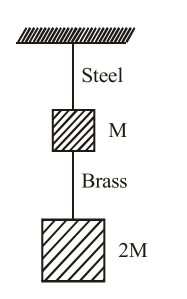
A cube of metal is subjected to a hydrostatic pressure 4 GPa. The percentage change in the length of the side of the cube is close to: (Given bulk modulus of metal, $$B = 8 \times 10^{10}$$ Pa)
We start with the definition of bulk modulus. For an isotropic body under a uniform (hydrostatic) pressure $$P$$, the bulk modulus $$B$$ is defined as
$$B \;=\; -\,\dfrac{P}{\dfrac{\Delta V}{V}}$$
Here $$\dfrac{\Delta V}{V}$$ is the volumetric (volume) strain and the minus sign accounts for the fact that an applied pressure (a compressive stress) makes the volume decrease (so $$\Delta V$$ is negative).
Rearranging the above formula to isolate the volume strain, we obtain
$$\dfrac{\Delta V}{V} \;=\; -\,\dfrac{P}{B}$$
Now we substitute the given numerical values. The hydrostatic pressure is $$P = 4 \text{ GPa} = 4 \times 10^{9}\ {\rm Pa}$$, and the bulk modulus is $$B = 8 \times 10^{10}\ {\rm Pa}$$. Therefore,
$$\dfrac{\Delta V}{V} \;=\; -\,\dfrac{4 \times 10^{9}}{8 \times 10^{10}}$$
Carrying out the division step by step, first divide the coefficients:
$$\dfrac{4}{8} = 0.5$$
Next handle the powers of ten:
$$\dfrac{10^{9}}{10^{10}} = 10^{-1} = 0.1$$
Multiplying the two intermediate results,
$$0.5 \times 0.1 = 0.05$$
Remembering the negative sign, we obtain
$$\dfrac{\Delta V}{V} = -\,0.05$$
This number means the volume decreases by 5 %. To convert this volume strain into linear (length) strain for a cube we use a geometrical relation. For a cube with side length $$l$$, the volume is $$V = l^{3}$$. If the side changes by a small amount $$\Delta l$$, we differentiate:
$$V = l^{3} \;\;\Longrightarrow\;\; \dfrac{dV}{V} = 3\,\dfrac{dl}{l}$$
In infinitesimal form, $$dV/V$$ is the volume strain and $$dl/l$$ is the linear strain. Re-writing this for finite but small changes, we approximate
$$\dfrac{\Delta V}{V} \approx 3\,\dfrac{\Delta l}{l}$$
Hence the linear strain is one-third of the volume strain:
$$\dfrac{\Delta l}{l} = \dfrac{1}{3}\,\dfrac{\Delta V}{V}$$
Substituting the value we already found,
$$\dfrac{\Delta l}{l} = \dfrac{1}{3}\,(-0.05)$$
Dividing by 3,
$$\dfrac{\Delta l}{l} = -0.016666\dots$$
To express this as a percentage change in length we multiply the absolute value by 100 %:
$$\bigl|\text{percentage change}\bigr| = 0.016666\dots \times 100\% = 1.6666\dots \%$$
Rounding to the number of significant figures implied by the data, we state
$$\text{percentage change in length} \approx 1.67\%$$
Hence, the correct answer is Option D.
An object of mass $$m$$ is suspended at the end of a massless wire of length $$L$$ and area of cross-section, A. Young modulus of the material of the wire is $$Y$$. If the mass is pulled down slightly its frequency of oscillation along the vertical direction is:
We consider a wire of equilibrium length $$L$$, cross-sectional area $$A$$ and Young modulus $$Y$$. A mass $$m$$ is hanging at its lower end. First, recall the definition of Young’s modulus:
$$Y=\frac{\text{stress}}{\text{strain}} =\frac{\dfrac{F}{A}}{\dfrac{\Delta L}{L}} =\frac{F\,L}{A\,\Delta L}.$$
Here $$F$$ is the tensile force producing an extension $$\Delta L$$. Solving the above relation for the extension produced by a force $$F$$, we get
$$\Delta L=\frac{F\,L}{Y\,A}.$$
Now imagine that the suspended mass is displaced very slightly downward so that the wire stretches an extra small amount $$x$$ (in addition to whatever static extension already exists). The corresponding extra restoring force $$F_x$$ that develops in the wire is obtained by replacing $$\Delta L$$ with this incremental stretch $$x$$:
$$x=\frac{F_x\,L}{Y\,A}\quad\Longrightarrow\quad F_x=\frac{Y\,A}{L}\,x.$$
We observe that this relation has the standard Hooke’s-law form $$F_x=kx$$, where the effective spring constant $$k$$ of the wire is
$$k=\frac{Y\,A}{L}.$$
Once the wire behaves like a spring of constant $$k$$, the system becomes a simple vertical mass-spring oscillator. The angular frequency $$\omega$$ of such an oscillator is given by the well-known formula
$$\omega=\sqrt{\frac{k}{m}}.$$
Substituting the value of $$k$$ we have just obtained,
$$\omega=\sqrt{\frac{Y\,A/L}{m}} =\sqrt{\frac{Y\,A}{m\,L}}.$$
The ordinary frequency $$f$$ (number of oscillations per second) is related to the angular frequency by $$f=\dfrac{\omega}{2\pi}$$. Therefore,
$$f=\frac{1}{2\pi}\sqrt{\frac{Y\,A}{m\,L}}.$$
This expression matches option B.
Hence, the correct answer is Option B.
Two steel wires having same length are suspended from a ceiling under the same load. If the ratio of their energy stored per unit volume is 1 : 4, the ratio of their diameters is:
We begin with the expression for the elastic (strain) energy stored per unit volume in a stretched wire. For a material that obeys Hooke’s law the strain energy density is
$$u \;=\; \frac12\,\sigma\,\varepsilon$$
where $$\sigma$$ is the normal stress and $$\varepsilon$$ is the linear strain. Because strain for an elastic material is related to stress through Young’s modulus $$E$$ by $$\varepsilon = \dfrac{\sigma}{E}$$, we can substitute and obtain
$$u \;=\; \frac12\,\sigma \left(\frac{\sigma}{E}\right) \;=\; \frac{\sigma^{2}}{2E}.$$
Both wires are made of steel, so the Young’s modulus $$E$$ is the same for each. Hence, for comparison of the two wires, the factor $$\dfrac{1}{2E}$$ is common and the energy density is directly proportional to the square of the stress:
$$u \;\propto\; \sigma^{2}.$$
Each wire carries the same load $$F$$, but because their diameters are different, their cross-sectional areas differ. For a circular cross-section of diameter $$d$$, the area is
$$A \;=\; \frac{\pi d^{2}}{4}.$$
Stress is force divided by area, so
$$\sigma \;=\; \frac{F}{A} \;=\; \frac{F}{\pi d^{2}/4} \;=\; \frac{4F}{\pi d^{2}}.$$
This shows that
$$\sigma \;\propto\; \frac{1}{d^{2}}.$$
Substituting this proportionality into the proportionality for energy density, we get
$$u \;\propto\; \sigma^{2} \;\propto\; \left(\frac{1}{d^{2}}\right)^{2} \;=\; \frac{1}{d^{4}}.$$
Therefore, for two wires (1) and (2) with diameters $$d_{1}$$ and $$d_{2}$$, the ratio of their strain energies per unit volume is
$$\frac{u_{1}}{u_{2}} \;=\; \frac{1/d_{1}^{4}}{1/d_{2}^{4}} \;=\; \frac{d_{2}^{4}}{d_{1}^{4}}.$$
The problem states that this ratio is $$1:4$$, i.e.
$$\frac{u_{1}}{u_{2}} \;=\; \frac{1}{4}.$$
Equating the two expressions, we have
$$\frac{d_{2}^{4}}{d_{1}^{4}} \;=\; \frac{1}{4}.$$
Cross-multiplying gives
$$4d_{2}^{4} \;=\; d_{1}^{4}.$$
Taking the fourth root of both sides,
$$d_{1} \;=\; \sqrt{2}\,d_{2}.$$
Thus the ratio of the diameters is
$$d_{1}:d_{2} \;=\; \sqrt{2}:1.$$
Hence, the correct answer is Option A.
A rod, of length $$L$$ at room temperature and uniform area of cross section $$A$$, is made of a metal having coefficient of linear expansion $$\alpha$$ /$$^{\circ}$$C. It is observed that an external compressive force $$F$$ is applied on each of its ends, prevents any change in the length of the rod when its temperature rises by $$\Delta T$$ K. Young's modulus, $$Y$$ for this metal is:
We begin by recalling that when the temperature of a free rod rises by $$\Delta T$$, its natural tendency is to increase its length. The linear thermal expansion formula is first stated:
$$\Delta L_{\text{thermal}} = \alpha L \Delta T,$$
where $$\alpha$$ is the coefficient of linear expansion, $$L$$ is the original length and $$\Delta T$$ is the rise in temperature.
This change of length produces a thermal strain (fractional change in length) given by
$$\varepsilon_{\text{thermal}} = \frac{\Delta L_{\text{thermal}}}{L} = \alpha \Delta T.$$
In the problem, however, a compressive force $$F$$ is applied at both ends so that the rod is not allowed to change its length at all. Therefore, the total strain in the rod must be zero:
$$\varepsilon_{\text{total}} = \varepsilon_{\text{thermal}} + \varepsilon_{\text{mechanical}} = 0.$$
We have already written $$\varepsilon_{\text{thermal}} = \alpha \Delta T.$$ Next, we write the mechanical strain caused by the external compressive force. Young’s modulus $$Y$$ is defined by the relation
$$Y = \frac{\text{stress}}{\text{strain}} \quad \Longrightarrow \quad \text{strain} = \frac{\text{stress}}{Y}.$$
The compressive stress produced by the force $$F$$ over the cross-sectional area $$A$$ is
$$\sigma = \frac{F}{A}.$$
Because the force is compressive, the corresponding mechanical strain is also compressive (negative):
$$\varepsilon_{\text{mechanical}} = -\frac{\sigma}{Y} = -\frac{F}{A\,Y}.$$
Now we impose the condition that the rod’s length does not change, i.e. $$\varepsilon_{\text{total}} = 0$$. Substituting the expressions for the two strains, we get
$$\alpha \Delta T \;+\; \left(-\frac{F}{A\,Y}\right) = 0.$$
Simplifying,
$$\alpha \Delta T = \frac{F}{A\,Y}.$$
We now solve for Young’s modulus $$Y$$ by cross-multiplying:
$$Y = \frac{F}{A\,\alpha \,\Delta T}.$$
This expression matches Option C in the given list.
Hence, the correct answer is Option C.
In an experiment, brass and steel wires of length 1 m each with areas of cross section 1 mm$$^2$$ are used. The wires are connected in series and one end of the combined wire is connected to a rigid support and other end is subjected to elongation. The stress required to produce a net elongation of 0.2 mm is,
[Given, the Young's Modulus for steel and brass are, respectively, $$120 \times 10^9$$ N/m$$^2$$ and $$60 \times 10^9$$ N/m$$^2$$]
We have two wires, one of brass and one of steel, each of length $$L = 1 \text{ m}$$ and cross-sectional area $$A = 1 \text{ mm}^2 = 1 \times 10^{-6}\,\text{m}^2$$. The wires are joined in series, so when a tensile force is applied the same force $$F$$ acts on both wires. Because the area is the same for both, the stress $$\sigma$$ in each wire is also the same, where
$$\sigma = \dfrac{F}{A}.$$
The elongation of a wire obeys Hooke’s law for small strains:
$$\Delta L = \dfrac{\sigma L}{Y},$$
where $$Y$$ is Young’s modulus. First we write down the given values:
$$Y_{\text{steel}} = 120 \times 10^{9}\,\text{N m}^{-2},\qquad Y_{\text{brass}} = 60 \times 10^{9}\,\text{N m}^{-2}.$$
For the brass wire the extension is
$$\Delta L_{\text{brass}} = \dfrac{\sigma L}{Y_{\text{brass}}},$$
and for the steel wire
$$\Delta L_{\text{steel}} = \dfrac{\sigma L}{Y_{\text{steel}}}.$$
The two wires are in series, so the total elongation is the sum of the individual elongations:
$$\Delta L_{\text{total}} = \Delta L_{\text{brass}} + \Delta L_{\text{steel}} = \dfrac{\sigma L}{Y_{\text{brass}}} + \dfrac{\sigma L}{Y_{\text{steel}}} = \sigma L\left(\dfrac{1}{Y_{\text{brass}}} + \dfrac{1}{Y_{\text{steel}}}\right).$$
The experiment specifies a required total elongation of
$$\Delta L_{\text{total}} = 0.2 \text{ mm} = 0.2 \times 10^{-3}\,\text{m}.$$
Substituting $$L = 1 \text{ m}$$ and solving for $$\sigma$$ gives
$$\sigma = \dfrac{\Delta L_{\text{total}}} {L\left(\dfrac{1}{Y_{\text{brass}}} + \dfrac{1}{Y_{\text{steel}}}\right)}.$$
Now we evaluate the bracketed term:
$$\dfrac{1}{Y_{\text{brass}}} + \dfrac{1}{Y_{\text{steel}}} = \dfrac{1}{60 \times 10^{9}} + \dfrac{1}{120 \times 10^{9}} = \dfrac{2}{120 \times 10^{9}} + \dfrac{1}{120 \times 10^{9}} = \dfrac{3}{120 \times 10^{9}} = \dfrac{1}{40 \times 10^{9}} = 2.5 \times 10^{-11}\,\text{m}^2\text{N}^{-1}.$$
Putting everything together, we obtain
$$\sigma = \dfrac{0.2 \times 10^{-3}} {1 \times 2.5 \times 10^{-11}} = \dfrac{0.2}{2.5} \times 10^{8} = 0.08 \times 10^{8} = 8.0 \times 10^{6}\,\text{N m}^{-2}.$$
Hence, the correct answer is Option A.
Young's moduli of two wires A and B are in the ratio 7:4. Wire A is 2 m long and has radius R. Wire B is 1.5 m long and has radius 2 mm. If the two wires stretch by the same length for a given load, the value of R is close to:
For a uniform wire that is stretched within the elastic limit, the extension produced by a load is given by the standard elastic‐string formula
$$\Delta L=\frac{F\,L}{A\,Y},$$
where $$F$$ is the applied force, $$L$$ is the original length, $$A$$ is the cross-sectional area and $$Y$$ is Young’s modulus of the material.
Because the two wires are subjected to the same load and are said to “stretch by the same length”, we have for wires A and B
$$\frac{F\,L_A}{A_A\,Y_A}=\frac{F\,L_B}{A_B\,Y_B}.$$
The force $$F$$ and the factor $$\pi$$ hidden inside each area will cancel, so we can write
$$\frac{L_A}{r_A^{\,2}\,Y_A}=\frac{L_B}{r_B^{\,2}\,Y_B},$$
where $$r_A=R$$ (unknown) and $$r_B=2\;\text{mm}$$ (given).
The ratio of Young’s moduli is given as $$Y_A:Y_B=7:4$$, so we may set $$Y_B=\dfrac{4}{7}\,Y_A$$.
Substituting this value together with the given lengths $$L_A=2\;\text{m}$$ and $$L_B=1.5\;\text{m}$$ gives
$$\frac{2}{R^{2}\,Y_A}=\frac{1.5}{(2\;\text{mm})^{2}\,\left(\dfrac{4}{7}Y_A\right)}.$$
The factor $$Y_A$$ now cancels out completely, leading to
$$\frac{2}{R^{2}}=\frac{1.5\times7}{(2\;\text{mm})^{2}\times4}.$$
Taking the reciprocal of both sides so that $$R^{2}$$ stands alone, we obtain
$$R^{2}=\frac{2\times4}{1.5\times7}\,(2\;\text{mm})^{2}.$$
Simplifying each numerical factor step by step:
$$\frac{2}{1.5}=\frac{4}{3}, \quad \text{so} \quad R^{2}=\frac{4}{3}\times\frac{4}{7}\times(2\;\text{mm})^{2}.$$
Next, multiply the first two fractions:
$$\frac{4}{3}\times\frac{4}{7}=\frac{16}{21}.$$
Because $$(2\;\text{mm})^{2}=4\;\text{mm}^{2},$$ we have
$$R^{2}=\frac{16}{21}\times4\;\text{mm}^{2}=\frac{64}{21}\;\text{mm}^{2}.$$
Evaluating the fraction numerically,
$$\frac{64}{21}\approx3.0476\;\text{mm}^{2}.$$
Taking the square root finally yields
$$R=\sqrt{3.0476}\;\text{mm}\approx1.7457\;\text{mm}.$$
The value rounds to about $$1.7\;\text{mm}$$, which matches the fourth option in the list.
Hence, the correct answer is Option D.
A copper wire is stretched to make it 0.5% longer. The percentage change in its electrical resistance if its volume remains unchanged is:
We have a copper wire whose original length is $$L$$ and original cross-sectional area is $$A$$. The original resistance is given by the basic relation
$$R = \rho \dfrac{L}{A},$$
where $$\rho$$ is the resistivity of copper. Resistivity does not change because only the dimensions are altered, not the material or temperature.
The wire is stretched so that its length becomes $$L' = L + \Delta L$$, and the question tells us that the percentage elongation is $$0.5\%.$$ Therefore, in fractional form,
$$\dfrac{\Delta L}{L} = 0.5\% = 0.005.$$
The stretching is done in such a way that the volume of the wire remains unchanged. Volume before stretching is
$$V = A L,$$
and after stretching it must still be the same:
$$V = A' L'.$$
Hence
$$A L = A' L' \quad\Longrightarrow\quad A' = \dfrac{A L}{L'}.$$
Substituting $$L' = L + \Delta L = L(1 + \dfrac{\Delta L}{L})$$ we get
$$A' = \dfrac{A L}{L(1 + \dfrac{\Delta L}{L})} = \dfrac{A}{1 + \dfrac{\Delta L}{L}}.$$
For small changes we use the first-order binomial approximation
$$\dfrac{1}{1 + x} \approx 1 - x \quad\text{when } x \text{ is small}.$$
Putting $$x = \dfrac{\Delta L}{L},$$
$$A' \approx A\!\left(1 - \dfrac{\Delta L}{L}\right).$$
Therefore the fractional change in area is
$$\dfrac{\Delta A}{A} = \dfrac{A' - A}{A} \approx \left(1 - \dfrac{\Delta L}{L}\right) - 1 = -\,\dfrac{\Delta L}{L}.$$
So the area decreases by exactly the same fraction by which the length increases.
Now we calculate the new resistance $$R'$$:
$$R' = \rho \dfrac{L'}{A'} = \rho \dfrac{L(1 + \dfrac{\Delta L}{L})}{A\!\left(1 - \dfrac{\Delta L}{L}\right)}.$$
Combining the two first-order factors and again neglecting higher-order terms $$\bigl((\Delta L/L)^2\bigr),$$ we have
$$\dfrac{1 + \dfrac{\Delta L}{L}}{1 - \dfrac{\Delta L}{L}} \approx 1 + \dfrac{\Delta L}{L} + \dfrac{\Delta L}{L} = 1 + 2\,\dfrac{\Delta L}{L}.$$
Thus
$$R' \approx \rho \dfrac{L}{A}\!\left(1 + 2\,\dfrac{\Delta L}{L}\right) = R \left(1 + 2\,\dfrac{\Delta L}{L}\right).$$
The fractional change in resistance is therefore
$$\dfrac{\Delta R}{R} = 2\,\dfrac{\Delta L}{L}.$$
Putting $$\dfrac{\Delta L}{L} = 0.005$$ gives
$$\dfrac{\Delta R}{R} = 2 \times 0.005 = 0.01.$$
Converting to percentage,
$$0.01 \times 100\% = 1.0\%.$$
So the resistance increases by $$1.0\%.$$ Hence, the correct answer is Option B.
A load of mass M kg is suspended from a steel wire of length 2m and radius 1.0 mm in Searle's apparatus experiment. The increase in length produced in the wire is 4.0 mm. Now the load is fully immersed in a liquid of relative density 2. The relative density of the material of load is 8. The new value of increase in length of the steel wire is:
In Searle’s apparatus the extension in the steel wire is obtained from Young’s modulus formula
$$\Delta L=\frac{F\,L}{A\,Y}$$
where $$\Delta L$$ is the increase in length, $$F$$ the tensile force in the wire, $$L$$ the original length, $$A$$ the cross-sectional area and $$Y$$ Young’s modulus of steel. For a given wire $$L,\;A$$ and $$Y$$ are fixed, so the extension is directly proportional to the applied force:
$$\Delta L\;\propto\;F$$
Initially the wire supports the load in air only. The force is simply the weight
$$F_1 = M\,g$$
and the corresponding extension is given as
$$\Delta L_1 = 4.0\;\text{mm}$$
Now the load is completely immersed in a liquid. The liquid exerts an upthrust (buoyant force) that reduces the effective weight. We determine this buoyant force step by step.
The relative density (specific gravity) of the load is 8, so its density is
$$\rho_{\text{load}} = 8\,\rho_{\text{water}}$$
The relative density of the liquid is 2, so the liquid’s density is
$$\rho_{\text{liq}} = 2\,\rho_{\text{water}}$$
The volume of the load is
$$V = \frac{M}{\rho_{\text{load}}} = \frac{M}{8\,\rho_{\text{water}}}$$
The buoyant force equals the weight of the displaced liquid:
$$F_b = \rho_{\text{liq}}\,V\,g = (2\,\rho_{\text{water}})\left(\frac{M}{8\,\rho_{\text{water}}}\right)g = \frac{2}{8}\,M\,g = \frac{1}{4}\,M\,g$$
Hence the apparent (effective) weight of the load while immersed is
$$F_2 = F_1 - F_b = M\,g - \frac{1}{4}\,M\,g = \frac{3}{4}\,M\,g$$
Because extension is proportional to force, the new extension $$\Delta L_2$$ satisfies
$$\frac{\Delta L_2}{\Delta L_1} = \frac{F_2}{F_1} = \frac{\frac{3}{4}M\,g}{M\,g} = \frac{3}{4}$$
Substituting $$\Delta L_1 = 4.0\;\text{mm}$$, we obtain
$$\Delta L_2 = \frac{3}{4}\times 4.0\;\text{mm} = 3.0\;\text{mm}$$
Hence, the correct answer is Option D.
A boy's catapult is made of rubber cord which is 42 cm long, with 6 mm diameter of cross-section and of negligible mass. The boy keeps a stone weighing 0.02 kg on it and stretches the cord by 20 cm by applying a constant force. When released, the stone flies off with a velocity of 20 ms$$^{-1}$$. Neglect the change in the area of cross-section of the cord while stretched. The Young's modulus of rubber is closest to:
Strain energy stored in the stretched rubber cord is
$$U=\frac{1}{2}\times \text{stress} \times \text{strain} \times \text{volume}$$
Using,
$$U=\frac{1}{2}\left(\frac{\Delta \ell}{\ell}\right)^2 Y A \ell$$
This stored energy converts into kinetic energy of the stone.
Hence,
$$\frac{1}{2}\left(\frac{\Delta \ell}{\ell}\right)^2 Y A\ell = \frac{1}{2}mv^2$$
Given,
$$\ell=42\ \text{cm}=42\times10^{-2}\ \text{m}$$$$\Delta \ell=20\ \text{cm}=20\times10^{-2}\ \text{m}$$
Radius of cord,
$$r=3\ \text{mm}=3\times10^{-3}\ \text{m}$$
Area of cross-section,
$$A=\pi r^2=\pi(3\times10^{-3})^2$$
Mass of stone,
$$m=0.02\ \text{kg}=2\times10^{-2}\ \text{kg}$$
Velocity,
$$v=20\ \text{m s}^{-1}$$
Substituting,
$$\frac{1}{2}\left(\frac{20}{42}\right)^2 Y\times \pi(3\times10^{-3})^2 \times 42\times10^{-2} = \frac{1}{2}\times2\times10^{-2}\times(20)^2$$
Solving,
$$Y \approx 3\times10^6\ \text{N m}^{-2}$$
Hence,
$$\boxed{Y \approx 3\times10^6\ \text{N m}^{-2}}$$
At 40°C, a brass wire of 1 mm radius is hung from the ceiling. A small mass, M is hung from the free end of the wire. When the wire is cooled down from 40°C to 20°C it regains its original length of 0.2 m. The value of M is close to:
(Coefficient of linear expansion of brass are $$10^{-5}$$/°C and Young's modulus of brass is $$10^{11}$$ N/m$$^2$$, respectively; g = 10 m s$$^{-2}$$)
We have a brass wire whose un-stretched length is given as $$l = 0.2\text{ m}$$ and whose radius is $$r = 1\text{ mm}=1\times 10^{-3}\text{ m}$$. The cross-sectional area is therefore
$$A = \pi r^{2}= \pi\,(1\times 10^{-3})^{2}= \pi\times 10^{-6}\;{\rm m^{2}}.$$
The wire is first at $$40^{\circ}{\rm C}$$, a mass $$M$$ is hung on it, and then the system is cooled to $$20^{\circ}{\rm C}$$. The information that “it regains its original length” tells us that the increase in length caused by the load is exactly cancelled by the decrease in length caused by cooling. Hence the magnitude of the elastic extension equals the magnitude of the thermal contraction:
$$\Delta l_{\text{load}}=\Delta l_{\text{thermal}}.$$
For a wire, the elastic (Young’s-law) extension produced by a force $$F$$ is
$$\Delta l_{\text{load}}=\frac{F\,l}{A\,Y},$$
where $$Y$$ is Young’s modulus. Here $$F=Mg$$, so
$$\boxed{\;\Delta l_{\text{load}}=\dfrac{Mg\,l}{A\,Y}\;}.$$
The thermal contraction when the temperature falls by $$\Delta T$$ is obtained from the linear expansion formula
$$\Delta l_{\text{thermal}}=\alpha\,l\,\Delta T,$$
where $$\alpha$$ is the coefficient of linear expansion. Because the wire is cooled, $$\Delta T = -20^{\circ}\text{C}$$, and the magnitude is
$$|\Delta l_{\text{thermal}}|=\alpha\,l\,(20).$$
Equating the two magnitudes we get
$$\frac{Mg\,l}{A\,Y} \;=\; \alpha\,l\,(20).$$
The original length $$l$$ cancels from both sides, giving a direct expression for the unknown mass:
$$\boxed{\;M = \frac{\alpha\,(20)\,A\,Y}{g}\;}.$$
Now we substitute the numerical data supplied in the question:
Coefficient of linear expansion: $$\alpha = 1.0\times 10^{-5}\;{\rm /^\circ C}$$
Temperature drop: $$20^{\circ}{\rm C}$$
Area: $$A = \pi\times 10^{-6}\;{\rm m^{2}}$$
Young’s modulus: $$Y = 1.0\times 10^{11}\;{\rm N/m^{2}}$$
Acceleration due to gravity: $$g = 10\;{\rm m/s^{2}}$$.
Putting these numbers in:
$$M = \frac{(1.0\times 10^{-5})(20)\,(\pi\times 10^{-6})\,(1.0\times 10^{11})}{10}.$$
Simplifying step by step, we first multiply the powers of ten:
$$1.0\times 10^{-5}\times 20 = 2.0\times 10^{-4},$$
and
$$(\pi\times 10^{-6})\times (1.0\times 10^{11}) = \pi\times 10^{5}.$$
Hence the numerator becomes
$$ (2.0\times 10^{-4})\times (\pi\times 10^{5}) = 2\pi\times 10^{1}=20\pi. $$
Finally we divide by $$g=10$$:
$$ M = \frac{20\pi}{10}=2\pi\;{\rm kg}\approx 6.3\;{\rm kg}. $$
The mass required is therefore about $$6\;{\rm kg}$$. Looking at the four choices provided, the value that lies closest to this calculation is $$9\;{\rm kg}$$.
Hence, the correct answer is Option D.
A steel wire having a radius of 2.0 mm, carrying a load of 4 kg, is hanging from a ceiling. Given that g = 3.1$$\pi$$ m s$$^{-2}$$, what will be the tensile stress that would be developed in the wire?
We have a vertical wire that is supporting a stationary load, so the force producing the stress is simply the weight of the load.
First, recall the definition of tensile stress.
$$\text{Tensile stress} \; (\sigma) \;=\; \dfrac{\text{Force}}{\text{Cross-sectional area}}$$
The force is the weight $$W$$ of the 4 kg mass. By Newton’s second law, weight is mass times acceleration due to gravity:
$$W \;=\; m\,g$$ where $$m = 4\ \text{kg}$$ and $$g = 3.1\pi\ \text{m s}^{-2}$$.
Substituting the numbers,
$$W \;=\; 4 \times (3.1\pi) \;=\; 12.4\pi\ \text{N}.$$
Next we need the cross-sectional area $$A$$ of the wire. The radius is given as 2.0 mm, so
$$r \;=\; 2.0\ \text{mm} \;=\; 2.0 \times 10^{-3}\ \text{m}.$$
For a circle, the area formula is
$$A \;=\; \pi r^{2}.$$
Substituting the value of $$r$$,
$$A \;=\; \pi \left(2.0 \times 10^{-3}\right)^{2} \;=\; \pi \left(4.0 \times 10^{-6}\right) \;=\; 4.0\pi \times 10^{-6}\ \text{m}^{2}.$$
Now we divide the force by the area to obtain the stress:
$$\sigma \;=\; \dfrac{W}{A} \;=\; \dfrac{12.4\pi}{4.0\pi \times 10^{-6}}.$$
The factor $$\pi$$ appears in both numerator and denominator, so it cancels out:
$$\sigma \;=\; \dfrac{12.4}{4.0} \times 10^{6} \;=\; 3.1 \times 10^{6}\ \text{N m}^{-2}.$$
Hence, the correct answer is Option D.
A uniform cylindrical rod of length L and radius r, is made from a material whose Young's modulus of Elasticity equals Y. When this rod is heated by temperature T and simultaneously subjected to a net longitudinal compressional force F, its length remains unchanged. The coefficient of volume expansion, of the material of the rod, is (nearly) equal to:
Let the linear coefficient of thermal expansion of the material be denoted by $$\alpha$$ and its coefficient of volume expansion by $$\beta$$. For any isotropic solid we have the standard relation $$\beta = 3\alpha$$ because uniform heating produces the same fractional change along all three mutually perpendicular directions.
When the temperature of the rod is raised by $$T$$, the natural (unconstrained) increase in its length would be given by the well-known thermal expansion formula
$$\Delta L_{\text{thermal}} = \alpha L T.$$
Simultaneously, the rod is subjected to a uniform compressive longitudinal force $$F$$. The mechanical (elastic) shortening produced by this force is obtained from the definition of Young’s modulus. First, the longitudinal stress is
$$\text{Stress} = \frac{F}{A},$$
where $$A$$ is the cross-sectional area. For a cylinder of radius $$r$$ we have $$A = \pi r^{2}.$$
Young’s modulus $$Y$$ is defined by the relation
$$Y = \frac{\text{Stress}}{\text{Strain}} \;\;\; \Longrightarrow \;\;\; \text{Strain} = \frac{\text{Stress}}{Y}.$$
The longitudinal strain is the fractional change in length, so
$$\text{Strain} = \frac{\Delta L_{\text{elastic}}}{L} = \frac{F}{A Y}.$$
Since the force is compressive, this change in length is a decrease, hence
$$\Delta L_{\text{elastic}} = -\,\frac{F L}{A Y} = -\,\frac{F L}{\pi r^{2} Y}.$$
The problem states that the rod’s overall length does not change at all, which means the algebraic sum of the thermal increase and the elastic decrease is zero:
$$\Delta L_{\text{thermal}} + \Delta L_{\text{elastic}} = 0.$$
Substituting the two expressions we have just obtained,
$$\alpha L T \;+\;\left(-\,\frac{F L}{\pi r^{2} Y}\right) = 0.$$
The common factor $$L$$ can be cancelled on both sides, giving
$$\alpha T - \frac{F}{\pi r^{2} Y} = 0.$$
Solving for $$\alpha$$ we obtain
$$\alpha = \frac{F}{\pi r^{2} Y T}.$$
Finally, using the earlier relation $$\beta = 3\alpha$$ for an isotropic solid, we substitute this value of $$\alpha$$ to get
$$\beta \;=\; 3 \times \frac{F}{\pi r^{2} Y T} \;=\; \frac{3F}{\pi r^{2} Y T}.$$
Hence, the correct answer is Option D.
The elastic limit of brass is 379 MPa. The minimum diameter of a brass rod if it is to support a 400 N load without exceeding its elastic limit will be
First, recall the definition of normal stress. We have the basic formula
$$\sigma=\frac{F}{A}$$
where $$\sigma$$ is the normal stress, $$F$$ is the axial load, and $$A$$ is the cross-sectional area on which the load acts.
The rod is circular, so its cross-sectional area is given by
$$A=\frac{\pi d^{2}}{4},$$
where $$d$$ is the diameter.
The material is brass with an elastic (safe) stress limit of $$\sigma_{\text{allow}}=379\;\text{MPa}$$. Since $$1\;\text{MPa}=1\;\text{N/mm}^2$$, we can write
$$\sigma_{\text{allow}} = 379\;\text{N/mm}^2.$$
The allowable stress must not be exceeded, so we set
$$\sigma \le \sigma_{\text{allow}}.$$
For the minimum diameter, we make the working stress exactly equal to the allowable value:
$$\frac{F}{A}= \sigma_{\text{allow}}.$$
The load is $$F = 400\;\text{N}$$, hence
$$\frac{400}{A}=379 \quad\Longrightarrow\quad A=\frac{400}{379}\;\text{mm}^2.$$
Carrying out the division gives
$$A\approx 1.055\;\text{mm}^2.$$
Next, substitute this area into the circular area formula to get the diameter:
$$A=\frac{\pi d^{2}}{4}\quad\Longrightarrow\quad d^{2}= \frac{4A}{\pi}.$$
Replacing $$A$$ by $$1.055\;\text{mm}^2$$ gives
$$d^{2}= \frac{4\times 1.055}{\pi}.$$
First compute the numerator:
$$4\times 1.055 = 4.220.$$
Now divide by $$\pi$$:
$$\frac{4.220}{\pi}\approx \frac{4.220}{3.1416}\approx 1.343.$$
Taking the square root yields
$$d = \sqrt{1.343}\;\text{mm}\approx 1.159\;\text{mm}.$$
Rounding to three significant figures, we obtain
$$d\approx 1.16\;\text{mm}.$$
Hence, the correct answer is Option C.
A solid sphere of radius r made of a soft material of bulk modulus K is surrounded by a liquid in a cylindrical container. A massless piston of area a floats on the surface of the liquid, covering entire cross-section of cylindrical container. When a mass m is placed on the surface of the piston to compress the liquid, the fractional decrement in the radius of the sphere $$\left(\frac{dr}{r}\right)$$, is:
First, let us find the extra pressure applied on the liquid when the mass $$m$$ is gently placed on the mass-less piston of area $$a$$. The weight of the mass is $$mg$$, so the force transmitted to the liquid is also $$mg$$. Since pressure is force per unit area, the increase in pressure is given by
$$P=\dfrac{\text{Force}}{\text{Area}}=\dfrac{mg}{a}\;.$$
This pressure is conveyed undiminished throughout the liquid (Pascal’s law), and hence the soft solid sphere experiences the same additional pressure $$P$$ on all its surfaces.
Now we recall the definition of bulk modulus. For any isotropic solid,
$$K=-\dfrac{P}{\dfrac{\Delta V}{V}},$$
where $$K$$ is the bulk modulus, $$P$$ is the applied pressure, $$V$$ is the original volume and $$\Delta V$$ is the change in volume (a decrease in volume makes $$\Delta V$$ negative, hence the minus sign in the definition).
The sphere has initial radius $$r$$, so its initial volume is
$$V=\dfrac{4}{3}\pi r^{3}\;.$$
If, because of the pressure, the radius decreases by a small amount $$dr$$ (so $$dr<0$$), then the new radius becomes $$r+dr$$ and the new volume is
$$V+\Delta V=\dfrac{4}{3}\pi(r+dr)^{3}\;.$$
Expanding the cube and keeping only the first-order term in the small quantity $$dr$$, we have
$$\begin{aligned} (r+dr)^{3}&=r^{3}+3r^{2}dr+\text{(higher-order terms in }dr) \\ &\approx r^{3}+3r^{2}dr. \end{aligned}$$
Thus,
$$\Delta V=\dfrac{4}{3}\pi\bigl[r^{3}+3r^{2}dr-r^{3}\bigr]=4\pi r^{2}dr.$$
Dividing by the original volume to obtain the fractional change, we get
$$\dfrac{\Delta V}{V}=\dfrac{4\pi r^{2}dr}{\dfrac{4}{3}\pi r^{3}}=3\,\dfrac{dr}{r}.$$
Putting this result into the bulk modulus relation, we write
$$K=-\dfrac{P}{\dfrac{\Delta V}{V}}=-\dfrac{P}{3\,\dfrac{dr}{r}}.$$
Rearranging to isolate the fractional change in radius,
$$\dfrac{dr}{r}=-\dfrac{P}{3K}.$$
Here $$dr<0$$ (a decrease), so the magnitude of the fractional decrement in radius is
$$\left|\dfrac{dr}{r}\right|=\dfrac{P}{3K}.$$
Substituting the earlier expression for $$P$$, namely $$P=\dfrac{mg}{a}$$, we finally obtain
$$\left|\dfrac{dr}{r}\right|=\dfrac{1}{3K}\,\dfrac{mg}{a} =\dfrac{mg}{3Ka}.$$
Therefore, the fractional decrease in the radius of the sphere equals $$\dfrac{mg}{3Ka}$$.
Hence, the correct answer is Option D.
As shown in the figure, forces of $$10^5$$ N each are applied in opposite directions, on the upper and lower faces of a cube of side 10 cm, shifting the upper face parallel to itself by 0.5 cm. If the side of another cube of the same material is, 20 cm then under similar conditions as above, the displacement will be:
An external pressure $$P$$ is applied on a cube at 0°C so that it is equally compressed from all sides. $$K$$ is the bulk modulus of the material of the cube and $$\alpha$$ is its coefficient of linear expansion. Suppose we want to bring the cube to its original size by heating. The temperature should be raised by:
We begin with the cube at an initial temperature of $$0^{\circ}C$$ and at its original volume $$V_0$$. An external pressure $$P$$ is applied uniformly from all directions, so the cube is compressed equally on all sides.
First, we recall the definition of the bulk modulus. The bulk modulus $$K$$ of a material is given by the formula
$$K = -\,\frac{P}{\displaystyle\frac{\Delta V}{V_0}}$$
where $$\Delta V = V - V_0$$ is the change in volume caused by the pressure $$P$$. Because the pressure compresses the cube, the change in volume is negative, so we may write
$$\frac{\Delta V}{V_0} = -\,\frac{P}{K}.$$
Hence the fractional decrease in volume produced by the pressure is
$$\left|\frac{\Delta V}{V_0}\right| = \frac{P}{K}.$$
Next, we wish to restore the cube to its original size by heating it while the same pressure $$P$$ continues to act. For an isotropic solid, the coefficient of linear expansion is $$\alpha$$, so the coefficient of volume expansion is
$$\beta = 3\alpha.$$
If we raise the temperature by an amount $$\Delta T$$, the fractional change in volume produced by thermal expansion is
$$\frac{\Delta V_{\text{thermal}}}{V_0} = \beta\Delta T = 3\alpha\Delta T.$$
To bring the cube back to its original volume, the volume increase produced by heating must exactly cancel the volume decrease caused by the applied pressure. Therefore we set
$$3\alpha\Delta T = \frac{P}{K}.$$
Solving for $$\Delta T$$, we obtain
$$\Delta T = \frac{P}{3\alpha K}.$$
This is the temperature rise required for the cube to regain its original size under the continued external pressure $$P$$.
Hence, the correct answer is Option 2.
A compressive force, $$F$$ is applied at the two ends of a long thin steel rod. It is heated, simultaneously, such that its temperature increases by $$\Delta T$$. The net change in its length is zero. Let $$l$$ be the length of the rod, $$A$$ its area of cross-section, $$Y$$ its Young's modulus, and $$\alpha$$ its coefficient of linear expansion. Then, $$F$$ is equal to:
We are told that a long, thin steel rod of initial length $$l$$ and cross-sectional area $$A$$ is subjected simultaneously to two different actions. One action is purely mechanical: a compressive force $$F$$ is applied axially at its ends. The other action is purely thermal: the rod is heated so that its temperature rises by $$\Delta T$$. Experimentally, we observe that the combined effect of these two actions leaves the overall length of the rod unchanged. Mathematically, this means that the total, or net, linear strain is zero.
We first recall the definition of linear strain. Whenever a body undergoes a fractional change in length, that fraction is called the strain: $$\text{strain} = \dfrac{\Delta l}{l}.$$ If two kinds of strain act simultaneously, we simply add them (with the proper algebraic signs) to get the net strain.
We therefore identify the two individual strains acting on the rod:
1. Thermal strain due to heating. The coefficient of linear expansion of the material is $$\alpha$$. By definition, the fractional change in length produced solely by a temperature rise $$\Delta T$$ is
$$\text{thermal strain} \;=\; \alpha \,\Delta T.$$
This strain is positive because heating tends to elongate the rod.
2. Mechanical strain due to the compressive force. We start with the relation between stress, strain and Young’s modulus. Young’s modulus $$Y$$ of a material is defined by the formula
$$Y \;=\; \dfrac{\text{stress}}{\text{strain}}.$$
Here the axial stress caused by the applied force $$F$$ is simply the force divided by the area of cross-section:
$$\text{stress} \;=\; \dfrac{F}{A}.$$
Substituting this stress into the defining equation of Young’s modulus, we get the mechanical strain:
$$\text{strain}_{\text{mech}} \;=\; \dfrac{\text{stress}}{Y} \;=\; \dfrac{F/A}{Y} \;=\; \dfrac{F}{A\,Y}.$$
Because the applied force is compressive, it attempts to shorten the rod. Hence this mechanical strain is negative with respect to the original length. To indicate the sign explicitly, we may write it as $$-\dfrac{F}{A\,Y}.$$
Adding the two strains and imposing the zero-net-strain condition. The net strain is the algebraic sum of the thermal strain and the mechanical strain. Setting their sum to zero gives
$$\text{thermal strain} \;+\; \text{mechanical strain} \;=\; 0,$$
$$\alpha \,\Delta T \;-\; \dfrac{F}{A\,Y} \;=\; 0.$$
Now we solve this equation step by step for the unknown force $$F$$. First, move the mechanical-strain term to the right-hand side:
$$\alpha \,\Delta T \;=\; \dfrac{F}{A\,Y}.$$
Next, multiply both sides by $$A\,Y$$ to isolate $$F$$:
$$F \;=\; A\,Y \, \alpha \,\Delta T.$$
Thus the compressive force necessary to counteract the expansion produced by the temperature rise and leave the rod’s length unchanged is
$$F \;=\; A Y \alpha \Delta T.$$
We compare this result with the given options. It matches Option B.
Hence, the correct answer is Option B.
A man grows into a giant such that his linear dimensions increase by a factor of 9. Assuming that his density remains same, the stress in the leg will change by a factor of:
We have to compare the mechanical stress on the leg before and after the man becomes a giant. In mechanics, stress is defined first:
$$\sigma=\frac{F}{A}$$
where $$\sigma$$ is the stress, $$F$$ is the force acting on the area (here the weight of the body that the legs must support), and $$A$$ is the area over which that force is distributed (the cross-sectional area of the legs).
The problem states that all linear dimensions (height, width, depth, diameter of the leg, etc.) are enlarged by a common factor of $$9$$. Let us call this scaling factor $$k$$, so here $$k = 9$$.
Step 1: How does the volume change?
The volume of any three-dimensional object is proportional to the cube of a characteristic length. Because every linear dimension grows by $$k$$, the new volume $$V'$$ becomes
$$V' = k^3 V = 9^3 V = 729\,V.$$
Step 2: How does the mass (and hence weight) change?
The density is given to remain the same. Mass is density times volume, so if volume increases by the factor $$729$$, mass increases by exactly the same factor:
$$m' = 729\,m.$$
The weight is the gravitational force $$F = mg$$. Therefore, the new weight $$F'$$ is
$$F' = m' g = 729\,m g = 729\,F.$$
Step 3: How does the supporting area of the leg change?
The cross-section of the leg is a two-dimensional quantity, so it scales with the square of the linear factor:
$$A' = k^2 A = 9^2 A = 81\,A.$$
Step 4: Compute the new stress.
Using the stress formula on the enlarged man, we have
$$\sigma' = \frac{F'}{A'} = \frac{729\,F}{81\,A}.$$
We now separate the numerical factor:
$$\sigma' = \frac{729}{81}\,\frac{F}{A} = 9\,\sigma.$$
So the stress in the giant’s legs is nine times the original stress.
Hence, the correct answer is Option B.
A steel rail of length 5 m and area of cross section 40 cm$$^2$$ is prevented from expanding along its length while the temperature rises by 10°C. If coefficient of linear expansion and Young's modulus of steel are $$1.2 \times 10^{-5}$$ K$$^{-1}$$ and $$2 \times 10^{11}$$ N m$$^{-2}$$ respectively, the force developed in the rail is approximately:
We know that any material, if free to expand, would increase its length by the thermal relation
$$\Delta L = \alpha L \Delta T,$$
where $$\alpha$$ is the coefficient of linear expansion, $$L$$ is the original length and $$\Delta T$$ is the rise in temperature. Here, however, the rail is rigidly fixed, so no actual change in length is allowed. This restriction produces a compressive mechanical strain exactly equal in magnitude (but opposite in sense) to the free thermal strain.
So the strain locked inside the rail is
$$\text{strain} = \alpha \Delta T.$$
Young’s modulus $$Y$$ links stress and strain through the formula
$$\text{stress} = Y \times \text{strain}.$$
Substituting the expression for strain, we obtain
$$\text{stress} = Y \, \alpha \, \Delta T.$$
The numerical values given are
$$Y = 2 \times 10^{11}\ \text{N m}^{-2}, \qquad \alpha = 1.2 \times 10^{-5}\ \text{K}^{-1}, \qquad \Delta T = 10^\circ\text{C}.$$
Putting these into the stress formula, we have
$$\text{stress} = \left(2 \times 10^{11}\right)\left(1.2 \times 10^{-5}\right)(10) = 2 \times 1.2 \times 10^{11} \times 10^{-5} \times 10.$$
Now, $$1.2 \times 10^{-5} \times 10 = 1.2 \times 10^{-4},$$ so
$$\text{stress} = 2 \times 1.2 \times 10^{11} \times 10^{-4} = 2.4 \times 10^{7}\ \text{N m}^{-2}.$$
Force is obtained from stress through the relation
$$\text{force} = \text{stress} \times \text{area}.$$
The cross-sectional area is 40 cm$$^2$$. Converting this to square metres:
$$40\ \text{cm}^2 = 40 \times 10^{-4}\ \text{m}^2 = 4.0 \times 10^{-3}\ \text{m}^2.$$
Substituting the values,
$$\text{force} = (2.4 \times 10^{7}) \times (4.0 \times 10^{-3}) = 2.4 \times 4.0 \times 10^{7} \times 10^{-3}.$$
Since $$10^{7} \times 10^{-3} = 10^{4},$$ we get
$$\text{force} = 9.6 \times 10^{4}\ \text{N}.$$
Rounding to one significant figure, this is
$$\text{force} \approx 1 \times 10^{5}\ \text{N}.$$
Hence, the correct answer is Option D.
A uniformly tapering conical wire is made from a material of Young's modulus $$Y$$ and has a normal, unextended length $$L$$. The radii, at the upper and lower ends of this conical wire, have values $$R$$ and $$3R$$, respectively. The upper end of the wire is fixed to a rigid support and a mass $$M$$ is suspended from its lower end. The equilibrium extended length, of this wire, would equal:
We have a conical wire whose upper, thinner end of radius $$R$$ is rigidly fixed and whose lower, thicker end of radius $$3R$$ supports a mass $$M$$. Because the mass hangs at the very end, every cross-section of the wire carries the same tensile force, namely the weight $$Mg$$ of the mass. The weight of the wire itself is not mentioned, so we neglect it.
The extension of a small element will be obtained from the basic definition of Young’s modulus. First we state the formula:
For a small element of length $$dx$$, cross-sectional area $$A$$ and tension $$F$$, the incremental extension is
$$d\ell=\frac{F}{YA}\;dx.$$
To find the total extension we integrate this expression along the full length of the wire, taking into account that the area varies with position.
Choose the coordinate $$x$$ measured from the fixed upper end (so $$x=0$$ at the top and $$x=L$$ at the bottom). Because the radius increases linearly from $$R$$ to $$3R$$, the radius at a distance $$x$$ from the top is
$$r(x)=R+\left(\frac{3R-R}{L}\right)x=R+\frac{2R}{L}x=R\left(1+\frac{2x}{L}\right).$$
Hence the cross-sectional area is
$$A(x)=\pi r(x)^2=\pi R^2\left(1+\frac{2x}{L}\right)^2.$$
The tensile force in every element is simply $$F=Mg$$. Substituting these expressions into the incremental extension formula, we get
$$d\ell=\frac{Mg}{Y\;\pi R^2\left(1+\dfrac{2x}{L}\right)^2}\;dx.$$
Integrating from the top ($$x=0$$) to the bottom ($$x=L$$) gives the total extension $$\Delta L$$:
$$\Delta L=\int_{0}^{L}\frac{Mg}{Y\;\pi R^2\left(1+\dfrac{2x}{L}\right)^2}\;dx.$$
Now we perform the integral. Put
$$u=1+\frac{2x}{L}\quad\Rightarrow\quad du=\frac{2}{L}dx\quad\Rightarrow\quad dx=\frac{L}{2}\,du.$$
When $$x=0$$, $$u=1$$; when $$x=L$$, $$u=3$$. Substituting, we obtain
$$\Delta L=\frac{Mg}{Y\pi R^2}\int_{u=1}^{3}\frac{L}{2}\,\frac{du}{u^{2}}$$ $$=\frac{MgL}{2Y\pi R^2}\int_{1}^{3}u^{-2}\,du.$$
We evaluate the integral:
$$\int u^{-2}\,du=-\frac{1}{u}\quad\text{so}\quad\int_{1}^{3}u^{-2}\,du=-\frac{1}{3}+1=\frac{2}{3}.$$
Substituting this result gives
$$\Delta L=\frac{MgL}{2Y\pi R^2}\cdot\frac{2}{3}=\frac{MgL}{3Y\pi R^2}.$$
The equilibrium (extended) length $$L_{\text{eq}}$$ is therefore
$$L_{\text{eq}}=L+\Delta L=L\left(1+\frac{Mg}{3Y\pi R^{2}}\right).$$
This expression exactly matches Option C.
Hence, the correct answer is Option C.
A bottle has an opening of radius a and length b. A cork of length b and radius $$(a + \Delta a)$$ where $$(\Delta a \ll a)$$, is compressed to fit into the opening completely (see figure). If the bulk modulus of the cork is B and the coefficient of friction between the bottle and the cork is $$\mu$$, then the force needed to push the cork into the bottle is
$$\Delta V = \pi a^2 b - \pi (a + \Delta a)^2 b$$
$$\Delta V = \pi b [a^2 - (a^2 + 2a\Delta a + (\Delta a)^2)]$$
$$\Delta V \approx -2\pi a b \Delta a$$
$$\frac{\Delta V}{V} = \frac{-2\pi a b \Delta a}{\pi a^2 b} = -\frac{2 \Delta a}{a}$$
The Bulk Modulus ($$B$$) relates pressure to volumetric strain:
$$B = -\frac{P}{\Delta V/V}$$
$$P = -B \left( -\frac{2 \Delta a}{a} \right) = \frac{2 B \Delta a}{a}$$
This pressure $$P$$ acts as the normal stress on the inner surface of the bottle neck.
The total Normal Force ($$N$$) exerted by the cork on the bottle is the pressure multiplied by the contact area (lateral surface area of the cylinder):
$$N = P \times (2\pi a b)$$
$$N = \left( \frac{2 B \Delta a}{a} \right) \times 2\pi a b = 4\pi B b \Delta a$$
The force ($$F$$) needed to push the cork must overcome the frictional force ($$f = \mu N$$):
$$F = \mu (4\pi B b \Delta a)$$
$$F = (4\pi \mu B b) \Delta a$$
A pendulum made of a uniform wire of cross sectional area A has time period T. When an additional mass M is added to its bob, the time period changes to $$T_M$$. If the Young's modulus of the material of the wire is $$Y$$, then $$\frac{1}{Y}$$ is equal to: ($$g$$ = gravitational acceleration)
We have a simple pendulum whose bob is suspended by a uniform metallic wire of cross-sectional area $$A$$. Let the actual (already slightly stretched) length of this wire be $$L$$ when only the original bob is hanging. With this length the measured time period is
$$T = 2\pi \sqrt{\dfrac{L}{g}}\;.$$
Now an additional mass $$M$$ is attached to the same bob. The extra load increases the tension in the wire by the amount
$$F = Mg\;.$$
Because the wire obeys Hooke’s law, this extra force produces an extra elongation $$\Delta L$$. For a wire of natural length $$L$$, Young’s modulus $$Y$$ is defined by the relation
$$Y = \dfrac{\text{Stress}}{\text{Strain}} = \dfrac{F/A}{\Delta L/L} = \dfrac{F\,L}{A\,\Delta L}\;.$$
Re-arranging, the extra extension is
$$\Delta L = \dfrac{F\,L}{A\,Y} = \dfrac{Mg\,L}{A\,Y}\;.$$
Because of this elongation, the new effective length of the pendulum becomes $$L + \Delta L$$ and the new time period is therefore
$$T_M = 2\pi \sqrt{\dfrac{L + \Delta L}{g}}\;.$$
Squaring the expressions for both time periods, we get
$$T^{2} = 4\pi^{2}\dfrac{L}{g}\;,\qquad T_M^{2} = 4\pi^{2}\dfrac{L + \Delta L}{g}\;.$$
Subtract the first equation from the second:
$$T_M^{2} - T^{2} = 4\pi^{2}\dfrac{(L + \Delta L) - L}{g} = 4\pi^{2}\dfrac{\Delta L}{g}\;.$$
Hence the extra elongation is also expressed as
$$\Delta L = \dfrac{g}{4\pi^{2}}\bigl(T_M^{2} - T^{2}\bigr)\;.$$
We now have two expressions for $$\Delta L$$, so we equate them:
$$\dfrac{Mg\,L}{A\,Y} = \dfrac{g}{4\pi^{2}}\bigl(T_M^{2} - T^{2}\bigr)\;.$$
The factor $$g$$ cancels from both sides, leaving
$$\dfrac{M\,L}{A\,Y} = \dfrac{1}{4\pi^{2}}\bigl(T_M^{2} - T^{2}\bigr)\;.$$
But from the first squared relation we already have $$L = \dfrac{g\,T^{2}}{4\pi^{2}}$$. Substitute this value of $$L$$ into the left-hand side:
$$\dfrac{M}{A\,Y}\left(\dfrac{g\,T^{2}}{4\pi^{2}}\right) = \dfrac{1}{4\pi^{2}}\bigl(T_M^{2} - T^{2}\bigr)\;.$$
Multiply both sides by $$4\pi^{2}$$ to clear the denominator:
$$\dfrac{M\,g\,T^{2}}{A\,Y} = T_M^{2} - T^{2}\;.$$
Solve for $$\dfrac{1}{Y}$$:
$$\dfrac{1}{Y} = \dfrac{T_M^{2} - T^{2}}{M\,g\,T^{2}}\,A = \left[\dfrac{T_M^{2}}{T^{2}} - 1\right]\dfrac{A}{M\,g}\;.$$
Writing the ratio compactly,
$$\dfrac{1}{Y} = \left[\left(\dfrac{T_M}{T}\right)^{2} - 1\right]\dfrac{A}{M\,g}\;.$$
This matches Option B in the given list.
Hence, the correct answer is Option B.
The pressure that has to be applied to the ends of a steel wire of length 10 cm to keep its length constant when its temperature is raised by 100 °C is: (For steel, Young's modulus is $$2 \times 10^{11}$$ N m$$^{-2}$$ and coefficient of thermal expansion is $$1.1 \times 10^{-5}$$ K$$^{-1}$$)
We are told that a steel wire is heated through a temperature rise of $$\Delta T = 100\;^{\circ}\mathrm{C}$$, but its length must remain unchanged. Normally, heating would make the wire expand. The thermal (free) linear strain that tries to develop is given by the well-known relation
$$ \text{Thermal strain} = \alpha \,\Delta T, $$
where $$\alpha$$ is the coefficient of linear thermal expansion. For steel we have $$\alpha = 1.1 \times 10^{-5}\;\mathrm{K^{-1}}$$. Substituting the given temperature rise, the thermal strain would be
$$ \alpha \,\Delta T = \left(1.1 \times 10^{-5}\right)\times 100 = 1.1 \times 10^{-3}. $$
To keep the length actually constant, an equal and opposite mechanical (compressive) strain must be produced. According to Hooke’s law for a linear elastic solid, the mechanical strain produced by an applied stress $$\sigma$$ is
$$ \text{Mechanical strain} = \frac{\sigma}{Y}, $$
where $$Y = 2 \times 10^{11}\;\mathrm{N\,m^{-2}}$$ is Young’s modulus for steel. Setting the mechanical strain equal in magnitude to the unwanted thermal strain, we write
$$ \frac{\sigma}{Y} = \alpha \,\Delta T. $$
Solving for the required stress $$\sigma$$ (which will be equal to the necessary external pressure $$P$$ because stress and pressure have the same dimensions), we obtain
$$ \sigma = Y \, \alpha \,\Delta T. $$
Now we substitute all the numerical values step by step:
$$ \sigma = \left(2 \times 10^{11}\;\mathrm{N\,m^{-2}}\right) \left(1.1 \times 10^{-5}\right) \left(100\right). $$
First multiply the powers of ten:
$$ 10^{11}\times 10^{-5}\times 100 = 10^{11}\times 10^{-5}\times 10^{2} = 10^{11}\times 10^{-3} = 10^{8}. $$
Next multiply the numerical coefficients:
$$ 2 \times 1.1 = 2.2. $$
Combining these two results, the stress (and therefore the pressure) required is
$$ \sigma = 2.2 \times 10^{8}\;\mathrm{N\,m^{-2}} = 2.2 \times 10^{8}\;\mathrm{Pa}. $$
This matches exactly the value in Option A.
Hence, the correct answer is Option A.
In materials like aluminium and copper, the correct order of magnitude of various elastic modulii is:
Since it takes significantly less effort to twist or slide a metal block than it does to stretch it or compress its entire volume, the energy required scales accordingly. Therefore, the resistance to changing shape is the lowest, while the resistance to changing volume is the highest, giving the order: Shear moduli < Young's moduli < bulk moduli
The bulk moduli of ethanol, mercury and water are given as 0.9, 25 and 2.2 respectively in units of $$10^9$$ Nm$$^{-2}$$. For a given value of pressure, the fractional compression in volume is $$\frac{\Delta V}{V}$$. Which of the following statements about $$\frac{\Delta V}{V}$$ for these three liquids is correct?
The bulk modulus $$K$$ is defined as the ratio of the applied pressure change $$\Delta P$$ to the fractional decrease in volume $$-\frac{\Delta V}{V}$$. The formula is:
$$ K = - \frac{\Delta P}{\frac{\Delta V}{V}} $$
Rearranging for the fractional compression $$\frac{\Delta V}{V}$$, we get:
$$ \frac{\Delta V}{V} = - \frac{\Delta P}{K} $$
Since the fractional compression is typically considered as a magnitude for comparison, we take the absolute value:
$$ \left| \frac{\Delta V}{V} \right| = \frac{\Delta P}{K} $$
For a given pressure change $$\Delta P$$ (same for all liquids), the fractional compression $$\left| \frac{\Delta V}{V} \right|$$ is inversely proportional to the bulk modulus $$K$$. Therefore, a smaller bulk modulus results in a larger fractional compression.
Given the bulk moduli in units of $$10^9$$ Nm$$^{-2}$$:
- Ethanol: $$K_e = 0.9$$
- Mercury: $$K_m = 25$$
- Water: $$K_w = 2.2$$
Comparing the values:
$$ K_e = 0.9, \quad K_w = 2.2, \quad K_m = 25 $$
So, $$K_e < K_w < K_m$$.
Since fractional compression is inversely proportional to $$K$$:
$$ \left| \frac{\Delta V}{V} \right| \propto \frac{1}{K} $$
The order of fractional compression from largest to smallest is:
Ethanol (smallest $$K$$) > Water (next smallest $$K$$) > Mercury (largest $$K$$)
Thus, $$\frac{\Delta V}{V}$$ is largest for ethanol, followed by water, and smallest for mercury.
Now, comparing with the options:
A. Ethanol > Water > Mercury
B. Water > Ethanol > Mercury
C. Mercury > Ethanol > Water
D. Ethanol > Mercury > Water
Option A matches our result.
Hence, the correct answer is Option A.
Steel ruptures when a shear of $$3.5 \times 10^8$$ N m$$^{-2}$$ is applied. The force needed to punch a 1 cm diameter hole in a steel sheet 0.3 cm thick is nearly:
The steel ruptures when the shear stress reaches $$3.5 \times 10^8$$ N m$$^{-2}$$. To punch a hole, we need to apply a force that causes this shear stress over the area being sheared.
When punching a hole of diameter 1 cm in a sheet of thickness 0.3 cm, the sheared area is the lateral surface area of the cylindrical hole. This area is calculated as the circumference of the hole multiplied by the thickness of the sheet.
First, convert all measurements to meters for consistency. The diameter is 1 cm, which is 0.01 m, so the radius $$r$$ is half of that: $$r = \frac{0.01}{2} = 0.005$$ m. The thickness $$t$$ is 0.3 cm, which is 0.003 m.
The circumference of the hole is $$2 \pi r$$. Therefore, the sheared area $$A$$ is:
$$A = 2 \pi r t$$
Substituting the values:
$$A = 2 \times \pi \times 0.005 \times 0.003$$
First, multiply the numerical parts:
$$0.005 \times 0.003 = 0.000015$$
Then:
$$A = 2 \times \pi \times 0.000015 = 0.00003 \pi$$
Using $$\pi \approx 3.1416$$,
$$A \approx 0.00003 \times 3.1416 = 0.000094248 \text{ m}^2$$
In scientific notation, $$A \approx 9.4248 \times 10^{-5}$$ m$$^2$$.
The shear stress $$\tau$$ is related to the force $$F$$ and area $$A$$ by:
$$\tau = \frac{F}{A}$$
At rupture, $$\tau = 3.5 \times 10^8$$ N m$$^{-2}$$. Solving for $$F$$:
$$F = \tau \times A$$
Substituting the values:
$$F = (3.5 \times 10^8) \times (9.4248 \times 10^{-5})$$
First, multiply the coefficients:
$$3.5 \times 9.4248 = 32.9868$$
Then multiply the powers of 10:
$$10^8 \times 10^{-5} = 10^{3}$$
So:
$$F \approx 32.9868 \times 10^3 = 32986.8 \text{ N}$$
Which is $$3.29868 \times 10^4$$ N. Rounding to two significant figures, as in the options, gives approximately $$3.3 \times 10^4$$ N.
Alternatively, using exact values:
$$A = 2 \pi r t = 2 \times \pi \times 0.005 \times 0.003 = 2 \times \pi \times 1.5 \times 10^{-5} = 3\pi \times 10^{-5} \text{ m}^2$$
Then:
$$F = (3.5 \times 10^8) \times (3\pi \times 10^{-5}) = 3.5 \times 3 \times \pi \times 10^{8-5} = 10.5 \pi \times 10^3 = 10500\pi \text{ N}$$
With $$\pi \approx 3.1416$$,
$$F \approx 10500 \times 3.1416 = 32986.8 \text{ N} \approx 3.3 \times 10^4 \text{ N}$$
Comparing with the options, $$3.3 \times 10^4$$ N corresponds to option C.
Hence, the correct answer is Option C.
If the ratio of lengths, radii and Young's moduli of steel and brass wires in the figure are a, b and c respectively, then the corresponding ratio of increase in their lengths is :
Tension in Brass wire ($$F_b$$): It supports only the bottom mass $$2M$$, hence, $$F_b = 2Mg$$
Tension in Steel wire ($$F_s$$): It supports both masses $$M$$ and $$2M$$, hence, $$F_s = Mg + 2Mg = 3Mg$$
$$\frac{F_s}{F_b} = \frac{3Mg}{2Mg} = \frac{3}{2}$$
$$\Delta L = \frac{FL}{AY} = \frac{FL}{\pi r^2 Y}$$
$$\frac{\Delta L_s}{\Delta L_b} = \left( \frac{F_s}{F_b} \right) \times \left( \frac{L_s}{L_b} \right) \times \left( \frac{r_b}{r_s} \right)^2 \times \left( \frac{Y_b}{Y_s} \right)$$
$$\frac{\Delta L_s}{\Delta L_b} = \left( \frac{3}{2} \right) \times (a) \times \left( \frac{1}{b} \right)^2 \times \left( \frac{1}{c} \right)$$
$$\frac{\Delta L_s}{\Delta L_b} = \frac{3a}{2b^2c}$$
A copper wire of length 1.0 m and a steel wire of length 0.5 m having equal cross-sectional areas are joined end to end. The composite wire is stretched by a certain load which stretches the copper wire by 1 mm. If the Young's modulii of copper and steel are respectively $$1.0 \times 10^{11}$$ Nm$$^{-2}$$ and $$2.0 \times 10^{11}$$ Nm$$^{-2}$$, the total extension of the composite wire is :
We have a composite wire made of copper and steel joined end to end. The copper wire is 1.0 m long and the steel wire is 0.5 m long, both with the same cross-sectional area. The composite wire is stretched by a load that causes the copper wire to extend by 1 mm. We need to find the total extension of the composite wire.
Given:
- Length of copper wire, $$ L_c = 1.0 \text{m} $$
- Length of steel wire, $$ L_s = 0.5 \text{m} $$
- Extension of copper wire, $$ \Delta L_c = 1 \text{mm} = 0.001 \text{m} $$
- Young's modulus of copper, $$ Y_c = 1.0 \times 10^{11} \text{Nm}^{-2} $$
- Young's modulus of steel, $$ Y_s = 2.0 \times 10^{11} \text{Nm}^{-2} $$
Since the wires are joined end to end, the same force $$ F $$ acts on both wires. The cross-sectional area $$ A $$ is the same for both.
Using Hooke's law for the copper wire:
$$ Y_c = \frac{F \cdot L_c}{A \cdot \Delta L_c} $$
Solving for the force $$ F $$:
$$ F = \frac{Y_c \cdot A \cdot \Delta L_c}{L_c} $$
Substituting the values:
$$ F = \frac{(1.0 \times 10^{11}) \cdot A \cdot (0.001)}{1.0} $$
$$ F = (1.0 \times 10^{11}) \cdot A \cdot 0.001 $$
$$ F = 1.0 \times 10^{11} \times 10^{-3} \cdot A $$
$$ F = 1.0 \times 10^{8} A \text{ Newtons} $$
Now, for the steel wire, the same force $$ F $$ is applied. Using Hooke's law:
$$ Y_s = \frac{F \cdot L_s}{A \cdot \Delta L_s} $$
Solving for the extension of steel $$ \Delta L_s $$:
$$ \Delta L_s = \frac{F \cdot L_s}{A \cdot Y_s} $$
Substituting the values:
$$ \Delta L_s = \frac{(1.0 \times 10^{8} A) \cdot (0.5)}{A \cdot (2.0 \times 10^{11})} $$
The $$ A $$ cancels out:
$$ \Delta L_s = \frac{1.0 \times 10^{8} \cdot 0.5}{2.0 \times 10^{11}} $$
$$ \Delta L_s = \frac{5.0 \times 10^{7}}{2.0 \times 10^{11}} $$
$$ \Delta L_s = \frac{5.0}{2.0} \times 10^{7-11} $$
$$ \Delta L_s = 2.5 \times 10^{-4} \text{m} $$
Converting to millimeters (since 1 m = 1000 mm):
$$ \Delta L_s = 2.5 \times 10^{-4} \times 1000 = 0.25 \text{mm} $$
The total extension of the composite wire is the sum of the extensions of the copper and steel parts:
$$ \Delta L_{\text{total}} = \Delta L_c + \Delta L_s = 1 \text{mm} + 0.25 \text{mm} = 1.25 \text{mm} $$
Hence, the correct answer is Option D.
A uniform wire (Young's modulus $$2 \times 10^{11}$$ Nm$$^{-2}$$) is subjected to longitudinal tensile stress of $$5 \times 10^7$$ Nm$$^{-2}$$. If the overall volume change in the wire is 0.02%, the fractional decrease in the radius of the wire is close to:
A uniform wire is subjected to a longitudinal tensile stress, and we are given Young's modulus $$Y = 2 \times 10^{11}$$ N/m² and stress $$\sigma = 5 \times 10^7$$ N/m². The overall volume change is 0.02%, which means $$\frac{\Delta V}{V} = \frac{0.02}{100} = 0.0002$$. We need to find the fractional decrease in the radius, which is $$\left| \frac{\Delta r}{r} \right|$$.
When a wire is stretched, the volume change relates to Poisson's ratio ($$\nu$$) and the longitudinal strain. The formula for volume change is:
$$\frac{\Delta V}{V} = (1 - 2\nu) \cdot \epsilon_{\text{long}}$$
where $$\epsilon_{\text{long}}$$ is the longitudinal strain. Using Hooke's law, $$\sigma = Y \cdot \epsilon_{\text{long}}$$, so $$\epsilon_{\text{long}} = \frac{\sigma}{Y}$$.
First, calculate $$\epsilon_{\text{long}}$$:
$$\epsilon_{\text{long}} = \frac{\sigma}{Y} = \frac{5 \times 10^7}{2 \times 10^{11}} = \frac{5}{2} \times 10^{7-11} = 2.5 \times 10^{-4}$$
Now substitute into the volume change formula:
$$\frac{\Delta V}{V} = (1 - 2\nu) \cdot \epsilon_{\text{long}}$$
$$0.0002 = (1 - 2\nu) \cdot (2.5 \times 10^{-4})$$
Solve for $$1 - 2\nu$$:
$$1 - 2\nu = \frac{0.0002}{2.5 \times 10^{-4}} = \frac{2 \times 10^{-4}}{2.5 \times 10^{-4}} = \frac{2}{2.5} = 0.8$$
Now solve for $$\nu$$:
$$1 - 2\nu = 0.8$$
$$-2\nu = 0.8 - 1 = -0.2$$
$$\nu = \frac{-0.2}{-2} = 0.1$$
Poisson's ratio $$\nu$$ is 0.1. The fractional decrease in radius is given by the magnitude of the lateral strain. Poisson's ratio relates lateral strain ($$\epsilon_{\text{lat}}$$) to longitudinal strain:
$$\nu = -\frac{\epsilon_{\text{lat}}}{\epsilon_{\text{long}}}$$
So,
$$\epsilon_{\text{lat}} = -\nu \cdot \epsilon_{\text{long}}$$
The fractional change in radius is $$\frac{\Delta r}{r} = \epsilon_{\text{lat}}$$, so the fractional decrease is $$\left| \frac{\Delta r}{r} \right| = \nu \cdot \epsilon_{\text{long}}$$.
Substitute the values:
$$\left| \frac{\Delta r}{r} \right| = \nu \cdot \epsilon_{\text{long}} = 0.1 \cdot (2.5 \times 10^{-4}) = 0.25 \times 10^{-4}$$
This matches option C. Therefore, the fractional decrease in the radius is $$0.25 \times 10^{-4}$$.
Hence, the correct answer is Option C.
The load versus elongation graphs for four wires of same length and made of the same material are shown in the figure. The thinnest wire is represented by the line
A steel wire can sustain $$100$$ kg weight without breaking. If the wire is cut into two equal parts, each part can sustain a weight of
A wooden wheel of radius $$R$$ is made of two semicircular parts (see figure). The two parts are held together by a ring made of a metal strip of cross sectional area $$S$$ and length $$L$$. $$L$$ is slightly less than $$2\pi R$$. To fit the ring on the wheel, it is heated so that its temperature rises by $$\Delta T$$ and it just steps over the wheel. As it cools down to surrounding temperature, it presses the semicircular parts together. If the coefficient of linear expansion of the metal is $$\alpha$$, and its Young's modulus is $$Y$$, the force that one part of the wheel applies on the other part is :
A structural steel rod has a radius of 10 mm and length of 1.0 m. A 100 kN force stretches it along its length. Young's modulus of structural steel is $$2 \times 10^{11}\ \text{Nm}^{-2}$$. The percentage strain is about
Two wires are made of the same material and have the same volume. However wire 1 has crosssectional area $$A$$ and wire-2 has cross-sectional area $$3A$$. If the length of wire 1 increases by $$\Delta x$$ on applying force $$F$$, how much force is needed to stretch wire 2 by the same amount?
A wire elongates by $$\ell\,mm$$ when a load $$W$$ is hanged from it. If the wire goes over a pulley and two weights $$W$$ each are hung at the two ends, the elongation of the wire will be (in $$mm$$)
If $$S$$ is stress and $$Y$$ is Young's modulus of material of a wire, the energy stored in the wire per unit volume is
A wire fixed at the upper end stretches by length $$\ell$$ by applying a force $$F$$. The work done in stretching is