
Join Our JEE Preparation Group
Prep with like-minded aspirants; Get access to free daily tests and study material.
Sign in
Please select an account to continue using cracku.in
↓ →
Join Our JEE Preparation Group
Prep with like-minded aspirants; Get access to free daily tests and study material.
Two wires as shown in the figure below, made of steel and have breaking stress of $$12 \times 10^8$$ N/m$$^2$$. Area of cross-section of upper wire is 0.008 cm$$^2$$ and of lower wire is 0.004 cm$$^2$$. The maximum mass that can be added to pan without breaking any wire is _______ kg. (take $$g = 10$$ m/s$$^2$$)
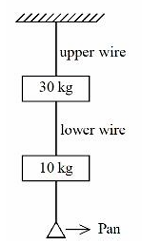
Breaking stress = $$12\times10^8N/m^2$$
Areas:
$$upper=0.008cm^2=8\times10^{-7}m^2$$
$$lower=0.004cm^2=4\times10^{-7}m^2$$
step 1: max tension each wire can bear
upper wire:
$$T_u=σA=12\times10^8\times8\times10^{-7}=960N$$
lower wire:
$$T_l=12\times10^8\times4\times10^{-7}=480N$$
step 2: tensions in wires
let mass added = mmm
lower wire carries:
$$T_l=(10+m)g=(10+m)\times10$$
=100+10m
limit:
$$100+10m\le480\Rightarrow m\le38$$
upper wire carries total mass:
$$30+10+m=40+m$$
$$T_u=(40+m)\times10=400+10m$$
limit:
$$400+10m\le960\Rightarrow m\le56$$
step 3: final
smaller limit governs → m=38
Was this solution helpful?
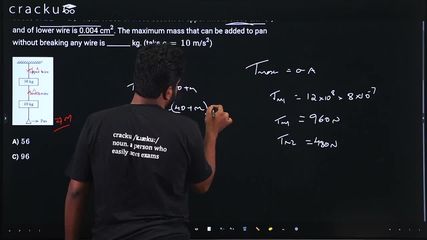
Click on the Email ☝️ to Watch the Video Solution
Create a FREE account and get:
_1.webp)

Educational materials for JEE preparation

Ask our AI anything

AI can make mistakes. Please verify important information.
AI can make mistakes. Please verify important information.


