
Join Our JEE Preparation Group
Prep with like-minded aspirants; Get access to free daily tests and study material.
Sign in
Please select an account to continue using cracku.in
↓ →
Join Our JEE Preparation Group
Prep with like-minded aspirants; Get access to free daily tests and study material.
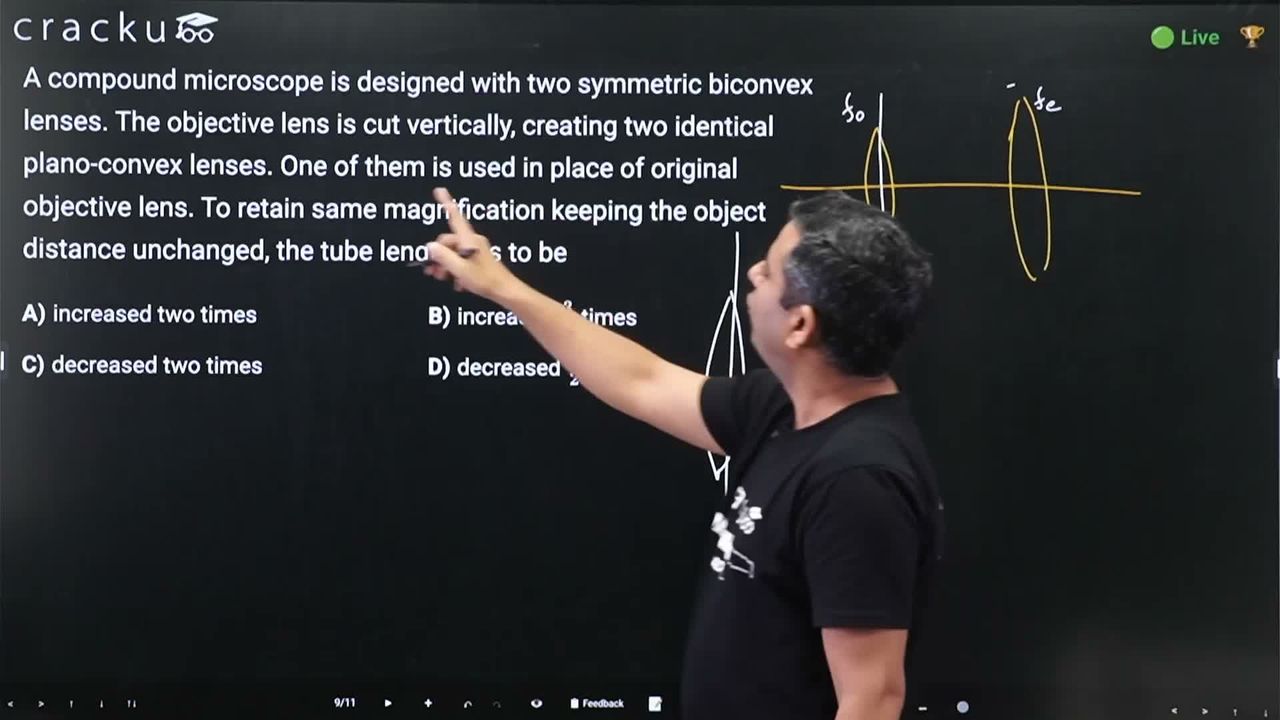
A compound microscope is designed with two symmetric biconvex lenses. The objective lens is cut vertically, creating two identical plano-convex lenses. One of them is used in place of original objective lens. To retain same magnification keeping the object distance unchanged, the tube length has to be
Key idea: cutting a symmetric biconvex lens into two plano-convex halves doubles its focal length.
So,
new objective focal length $$f_o'=2f_o$$
For a compound microscope:
magnification $$M\propto\frac{L}{f_o}$$
To keep magnification same:
$$\frac{L'}{f_o'}=\frac{L}{f_o}$$
$$\frac{L'}{2f_o}=\frac{L}{f_o}\Rightarrow L'=2L$$
final answer:
tube length must be doubled
Was this solution helpful?
Click on the Email ☝️ to Watch the Video Solution
Create a FREE account and get:
_1.webp)

Educational materials for JEE preparation

Ask our AI anything

AI can make mistakes. Please verify important information.
AI can make mistakes. Please verify important information.


