
Join Our JEE Preparation Group
Prep with like-minded aspirants; Get access to free daily tests and study material.
Sign in
Please select an account to continue using cracku.in
↓ →
Join Our JEE Preparation Group
Prep with like-minded aspirants; Get access to free daily tests and study material.
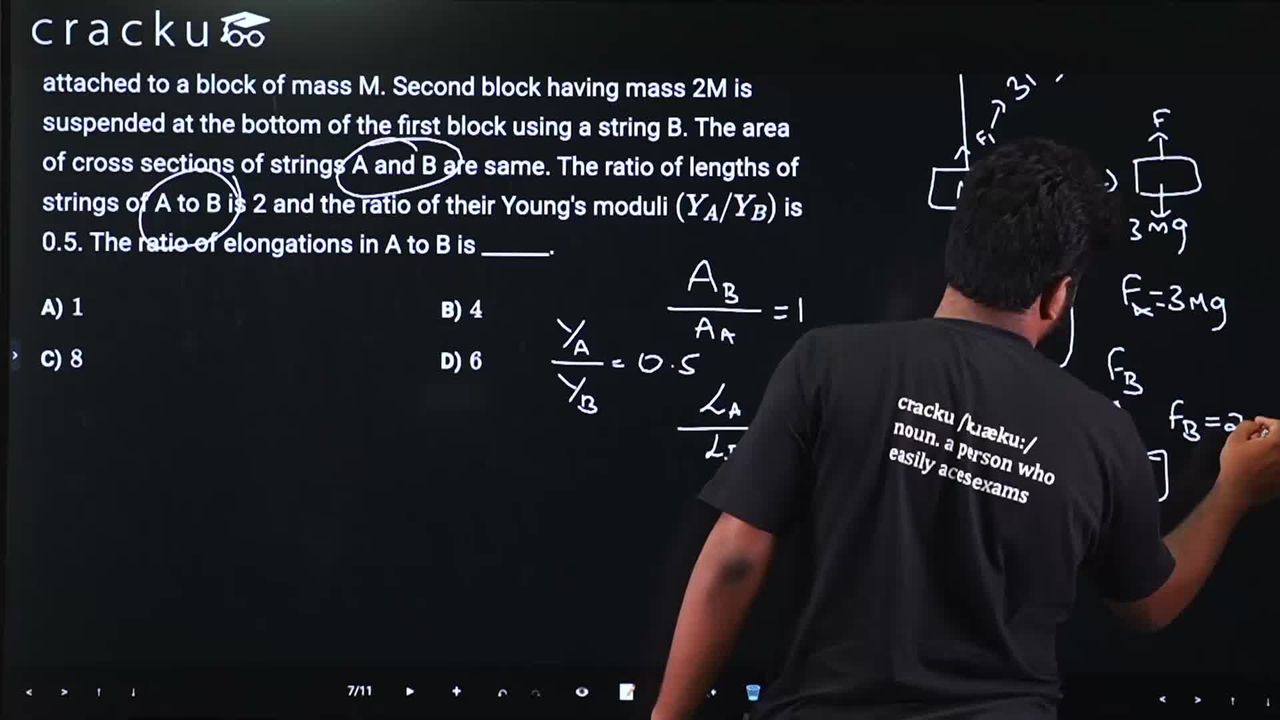
A metal string A is suspended from a rigid support and its free end is attached to a block of mass M. Second block having mass 2M is suspended at the bottom of the first block using a string B. The area of cross sections of strings A and B are same. The ratio of lengths of strings of A to B is 2 and the ratio of their Young's moduli $$(Y_A/Y_B)$$ is 0.5. The ratio of elongations in A to B is ______.
Both strings have the same cross-sectional area, call it $$A$$. The masses of the strings themselves are negligible, so the only forces are the weights of the attached masses.
For string B
Only the mass $$2M$$ is hanging from its lower end, so the tension throughout string B is
$$F_B = 2Mg$$
For string A
String A has to support both masses: the mass $$M$$ fixed to its lower end and the mass $$2M$$ hanging further below. Hence the tension in string A is
$$F_A = (M + 2M)g = 3Mg$$
The elongation of a string of length $$L$$ under tension $$F$$ is given by
$$\Delta L = \frac{F\,L}{A\,Y}$$
where $$Y$$ is Young’s modulus.
Let the original lengths be $$L_A$$ and $$L_B$$. The data give
$$\frac{L_A}{L_B} = 2 \quad\Rightarrow\quad L_A = 2L_B$$
and
$$\frac{Y_A}{Y_B} = 0.5 \quad\Rightarrow\quad Y_B = 2Y_A$$
Now write the ratio of elongations:
$$\frac{\Delta L_A}{\Delta L_B} = \frac{\dfrac{F_A L_A}{A Y_A}} {\dfrac{F_B L_B}{A Y_B}} = \frac{F_A L_A Y_B}{F_B L_B Y_A}$$
Insert the known values:
$$\frac{\Delta L_A}{\Delta L_B} = \frac{(3Mg)\,(2L_B)\,(2Y_A)}{(2Mg)\,(L_B)\,(Y_A)} = \frac{3 \times 2 \times 2}{2} = 6$$
Therefore, the ratio of elongations is $$\mathbf{6}$$.
Option D which is: $$6$$
Was this solution helpful?
Click on the Email ☝️ to Watch the Video Solution
Create a FREE account and get:
_1.webp)

Educational materials for JEE preparation

Ask our AI anything

AI can make mistakes. Please verify important information.
AI can make mistakes. Please verify important information.


