
Join Our JEE Preparation Group
Prep with like-minded aspirants; Get access to free daily tests and study material.
Sign in
Please select an account to continue using cracku.in
↓ →
Join Our JEE Preparation Group
Prep with like-minded aspirants; Get access to free daily tests and study material.
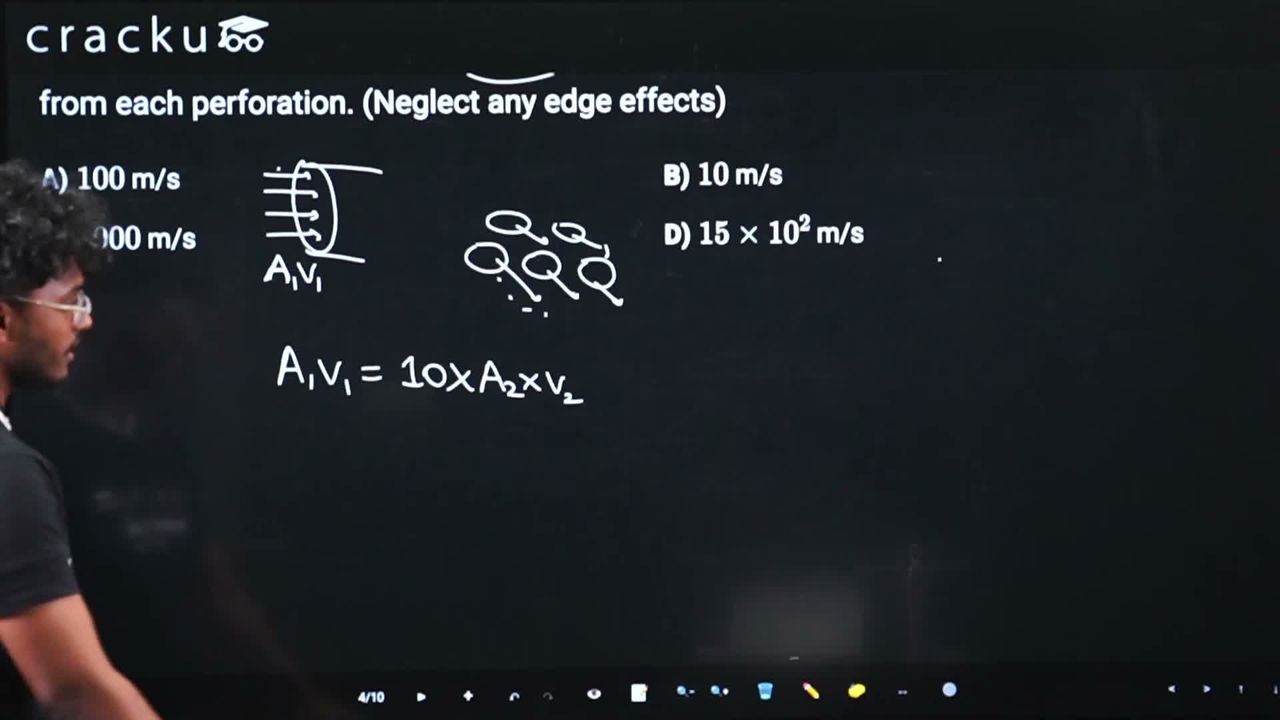
A water spray gun is attached to a hose of cross sectional area 30 cm$$^2$$. The gun comprises of 10 perforations each of cross sectional area of 15 mm$$^2$$. If the water flows in the hose with the speed of 50 cm/s, calculate the speed at which the water flows out from each perforation. (Neglect any edge effects)
The volume flow rate of an incompressible fluid remains constant along a streamline. This is the equation of continuity: $$Q = A_1 v_1 = A_2 v_2$$, where $$Q$$ is the discharge (volume per time), $$A$$ is area and $$v$$ is speed.
Inlet (hose)
Cross-sectional area: $$30\text{ cm}^2 = 30 \times 10^{-4}\text{ m}^2 = 3.0 \times 10^{-3}\text{ m}^2$$
Speed of water: $$50\text{ cm/s} = 0.50\text{ m/s}$$
Volume flow rate at inlet:
$$Q = A_{\text{in}} v_{\text{in}} = (3.0 \times 10^{-3}) (0.50) = 1.5 \times 10^{-3}\text{ m}^3\!\!/\text{s}$$
Outlet (10 perforations)
Area of one perforation: $$15\text{ mm}^2 = 15 \times 10^{-6}\text{ m}^2$$
Total outlet area: $$A_{\text{out}} = 10 \times 15 \times 10^{-6} = 1.5 \times 10^{-4}\text{ m}^2$$
Let $$v_{\text{out}}$$ be the speed of water emerging from each perforation (all equal). Using continuity: $$Q = A_{\text{out}} v_{\text{out}}$$
Therefore,
$$v_{\text{out}} = \frac{Q}{A_{\text{out}}} = \frac{1.5 \times 10^{-3}}{1.5 \times 10^{-4}} = 10\text{ m/s}$$
Hence, the speed of water leaving each perforation is $$10\text{ m/s}$$.
Option B which is: $$10\text{ m/s}$$
Was this solution helpful?
Click on the Email ☝️ to Watch the Video Solution
Create a FREE account and get:
_1.webp)

Educational materials for JEE preparation

Ask our AI anything

AI can make mistakes. Please verify important information.
AI can make mistakes. Please verify important information.


