
Join Our JEE Preparation Group
Prep with like-minded aspirants; Get access to free daily tests and study material.
Sign in
Please select an account to continue using cracku.in
↓ →
Join Our JEE Preparation Group
Prep with like-minded aspirants; Get access to free daily tests and study material.
Given below are two statements: one is labelled as Assertion A and the other is labelled as Reason R
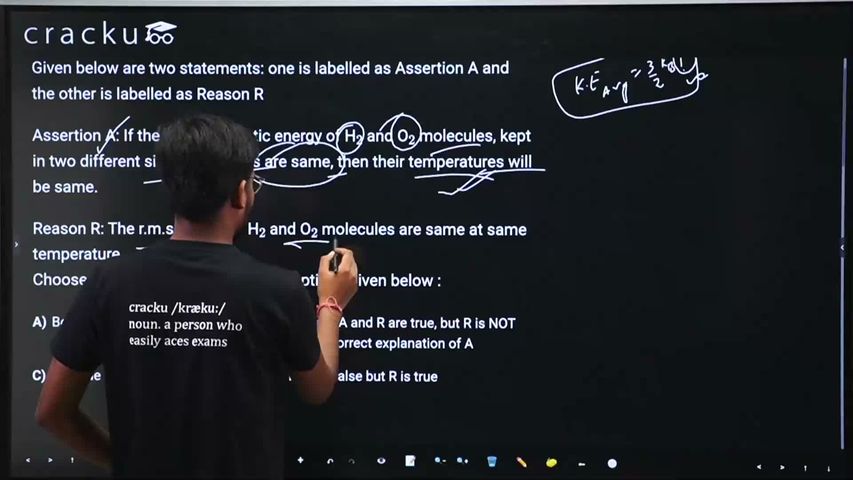
Assertion A: If the average kinetic energy of H$$_2$$ and O$$_2$$ molecules, kept in two different sized containers are same, then their temperatures will be same.
Reason R: The r.m.s. speed of H$$_2$$ and O$$_2$$ molecules are same at same temperature.
Choose the correct answer from the options given below :
Average translational kinetic energy per molecule in an ideal gas is given by
$$\overline{E_k} = \frac{3}{2}kT$$
where $$k$$ is Boltzmann’s constant and $$T$$ is the absolute temperature.
Thus, when $$\overline{E_k}$$ of any two gases is equal, we must have the same temperature $$T$$ for both. Therefore, the Assertion (A) is true.
The rms speed of molecules of an ideal gas is
$$v_{\text{rms}} = \sqrt{\frac{3kT}{m}}$$
where $$m$$ is the mass of one molecule (or molar mass $$M$$ in suitable units). For two different gases at the same temperature:
$$\frac{v_{\text{rms}(1)}}{v_{\text{rms}(2)}} = \sqrt{\frac{m_2}{m_1}}$$
Because $$m_{H_2} \neq m_{O_2}$$, their rms speeds cannot be equal at the same temperature. Hence the Reason (R) is false.
Assertion is true while Reason is false ⇒ Option C.
Was this solution helpful?
Click on the Email ☝️ to Watch the Video Solution
Create a FREE account and get:
_1.webp)

Educational materials for JEE preparation

Ask our AI anything

AI can make mistakes. Please verify important information.
AI can make mistakes. Please verify important information.


