
Join Our JEE Preparation Group
Prep with like-minded aspirants; Get access to free daily tests and study material.
Sign in
Please select an account to continue using cracku.in
↓ →
Join Our JEE Preparation Group
Prep with like-minded aspirants; Get access to free daily tests and study material.
The temperature of a metal strip having coefficient of linear expansion $$\alpha$$ is increased from $$T_1$$ to $$T_2$$ resulting in increase of its length by $$\Delta L_1$$. The temperature is further increased from $$T_2$$ to $$T_3$$ such that the increase in its length is $$\Delta L_2$$. Given $$T_3 + T_1 = 2T_2$$ and $$T_2 - T_1 = \Delta T$$, the value of $$\Delta L_2$$ is ______.
Let the original length of the strip at temperature $$T_1$$ be $$L_0$$. For a solid with constant linear expansion coefficient $$\alpha$$, the change in length for a temperature change $$\Delta T$$ is
$$\Delta L = L \,\alpha\,\Delta T \quad -(1)$$
Elongation from $$T_1$$ to $$T_2$$
The temperature rise is $$T_2-T_1 = \Delta T$$.
Using $$(1)$$ with the initial length $$L_0$$, we have
$$\Delta L_1 = L_0 \,\alpha\,\Delta T \quad -(2)$$
After this heating, the new length at $$T_2$$ becomes
$$L_{T_2} = L_0 + \Delta L_1 = L_0\bigl(1+\alpha\Delta T\bigr) \quad -(3)$$
Elongation from $$T_2$$ to $$T_3$$
We are told $$T_3+T_1 = 2T_2$$.
Re-arranging, $$T_3 - T_2 = T_2 - T_1 = \Delta T \quad -(4)$$
Thus the second heating also raises the temperature by $$\Delta T$$.
Now use $$(1)$$ again, but the initial length for this stage is $$L_{T_2}$$ from $$(3)$$:
$$\Delta L_2 = L_{T_2}\,\alpha\,(T_3-T_2) = L_0\bigl(1+\alpha\Delta T\bigr)\alpha\Delta T \quad -(5)$$
Compare $$(5)$$ with $$(2)$$ (note that $$\Delta L_1 = L_0\alpha\Delta T$$):
$$\Delta L_2 = \Delta L_1\bigl(1+\alpha\Delta T\bigr)$$
Hence
$$\boxed{\;\Delta L_2 = \Delta L_1[\,1+\alpha\Delta T\,]\;}$$
Therefore the correct option is
Option D which is: $$\Delta L_1[1 + \alpha\Delta T]$$.
Was this solution helpful?
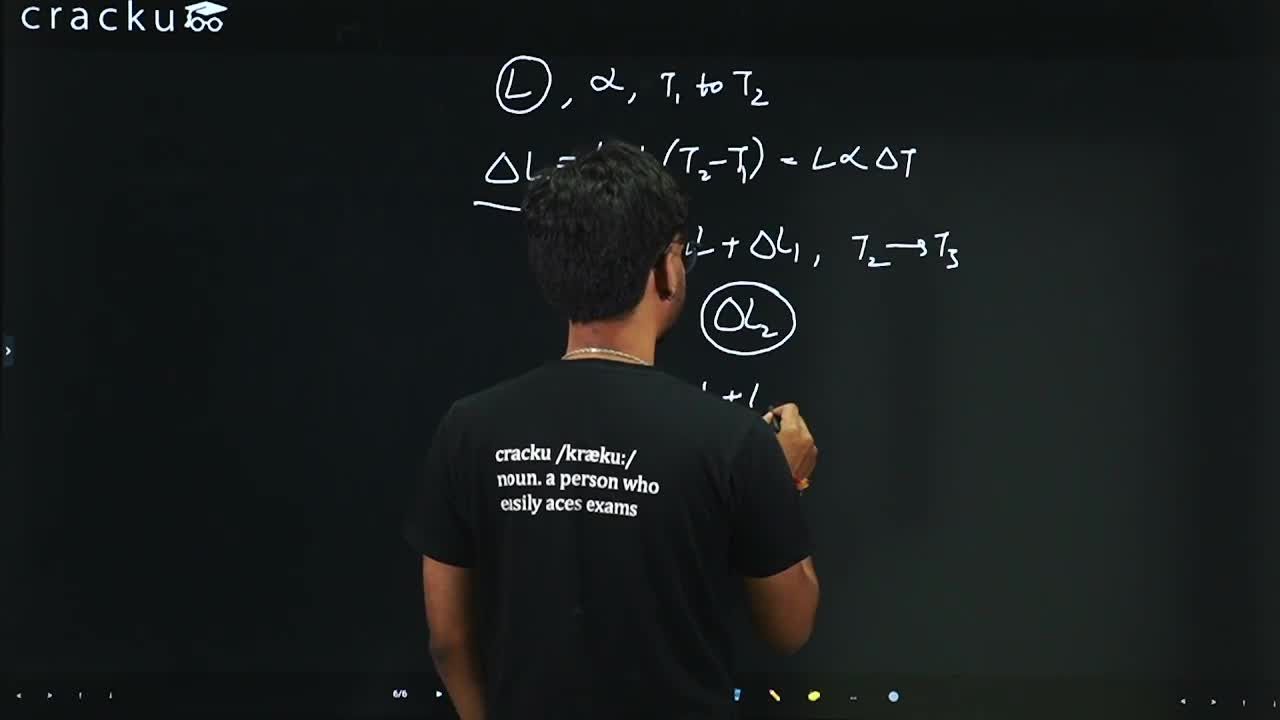
Click on the Email ☝️ to Watch the Video Solution
Create a FREE account and get:
_1.webp)

Educational materials for JEE preparation

Ask our AI anything

AI can make mistakes. Please verify important information.
AI can make mistakes. Please verify important information.


