
Join Our JEE Preparation Group
Prep with like-minded aspirants; Get access to free daily tests and study material.
Sign in
Please select an account to continue using cracku.in
↓ →
Join Our JEE Preparation Group
Prep with like-minded aspirants; Get access to free daily tests and study material.
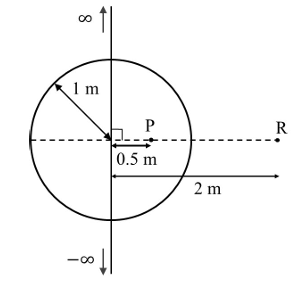
An infinitely long thin wire, having a uniform charge density per unit length of $$5\ \frac{nC}{m}$$ , is passing through a spherical shell of radius $$1\ m$$, as shown in the figure. A $$10\ nC$$ charge is distributed uniformly over the spherical shell. If the configuration of the charges remains static, the magnitude of the potential difference between points $$P$$ and $$R$$, in Volt, is ________.
[Given: In SI units $$\dfrac{1}{4\pi \varepsilon_0} = 9 \times 10^9$$, ln 2 = 0.7. Ignore the area pierced by the wire.]
Correct Answer: 171
Evaluating potential difference due to the spherical shell:
$$V_{P,\text{shell}} = \frac{1}{4\pi\varepsilon_0}\frac{Q}{R_{\text{shell}}} = 9 \times 10^9 \times \frac{10 \times 10^{-9}}{1} = 90\text{ V}$$
$$V_{R,\text{shell}} = \frac{1}{4\pi\varepsilon_0}\frac{Q}{r_R} = 9 \times 10^9 \times \frac{10 \times 10^{-9}}{2} = 45\text{ V}$$
$$\Delta V_{\text{shell}} = V_{P,\text{shell}} - V_{R,\text{shell}} = 90 - 45 = 45\text{ V}$$
Evaluating potential difference due to the line charge:
$$\Delta V_{\text{line}} = V_P - V_R = \frac{\lambda}{2\pi\varepsilon_0}\ln\left(\frac{r_R}{r_P}\right) = 2 \times \left(\frac{1}{4\pi\varepsilon_0}\right) \lambda \ln\left(\frac{2}{0.5}\right)$$
$$\Delta V_{\text{line}} = 2 \times (9 \times 10^9) \times (5 \times 10^{-9}) \ln 4 = 90 \times 2\ln 2 = 180 \times 0.7 = 126\text{ V}$$
Finding net potential difference:
$$\Delta V_{\text{net}} = \Delta V_{\text{shell}} + \Delta V_{\text{line}} = 45 + 126 = 171\text{ V}$$
Was this solution helpful?
Click on the Email ☝️ to Watch the Video Solution
Create a FREE account and get:
_1.webp)

Educational materials for JEE preparation

Ask our AI anything

AI can make mistakes. Please verify important information.
AI can make mistakes. Please verify important information.
