
Join Our JEE Preparation Group
Prep with like-minded aspirants; Get access to free daily tests and study material.
Sign in
Please select an account to continue using cracku.in
↓ →
Join Our JEE Preparation Group
Prep with like-minded aspirants; Get access to free daily tests and study material.
Two equilateral-triangular prisms $$P_1$$ and $$P_2$$ are kept with their sides parallel to each other, in vacuum, as shown in the figure. A light ray enters prism $$P_1$$ at an angle of incidence $$\theta$$ such that the outgoing ray undergoes minimum deviation in prism $$P_2$$. If the respective refractive indices of $$P_1$$ and $$P_2$$ are $$\sqrt{\dfrac{3}{2}}$$ and $$\sqrt{3}$$, $$\theta = \sin^{-1}\left[\sqrt{\dfrac{3}{2}} \sin\left(\dfrac{\pi}{\beta}\right)\right]$$, where the value of $$\beta$$ is ________.
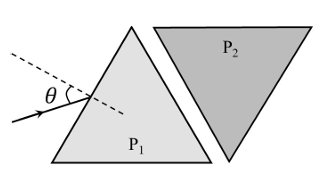
Correct Answer: 12
For each equilateral-triangular prism the refracting (apex) angle is $$A = 60^\circ = \dfrac{\pi}{3}$$.
Step 1: Condition for minimum deviation in prism $$P_2$$
For minimum deviation in any prism, the path of the ray is symmetrical, so
$$r = r' = \dfrac{A}{2} = 30^\circ$$ inside the prism, and the angles of incidence and emergence are equal: $$i = e$$.
Applying Snell’s law at the first face of $$P_2$$ (outside medium is vacuum, $$n = 1$$):
$$\sin i = n_2 \sin r$$
Given $$n_2 = \sqrt{3}$$, therefore
$$\sin i = \sqrt{3}\,\sin 30^\circ = \sqrt{3}\left(\dfrac{1}{2}\right)=\dfrac{\sqrt{3}}{2}$$
so $$i = 60^\circ = \dfrac{\pi}{3}$$.
Hence the light ray must strike the first face of $$P_2$$ with an incidence angle of $$60^\circ$$.
Step 2: This same ray is the emergent ray from prism $$P_1$$
The two prisms are arranged with their corresponding faces parallel; therefore the angle the ray makes with the normal when it leaves $$P_1$$ is the same $$60^\circ$$.
Let that angle of emergence from $$P_1$$ be $$e_1 = 60^\circ$$.
Step 3: Ray path inside prism $$P_1$$
Let the angles of refraction at the two faces of $$P_1$$ be $$r_1$$ and $$r_2$$. For any prism
$$r_1 + r_2 = A = 60^\circ \qquad -(1)$$
Snell’s law at the second face (emergence) of $$P_1$$:
$$n_1 \sin r_2 = \sin e_1$$
Given $$e_1 = 60^\circ$$ and $$n_1 = \sqrt{\dfrac{3}{2}}$$, we get
$$\sin r_2 = \dfrac{\sin 60^\circ}{n_1} = \dfrac{\dfrac{\sqrt{3}}{2}}{\sqrt{\dfrac{3}{2}}} = \dfrac{\sqrt{2}}{2} = \sin 45^\circ$$
so $$r_2 = 45^\circ$$.
Using $$(1)$$:
$$r_1 = 60^\circ - 45^\circ = 15^\circ.$$
Step 4: Incidence angle $$\theta$$ on the first face of $$P_1$$
Apply Snell’s law at the first face of $$P_1$$:
$$\sin \theta = n_1 \sin r_1 = \sqrt{\dfrac{3}{2}}\;\sin 15^\circ$$
Since $$15^\circ = \dfrac{\pi}{12}$$,
$$\sin \theta = \sqrt{\dfrac{3}{2}}\;\sin\!\left(\dfrac{\pi}{12}\right).$$
The question states this result as $$\theta = \sin^{-1}\!\left[\sqrt{\dfrac{3}{2}}\;\sin\!\left(\dfrac{\pi}{\beta}\right)\right].$$ Comparing, we must have $$\dfrac{\pi}{\beta} = \dfrac{\pi}{12}\quad\Longrightarrow\quad \beta = 12.$$
Hence the required value is 12.
Was this solution helpful?
Create a FREE account and get:
_1.webp)

Educational materials for JEE preparation

Ask our AI anything

AI can make mistakes. Please verify important information.
AI can make mistakes. Please verify important information.
