
Join Our JEE Preparation Group
Prep with like-minded aspirants; Get access to free daily tests and study material.
Sign in
Please select an account to continue using cracku.in
↓ →
Join Our JEE Preparation Group
Prep with like-minded aspirants; Get access to free daily tests and study material.
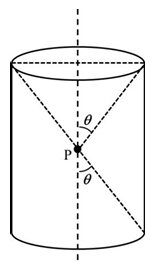
A charge is kept at the central point $$P$$ of a cylindrical region. The two edges subtend a half-angle $$\theta$$ at $$P$$, as shown in the figure. When $$\theta = 30^\circ$$, then the electric flux through the curved surface of the cylinder is $$\Phi$$. If $$\theta = 60^\circ$$, then the electric flux through the curved surface becomes $$\Phi / \sqrt{n}$$, where the value of $$n$$ is ________.
Correct Answer: 3
Gauss law states that the electric flux through any open surface $$S$$ kept in the field of a point charge $$q$$ placed at the origin is proportional to the solid angle $$\Omega$$ subtended by that surface at the charge:
$$\Phi_S=\frac{q}{4\pi\varepsilon_0}\,\Omega$$
Hence, for two different geometries of the same charge, the ratio of fluxes equals the ratio of the corresponding solid angles.
The cylindrical surface is coaxial with the charge located at its centre $$P$$. Each end‐edge of the cylinder makes a half-angle $$\theta$$ with the axis (figure in the question). In spherical polar coordinates with the axis of the cylinder as the polar axis, any direction from $$P$$ is specified by polar angle $$\beta$$ (measured from the +z-axis) and azimuth $$\phi$$.
• For $$0\le\beta<\theta$$ the ray meets the top circular face.
• For $$\theta\le\beta\le\pi-\theta$$ the ray meets the curved surface.
• For $$\pi-\theta<\beta\le\pi$$ the ray meets the bottom circular face.
Thus the curved surface subtends the full azimuth $$0\le\phi\le2\pi$$ but only the polar band $$\theta\le\beta\le\pi-\theta$$. The solid angle of that band is
$$\Omega = \int_{\phi=0}^{2\pi}\int_{\beta=\theta}^{\pi-\theta}\sin\beta\,d\beta\,d\phi = 2\pi\Bigl[-\cos\beta\Bigr]_{\theta}^{\pi-\theta} = 2\pi\Bigl[-\cos(\pi-\theta)+\cos\theta\Bigr] = 2\pi\bigl[\;+\cos\theta+\cos\theta\bigr] = 4\pi\cos\theta.$$
The flux through the curved surface is therefore
$$\Phi(\theta)=\frac{q}{4\pi\varepsilon_0}\;\Omega =\frac{q}{4\pi\varepsilon_0}\;(4\pi\cos\theta) =\frac{q}{\varepsilon_0}\cos\theta.$$
Case 1: $$\theta=30^{\circ}$$ (i.e. $$\theta=\pi/6$$)
$$\Phi=\Phi(30^{\circ})=\frac{q}{\varepsilon_0}\cos30^{\circ}
=\frac{q}{\varepsilon_0}\,\frac{\sqrt3}{2}.$$
Case 2: $$\theta=60^{\circ}$$ (i.e. $$\theta=\pi/3$$)
$$\Phi'=\Phi(60^{\circ})=\frac{q}{\varepsilon_0}\cos60^{\circ}
=\frac{q}{\varepsilon_0}\,\frac12.$$
The problem states that $$\Phi'=\dfrac{\Phi}{\sqrt{n}}$$. Taking the ratio of the two fluxes:
$$\frac{\Phi'}{\Phi} =\frac{\tfrac{q}{\varepsilon_0}\,\tfrac12} {\tfrac{q}{\varepsilon_0}\,\tfrac{\sqrt3}{2}} =\frac{1}{\sqrt3} \;=\;\frac{1}{\sqrt{n}}.$$
Equating, $$\sqrt{n}=\sqrt3\;\Longrightarrow\;n=3.$$
Therefore, the required value of $$n$$ is 3.
Was this solution helpful?
Create a FREE account and get:
_1.webp)

Educational materials for JEE preparation

Ask our AI anything

AI can make mistakes. Please verify important information.
AI can make mistakes. Please verify important information.
