
Join Our JEE Preparation Group
Prep with like-minded aspirants; Get access to free daily tests and study material.
Sign in
Please select an account to continue using cracku.in
↓ →
Join Our JEE Preparation Group
Prep with like-minded aspirants; Get access to free daily tests and study material.
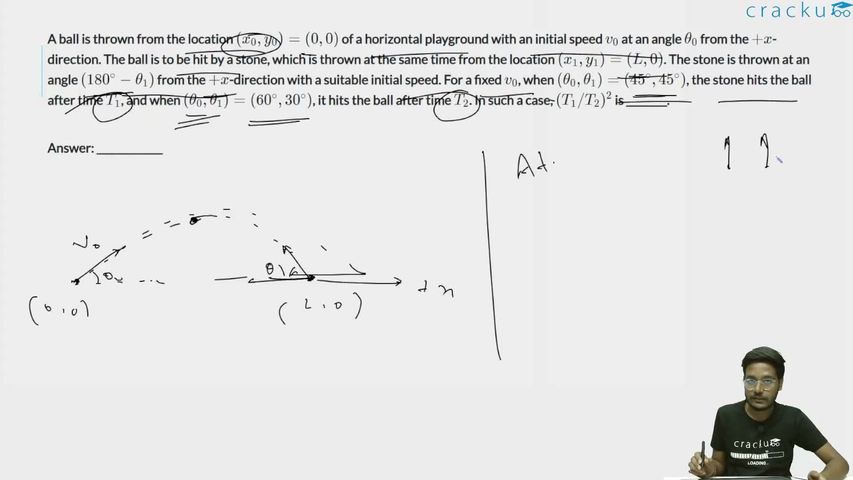
A ball is thrown from the location $$(x_0, y_0) = (0,0)$$ of a horizontal playground with an initial speed $$v_0$$ at an angle $$\theta_0$$ from the $$+x$$-direction. The ball is to be hit by a stone, which is thrown at the same time from the location $$(x_1, y_1) = (L, 0)$$. The stone is thrown at an angle $$(180^\circ - \theta_1)$$ from the $$+x$$-direction with a suitable initial speed. For a fixed $$v_0$$, when $$(\theta_0, \theta_1) = (45^\circ, 45^\circ)$$, the stone hits the ball after time $$T_1$$, and when $$(\theta_0, \theta_1) = (60^\circ, 30^\circ)$$, it hits the ball after time $$T_2$$. In such a case, $$(T_1/T_2)^2$$ is ________.
Correct Answer: 2
Let the ball start from the origin with speed $$v_0$$ and projection angle $$\theta_0$$ (measured from the +x-axis).
Its velocity components are $$v_{bx}=v_0\cos\theta_0$$ and $$v_{by}=v_0\sin\theta_0$$.
The stone is thrown simultaneously from $$(L,0)$$ at an angle $$(180^\circ-\theta_1)$$ with the +x-axis.
Hence its horizontal component is toward the negative x-direction:
$$v_{sx}=-v_s\cos\theta_1$$, $$v_{sy}=v_s\sin\theta_1$$, where $$v_s$$ is the stone’s launch speed.
Suppose they meet after time $$t$$ (same $$t$$ for both because they start together).
Horizontal co-ordinate equality
$$x_{\text{ball}} = x_{\text{stone}}$$ gives
$$v_0\cos\theta_0\,t = L + (-v_s\cos\theta_1)\,t$$
$$\Rightarrow t\,(v_0\cos\theta_0+v_s\cos\theta_1)=L \quad -(1)$$
Vertical co-ordinate equality
Both experience the same downward acceleration $$g$$, so the $$-\dfrac12 g t^2$$ term cancels:
$$v_0\sin\theta_0\,t = v_s\sin\theta_1\,t$$
Since $$t\gt 0$$,
$$v_0\sin\theta_0 = v_s\sin\theta_1 \quad -(2)$$
From $$(2)$$, express the stone’s speed:
$$v_s = \dfrac{v_0\sin\theta_0}{\sin\theta_1} \quad -(3)$$
Insert $$(3)$$ into $$(1)$$ to obtain the common time of flight:
$$t = \dfrac{L}{v_0\cos\theta_0 + \left(\dfrac{v_0\sin\theta_0}{\sin\theta_1}\right)\cos\theta_1 } = \dfrac{L}{v_0\left(\cos\theta_0+\sin\theta_0\cot\theta_1\right)} \quad -(4)$$
Thus, for any pair $$(\theta_0,\theta_1)$$, $$T(\theta_0,\theta_1)=\dfrac{L}{v_0\left(\cos\theta_0+\sin\theta_0\cot\theta_1\right)}$$
Case 1: $$(\theta_0,\theta_1)=(45^\circ,45^\circ)$$
$$\cos45^\circ=\sin45^\circ=\dfrac{\sqrt2}{2}, \;\cot45^\circ=1$$
Denominator in $$(4)$$:
$$\cos45^\circ+\sin45^\circ\cot45^\circ
= \dfrac{\sqrt2}{2}+\dfrac{\sqrt2}{2}= \sqrt2$$
Hence
$$T_1=\dfrac{L}{v_0\sqrt2} \quad -(5)$$
Case 2: $$(\theta_0,\theta_1)=(60^\circ,30^\circ)$$
$$\cos60^\circ=\dfrac12,\; \sin60^\circ=\dfrac{\sqrt3}{2},\; \cot30^\circ=\sqrt3$$
Denominator in $$(4)$$:
$$\dfrac12+\dfrac{\sqrt3}{2}\,\sqrt3
= \dfrac12+\dfrac{3}{2}=2$$
Thus
$$T_2=\dfrac{L}{2v_0} \quad -(6)$$
Required ratio
$$\left(\dfrac{T_1}{T_2}\right)^2
=\left(\dfrac{\,L/(v_0\sqrt2)\,}{\,L/(2v_0)\,}\right)^2
=\left(\dfrac{2}{\sqrt2}\right)^2
=\left(\sqrt2\right)^2
=2$$
Therefore, $$(T_1/T_2)^2 = 2$$.
Was this solution helpful?
Click on the Email ☝️ to Watch the Video Solution
Create a FREE account and get:
_1.webp)

Educational materials for JEE preparation

Ask our AI anything

AI can make mistakes. Please verify important information.
AI can make mistakes. Please verify important information.
