
Join Our JEE Preparation Group
Prep with like-minded aspirants; Get access to free daily tests and study material.
Sign in
Please select an account to continue using cracku.in
↓ →
Join Our JEE Preparation Group
Prep with like-minded aspirants; Get access to free daily tests and study material.
A charged ball $$B$$ hangs from a silk thread $$S$$ which makes an angle $$\theta$$ with a large charged conducting sheet $$P$$, as show in the figure. The surface charge density $$\sigma$$ of the sheet is proportional to
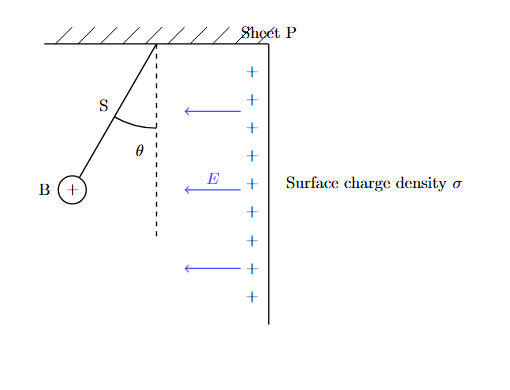
Let the mass of the charged ball $$B$$ be $$m$$ and its charge be $$q$$.
The electric field $$E$$ produced by a large charged conducting sheet $$P$$ with surface charge density $$\sigma$$ is given by:
$$E = \frac{\sigma}{\epsilon_0}$$
The forces acting on the charged ball are:
1. The weight of the ball, $$mg$$, acting vertically downwards.
2. The electric force, $$F_e = qE$$, acting horizontally away from the sheet.
3. The tension $$T$$ in the silk thread $$S$$.
In equilibrium, the thread makes an angle $$\theta$$ with the vertical sheet. We can resolve the tension $$T$$ into horizontal and vertical components:
The vertical component balances the weight:
$$T \cos\theta = mg$$
The horizontal component balances the electric force:
$$T \sin\theta = qE$$
Dividing the horizontal equilibrium equation by the vertical equilibrium equation, we get:
$$\frac{T \sin\theta}{T \cos\theta} = \frac{qE}{mg}$$
$$\Rightarrow \quad \tan\theta = \frac{qE}{mg}$$
Now, substitute the value of the electric field $$E$$ into the equation:
$$\tan\theta = \frac{q \sigma}{\epsilon_0 mg}$$
Rearranging the equation to solve for $$\sigma$$, we find:
$$\sigma = \left( \frac{\epsilon_0 mg}{q} \right) \tan\theta$$
Since $$\epsilon_0$$, $$m$$, $$g$$, and $$q$$ are all constants for this system, we can conclude that the surface charge density $$\sigma$$ is directly proportional to $$\tan\theta$$:
$$\sigma \propto \tan\theta$$
Was this solution helpful?
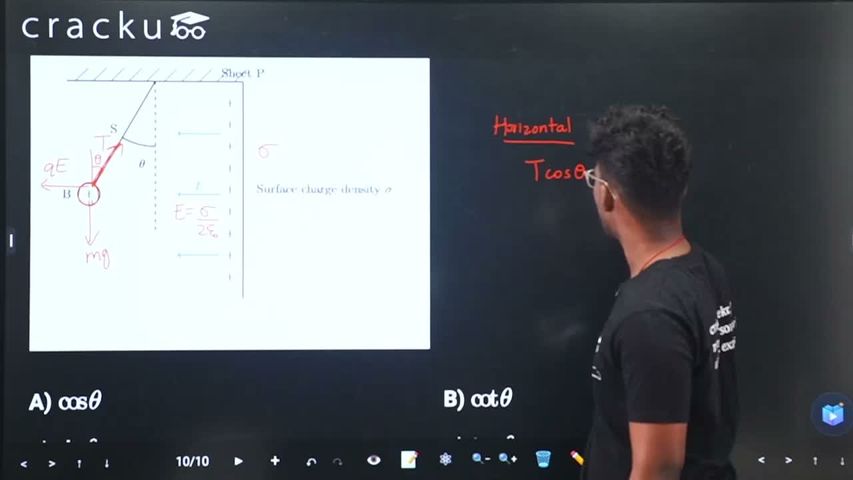
Click on the Email ☝️ to Watch the Video Solution
Create a FREE account and get:
_1.webp)

Educational materials for JEE preparation

Ask our AI anything

AI can make mistakes. Please verify important information.
AI can make mistakes. Please verify important information.
